
Life issues, immigration, juvenile justice and education were key issues addressed during the Maryland General Assembly session that ended April 13 that the Maryland Catholic Conference followed and took stances on.
The MCC opposed the Emergency Pregnancy-Related Medical Conditions – Procedures bill (SB 169/HB 372), which passed both chambers, because it interferes with the conscience rights of Catholic hospitals. The Emergency Medical Treatment and Labor Act, a 1986 federal law, requires Medicare-participating hospitals with emergency departments to provide certain care for anyone, regardless of ability to pay or insurance status. EMTALA requires stabilizing or appropriately transferring patients with emergency conditions.
Catholic hospitals in the state have been following EMTALA for a long time, while upholding the Ethical and Religious Directives that ensure that Catholic health facilities don’t provide services antithetical to Church teaching, such as abortions.
Jenny Kraska, executive director of the Maryland Catholic Conference, said, “What this bill does is it codifies the federal law into state law. And the reason that we specifically raised concerns about this is that once you codify it into state law, it makes it very difficult to undo it if something were to happen at the federal level with EMTALA. It just makes things much more difficult down the road.”
Early in the session that began in January, both the Maryland House and Senate passed SB 245/HB 444, which ended immigration enforcement arrangements for all counties in the state. The bill was signed by Gov. Wes Moore (D) during the session. The U.S. Department of Homeland Security had established a program designated 287(g) that authorized local law enforcement officials to perform federal civil immigration functions under ICE’s oversight, according to a news release from the governor’s office. Such arrangements are now prohibited in the state and any local jurisdictions with such arrangements were to terminate them immediately.
Kraska told reporters for Catholic publications in Maryland April 14 that passage of the bill was a priority for the conference. The MCC also supported legislation passed late in the session, the Community Trust Act (SB 791/HB 1575), to close a loophole in SB 245/HB 444 to specify that police are restricted from inquiring about citizenship, sharing information with ICE and holding detainees without a judicial warrant.
Kraska said the act still provides that federal authorities can arrest people for very serious crimes, including homicide, sexual assault and rape.
Maryland has one of the highest rates of charging juveniles as adults, a concern that was addressed by the Youth Charging Reform Act (SB 323/HB 409), which passed with MCC support. Before the legislation, many offenses juveniles were alleged to commit were automatically charged as adults, but 87 percent of those charged as adults did not end with an adult criminal conviction in the case. Kraska said that about 55 percent of the juvenile cases that had previously been started with the alleged offender charged as an adult will now be started in the youth detention system. “Of the 33 crimes that were originally listed in the original bill, only six were included in the final bill, and all of the six have to do with guns,” she said.
The new law affects only where charges start. A judge retains the discretion to move a minor’s charges to adult court. And the most serious offenses, such as first-degree murder, assault and rape, will continue to be automatically subject to adult court jurisdiction, the conference said.
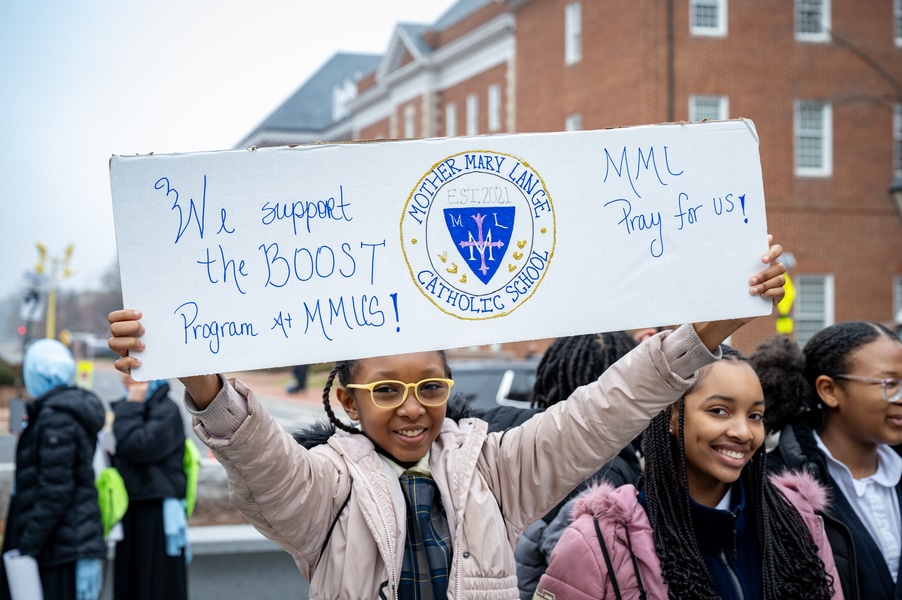
In education matters, the state kept the funding available for the Broadening Options and Opportunities for Students Today scholarship program at $9 million. BOOST provides scholarship awards for some students who are eligible for the free or reduced-price school meals program to attend a participating nonpublic school. The budget for grants to nonpublic schools for deferred maintenance, aging building improvements and infrastructure renovation was funded at $5 million, compared to $3.5 million in FY 2026. The MCC supported both efforts.
The conference also supported SB 420/HB 06, titled Public Institutions of Higher Education – Pregnant and Parenting Students – Plan and Reporting. The law, which passed, requires the state’s higher education commission to collect demographic data on parenting status at higher ed institutions.
Kraska said the bill establishes a study to discern what pregnant students need to flourish at the college level. “It would also require that colleges have a plan in place for pregnant and parenting students,” she said.
Nearly 900 bills were passed in the 2026 session, with 1,010 proposed in the Senate and 1,658 in the House. The MCC tracks hundreds of bills and provided testimony on more than 200 pieces of legislation.
Email Christopher Gunty at editor@CatholicReview.org
Also see



Copyright © 2026 Catholic Review Media
