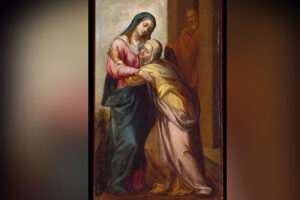
Among the many beautiful feasts of the Blessed Virgin Mary is the Visitation. This year it falls on a Sunday and so won’t be celebrated in the liturgy. Nevertheless, it should not be passed over in silence. Among its important lessons is the beauty of interior freedom – Mary’s interior freedom.
When the Angel Gabriel announced to Mary that she would be the mother of the Savior, she had questions, not because she resisted God’s will, but because she wanted to fulfill it. But even without fully understanding how her unique vocation would change her life, Mary was free to say, “I am the handmaid of the Lord. May it be it done to me according to your word” (Lk 1:38).
Hearing from the angel that her cousin Elizabeth was with child in her advancing years, Mary did not sit at home to ponder all that had happened to her. She hastened to see her cousin, making a difficult journey of some 90 miles. Once there, she and Elizabeth celebrated the wonders of God’s love and Mary spent about three months helping her cousin during her pregnancy.
How was Mary so free that she could say “yes” to the Lord’s singular plan for her life and then drop everything to rejoice with her cousin and to help her?
The answer is Mary’s complete freedom from sin. As we know, Mary was preserved from original sin and throughout her life she committed no actual sin. Mary was free to say “yes” to God because she was entirely free from sin and its harmful effects on the human will.
Freedom from sin enabled Mary to assent to God’s will but did not preserve her from suffering. Mary who is the “Cause of Our Joy” is also “Our Lady of Sorrows.” She experienced hardship and misunderstanding. As Simeon predicted, her soul was pierced with the sword of sorrow; there was no sorrow like Mary’s as she stood beneath the cross as her Son gave his life for the world’s redemption. Because she was free from sin, Mary could assent to and bear the suffering her vocation entailed and thus fully participate in Christ’s self-offering.
Unlike the Blessed Virgin Mary, none of us is spared original sin and its effects. But we are redeemed from sin by Christ’s death and resurrection and are given all the helps and graces we need to overcome sin and the effects of sin in our lives, most especially the sacrament of reconciliation. Yet, when we’re engaging in the struggle to eradicate sin from our lives, we may not feel particularly free. We may feel as though “the narrow way” to eternal life compromises our freedom. At times, the Ten Commandments, the Precepts of the Church and the Beatitudes can seem like a moral straitjacket rather than the path to freedom.
Conversion of life hinges on our rejecting that lie. A life of virtue and generous love is the path to true freedom. To live that way, we depend on the Holy Spirit to work in us. We rely utterly on God’s grace as we seek to break the grip of those sins that bedevil us. God’s grace works in our humanity (as it did in Mary’s) – our minds, our hearts, our wills, our appetites. Wresting our freedom from the power of sin feels like hard work – but once free of sin, we, like Mary, can say “yes” to God, to our vocations, to our families and to those in need.
May Mary, the Virgin Mother of God, intercede for us – that in our journey through life we become progressively freer from sin until that day when we are supremely free in our true homeland of heaven. Vivat Jesus!
read more commentary




Copyright © 2026 Catholic Review Media
