WASHINGTON (OSV News) — The nation’s colleges and universities “have a critical and substantive role to play in arresting the eclipse of the order of grace in our society,” Cardinal Robert W. McElroy of Washington said in his homily at the opening Mass of the 2026 annual meeting of the Association of Catholic Colleges and Universities.
“This mission of Catholic colleges and universities requires placing the order of grace at the heart of college life,” he said in his Jan. 31 homily. “It means being unapologetic about Catholic social teaching. … Discussion and debate lie at the heart of college and university life, and to true moral and spiritual conversion.”
“Through the Lens of Mission” was the theme of the ACCU’s meeting, held Jan. 31 to Feb. 2 at the Grand Hyatt Washington. Cardinal Christophe Pierre, apostolic nuncio to the United States, was a concelebrant at the opening Mass.
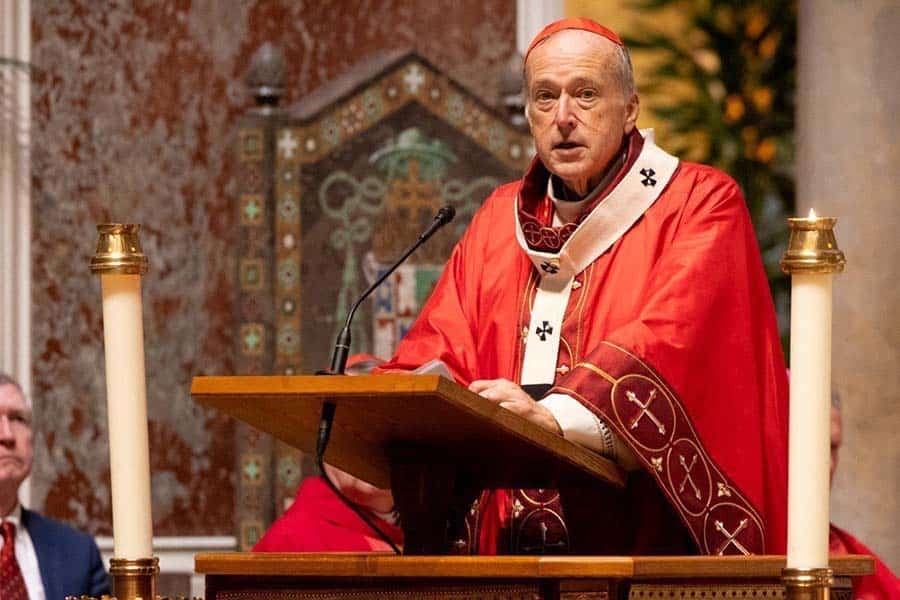
In his homily, Cardinal McElroy referenced director Terrence Malick’s 2011 film, “The Tree of Life,” which he called a “religious allegory of life and death” that highlighted “two things that move the hearts of men — the order of nature and the order of grace.”
The prelate connected those two concepts with current U.S. policymaking and public conversation on issues including immigration, the threat of military power, abortion restrictions and polarization across the political spectrum.
He contrasted those two concepts, noting that “the order of nature thrusts itself upon us. It compels us to obey. It is self-seeking and overrides the well-being of others. It rests upon power and the ability to dominate.”
“The order of grace, on the other hand, teaches us to find God’s beauty in the hearts and lives of others,” he said. “It rejoices in forgiveness. It does not seek dominance as a source of contentment but community and peace. It values embrace and dialogue over the accumulation of power.”
“I fear we as a nation are experiencing a moment in which the order of nature is eclipsing the order of grace,” he added. “For us as Christians this is a crisis which we cannot ignore.”
He drew on the day’s Gospel reading from Matthew 5:1-12, in which Jesus proclaimed the Eight Beatitudes during his Sermon on the Mount.
“The Beatitudes present the fundamental inversion of the order of nature that is at the heart of the Christian mission,” he said. “Blessed are not those who seek to dominate and seek massive wealth and power. No, no blest are they who have no power. Blest are the poor who have no wealth. Blest are they who show mercy. Blest are the peacemakers. Blest are the persecuted.”
Cardinal McElroy warned about a conception of the world that now seems “to dominate vital elements of our policymaking and public conversation. Principles of human dignity and compassion are discarded in favor of a calculus that values the acquisition of wealth, military power and the stoking of racial, ethnic and economic divisions.”
Jesus’ Eight Beatitudes, he said, offer a counterpoint to this worldview and “a moral framework for our personal lives and our public lives as citizens. … It is by living the Beatitudes that we strengthen the order of grace all around us and in our nation.”
Cardinal McElroy addressed the Trump administration’s policy of the mass deportation of immigrants in the country without documents. He has strongly criticized the policy since becoming Washington’s archbishop in 2025.
“Solving our immigration problems will have to include controlling our borders and deporting undocumented individuals who have been convicted of violent crimes,” the cardinal said.
“But solutions rooted in the order of grace,” he continued, “cannot countenance the vilification of the undocumented or the indiscriminate deportation of millions of undocumented men and women and families who have lived productively and peacefully in our land for decades and who contribute to our society so many of the values that we are desperately in need of.”
The United States, Cardinal McElroy said, “by reason of its military and economic power can achieve much good in the world. But the order of grace cannot be built upon military and economic threats used to advance narrow national goals at the expense of the vital well-being of others and the solidarity among nations that is essential for the well-being of all.”
“America cannot end poverty in our world. But the order of grace cannot tolerate the richest nation in the world, decimating the less than 1 percent of our federal budget that our nation gives to international humanitarian aid,” he said. “For compassion lies at the very heart of the Beatitudes.”
Cardinal McElroy was referring to the Trump administration’s shutting down of the U.S. Agency for International Development. As of July 1, USAID was shuttered and its remaining operations were transferred to the Department of State.
Based on recent budget data, ending USAID funding eliminated roughly 1% percent of the federal budget.
“No country can call itself compassionate if it retains even the scraps from its table rather than providing economic assistance to those who are starving, hungry or sick in our world,” the cardinal said.
Oxfam America — part of a global organization that works to end poverty — has estimated that shutting down USAID could lead to 23 million children losing access to education and as many as 95 million people losing access to basic health care, and that could potentially lead to “more than 3 million preventable deaths per year.”
Cardinal McElroy also criticized how U.S. political parties are addressing the abortion issue, saying neither major party “is willing to support critically important actions necessary to protect the unborn children of our country. And Jesus weeps.”
He called for “the healing of the polarization that creates false and amplified divisions in our culture. Our community and institutional life have been crippled by the toxic drive to judge and ostracize others on all sides of the political spectrum.”
“Pope Francis stressed that key to authentic dialogue is accompaniment, the willingness to truly embrace the other and walk with them in profound respect for their dignity and opinions,” Cardinal McElroy said. “Catholic universities must truly accompany their students with respect, caring for their deepest needs and beliefs and carrying the torch of the order of grace to help light the way in our troubled world.”
The Association of Catholic Colleges and Universities, founded in 1899, serves as the collective voice of Catholic higher education.
According to its website, there are 230 Catholic institutions of higher education in the United States. About 675,000 students were enrolled in U.S. Catholic colleges or universities in fall 2023, according to the National Center for Education Statistics.
Read More Colleges




Copyright © 2026 OSV News
