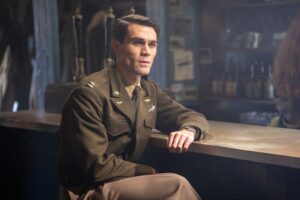
The Hollywood biopic “Jimmy” (Fathom) takes on the daunting task of attempting to explain how one movie actor’s wartime service came to influence what would eventually be considered his greatest role, and how Christian faith sustained him in both endeavors. It is a lot to undertake in a single film.
While memories of the grim reality of World War II air combat have faded with the passage of time and generations, the movie in question, “It’s a Wonderful Life” (1946), remains so familiar that, as with “The Wizard of Oz,” many viewers can recite passages of its dialogue by heart. Chalk that up to decades of annual Christmastide airings on TV.
The Army Air Corps service of Pennsylvania-born James Stewart (KJ Apa), best known before World War II for appearing in MGM light comedies — such as 1940’s “The Philadelphia Story,” for which he won an Academy Award — has been written about frequently by military historians. It saw him rise from the rank of second lieutenant to that of colonel.
Stewart was indisputably a hero in Europe as the commanding officer of the 703rd Bombardment Squadron of the 445th Bomb Group, and later as the operations officer of the 453rd Bombardment Group, eventually being promoted to chief of staff of the 2nd Combat Wing of the 8th Air Force. Based in England, he flew 20 missions over Europe.
Most of the movie’s running time is devoted to these events. Director Aaron Burns and screenwriter Justin Strawhand have clearly worked diligently to convey the experience accurately, including the terror of impending death on each flight and the reality of post-traumatic stress that ensued.
Despite being the first major movie star to enlist, Stewart — an avid pilot whose father Alexander (Neal McDonough) served in World War I — had to win over a lot of people in order to become an Army flier. He was initially of more interest for whatever he could do as a recruiter.
As his commanding officer, Col. Terrill (Rob Riggle), tells him, “You are a god. And gods don’t fly airplanes.”
Once in and leading a squadron, Stewart tries to keep things somewhat lighthearted by showing other airmen a handkerchief that has lipstick kisses from Ginger Rogers, Olivia de Havilland and Rita Hayworth on it. But the heavy loss of life on bombing missions quickly supersedes such frivolity.
In response, Stewart finds strength in faith. Before he left, his father presented him with a book of Psalms he said got him through World War I. Psalm 91, known as the Soldier’s Prayer, praises God as a refuge and a fortress. In the book, Alexander Stewart had written, “The thing that takes the place of fear and worry is the promise of these words.”
The Psalms, and praying in church, also fortify Stewart for the awful task of writing letters to the parents of airmen killed in combat.
Returning to Hollywood, Stewart finds that his star has dimmed. MGM has no use for him, and he has to strike out on his own, which sends him to Frank Capra (Max Casella) for whom he’d made two movies, including “Mr. Smith Goes to Washington.”
Capra explains his plans for “a Christmas film” in which a man considering suicide is shown what the life of his community and family would have been like without him. This conversation is reproduced exactly as Stewart related it in many of his TV interviews.
But it’s not a happy set. The pain of war memories intrudes, Stewart is prone to rages, and co-star Lionel Barrymore (Christopher McDonald) takes it on himself to explain that acting is still an essential vocation.
Stewart finds a way to channel his pain into his character, George Bailey. And George’s tearful prayer in a bar as he seeks divine guidance — which comes along in the form of an angel named Clarence (Henry Travers) — represents the moment where the man and the performer become one.
So there’s much to digest, and a full appreciation of the picture requires more than a superficial knowledge of both World War II and vintage Hollywood. It is, however, worth the journey.
The film contains intense aerial combat sequences, scenes of death and fleeting gore. The OSV News classification is A-II — adults and adolescents. The Motion Picture Association rating is PG-13 — parents strongly cautioned. Some material may be inappropriate for children under 13.
Read More Movie & Television Reviews






Copyright © 2026 OSV News
