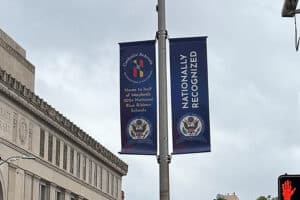
A blue ribbon might not be on its way to St. Louis School in Clarksville, but that won’t deter Archdiocese of Baltimore Catholic educators from putting a bow on what the school accomplished.
The Howard County school was one of two schools in Maryland to have the proverbial rug pulled out from under it by the U.S. Department of Education when it ended the National Blue Ribbon Schools program this summer.
St. Louis and Little Flower School in Bethesda were both among the nominees for the prestigious award in 2025. In 2024, Catholic schools in the Archdiocese of Baltimore celebrated having five schools named National Blue Ribbon Schools.
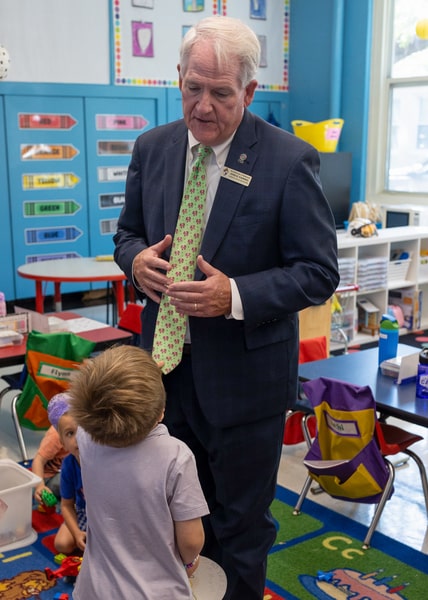
The five honorees were among 356 schools nationwide to receive the recognition and represented 12 percent of all nonpublic schools recognized in 2024.
The Trump administration ended the program in August with the U.S. Department of Education notifying state education chiefs of the decision by letter Aug. 29. The Department of Education made the move continuing the Trump administration’s drive to reduce the federal role in education.
“Yes, it’s a little disappointing,” said St. Louis Principal Debbie Thomas, a veteran of 19 years in Catholic school administration. “But even without the national recognition, the whole process of self-reflection has been incredibly important.”
Gregory Farno, chancellor of Catholic Schools for the Archdiocese of Baltimore, said he, too, is disappointed the program is ending. However, he’s confident that another national program eventually will replace it.
“The Blue Ribbon was the pinnacle, the highest honor, the gold standard,” Farno said. “It’s something every school in the country hoped to attain. We are very proud that since 2009, 24 of our schools have earned a Blue Ribbon. It’s a validation of all the hard work.
“But it’s gone away,” Farno said. “Those things happen and you move on. For now, there’s hope of creating another type of national competition.”
Thomas, who has been principal at St. Louis the past six years, estimated her team put in about 120 hours of work, reviewing every aspect of the school from special programs to math and reading. After compiling the information, the school pored over the information writing, rewriting and editing for the 20- to 30-page application.
“We went over every aspect of the school,” said the graduate of The Catholic High School of Baltimore. “The whole process really affirmed the great work that we are doing and helped perpetuate the evolution of success and the growth that we are experiencing. Our mission is to be joyfully Catholic, and we incorporate that into everything we do. A lot of the process involved in-depth self-reflection.”
Garrett O’Day, deputy director of the Maryland Catholic Conference, said he hopes the Education Department will reconsider its decision. The MCC is the official public policy entity for Maryland Catholic bishops whose dioceses include the Archdiocese of Baltimore, Archdiocese of Washington and Diocese of Wilmington.
“We’re disappointed to see the U.S. Department of Education ending the Blue Ribbon Schools Program, particularly for the two Catholic schools in Maryland that were set to be recognized this year,” said O’Day, who also serves as vice president of the Maryland Council for American Private Education. “We hope the department will revisit this decision. If not, we have asked our state department of education to recognize our exemplary Catholic schools in a similar manner.”
From 2004 to 2015, the Maryland Department of Education recognized its own Blue Ribbon schools, but the program was limited to public schools.
“As far as the impact on our Catholic schools, it’s disappointing to cut them off from the opportunity for national recognition,” said O’Day, who has served as a Catholic school board chair. “It’s another way to reinforce to Marylanders the important contribution of our Catholic schools to the future of our state.”
The Council for American Private Education produced the national private school nominees each year. Thomas hopes the state or CAPE will continue the recognition in some fashion.
“The Blue Ribbon promoted a lot of good,” Thomas said. “It’s recognition for our Catholic educators, and that affirmation is important. It’s a calling, not a job for these educators.”
Thomas also said the Blue Ribbon program promoted a good deal of idea sharing between educators that she hopes will continue in some form.
Jonathan Pressimone, principal at 2024 Blue Ribbon winner Our Lady of Perpetual Help School in Ellicott City, agrees with Thomas about the shared value of the awards.
“It’s a good motivator and gives some validity to what you are doing as a Catholic educator,” Pressimone said. “Getting to attend the awards ceremony last year in D.C., you really got to share in the passion for education. It was very uplifting.”
Pressimone said the award also was a community-wide recognition that continues to reverberate at OLPH.
“It was great to receive the recognition that what we are doing as students and faculty is exceptional,” he said. “It’s verification for our entire community.”
Raven Hill, spokesperson for the Maryland State Department of Education, said the state was “deeply disappointed” by the federal decision and “shocked” by the timing.
She said it was too early to say what form a state recognition program would take, but that the MSDE looked forward to continuing its relationship with Maryland Catholic schools.
Farno said the archdiocese plans to recognize St. Louis as a Blue Ribbon school, and he’s certain that another national awards program will be developed.
“St. Louis made it to the end of the process; we’re going to make sure they get recognized,” he said.
“I’m highly confident that the program will be replicated nationally,” Farno said. “And maybe something better will be formed. It’s important to keep that recognition in place.”
Email Gerry Jackson at gjackson@CatholicReview.org
Read More Schools

Copyright © 2025 Catholic Review Media
