
In his song “Gotta Serve Somebody” from the 1979 album “Slow Train Coming,” Bob Dylan echoed our Lord’s admonition, “He who is not for me is against me” (Mt 12:30).
In a long string of couplets, Dylan sings, for example, “You may be an ambassador to England or France/You may like to gamble, you might like to dance”; and “You may be a preacher preaching spiritual pride/Maybe a city councilman taking bribes on the side.” Regardless of the height or depth of one’s station in life, every verse is followed by the chorus, “But you’re gonna have to serve somebody/It may be the devil or it may be the Lord/But you’re gonna have to serve somebody.”
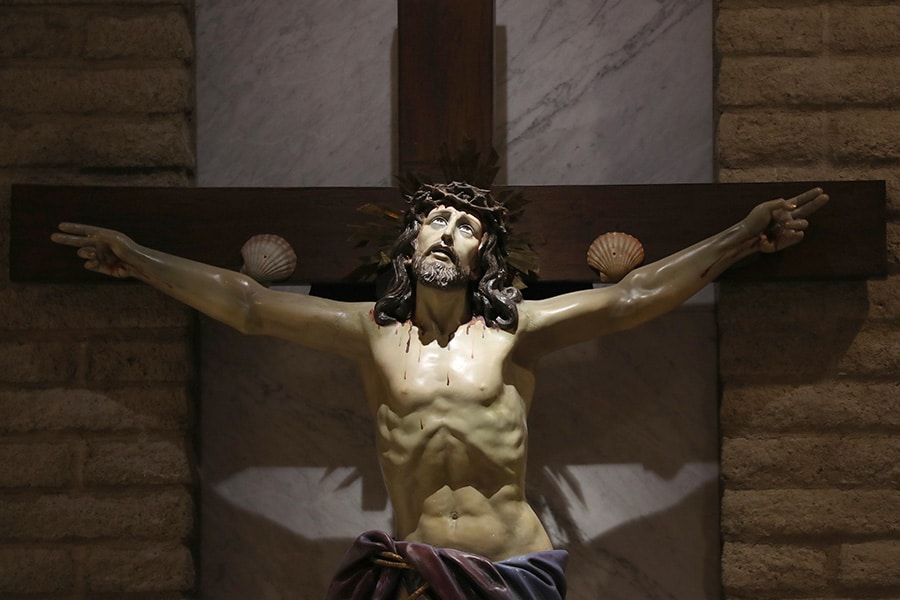
I thought of Dylan’s song as I followed the so-called “No Kings” rallies across the United States, while also anticipating the end of the liturgical year with the Feast of Christ the King, or, as it is formally known, the Solemnity of Our Lord Jesus Christ, King of the Universe.
The juxtaposition of the October rallies and the November Solemnity are a proxy for both the hubris at the heart of American politics and the paradox of Catholic citizenship in this or any regime.
The ostensible message of the No Kings rallies was to assert that we Americans have rejected kingship in favor of some sort of democratic governance. We are not ruled by kings, so the attitude might be summarized, but rather governed by ourselves.
Indeed, we tell ourselves that the United States is a great experiment in self-governance. But the ideological stridency of the No Kings rallies proves that the demonstrators do not really object to being ruled by an autocratic organization. On the contrary, the assemblies were a model of absolute obedience to party rules.
Many of the protestors do not object to absolute obeisance to some political (or partisan) authority. They just object to certain ones. They are no less willing slavishly to adhere to the diktats of their partisan overlords than the most obsequious subject of a vengeful tyrant. They are not committed to the rule of law, but rather to their own partisan faith.
But partisan obedience runs both ways. At least in the form of their commitments, critics of the No Kings demonstrators are often no less devoted to the dictates of partisanship than those they criticize. This is because most of us are perfectly willing to bow to king-like authority, just as long as it’s not that authority. While telling ourselves we are committed to self-governance, we slavishly follow the policies and politics of our political party.
This is a cautionary tale for us Catholics as we attempt to navigate the responsibilities of democratic citizenship while maintaining our obedience to Christ the King, who transcends and relativized all politics.
The question is not whether our lives should be ordered by some authority outside ourselves.
Rather, the question is who the authority is and what is the extent of his, her or its reach. In the U.S., from the far political left to the far political right, we Americans subscribe to the fiction that we are all autonomous individual actors. We live under the self-deceit that we are the sole arbiters of good and evil, right and wrong. But the fact is our beliefs and convictions are always inherited from the past, guarded in the present and shaped for the future.
We Americans do, indeed, love ourselves above all things; but even though we claim autonomy in our moral choices, we are all beholden to someone or some thing. We Catholics should use such events as the No Kings rallies as opportunities to reject all claims of absolute authority, except the authority of Christ the King.
What does it mean to acknowledge the authority of a king? How should it affect the way we order our moral, spiritual and religious lives?
At the bare minimum, it means that we subordinate all claims of political authority to the Lordship of Christ. Nor is this limited to personal or private devotion. On the contrary, as Pius XI put it in the encyclical, “Quas Primas,” creating the Feast of Christ the King, “Oh, what happiness would be Ours if all men, individuals, families, and nations, would but let themselves be governed by Christ!”
We all gotta serve somebody. It may be the party or it may be the Lord, but we all gotta serve somebody.
Read More Commentary

Copyright © 2025 OSV News
