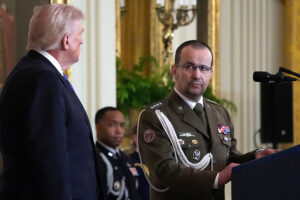
When President Donald Trump on March 2 posthumously awarded the Medal of Honor to U.S. Army Staff Sgt. Michael H. Ollis during a White House ceremony, the recognition did more than honor a battlefield hero.
More than a decade after Ollis was killed in Afghanistan, it cast new light on a story that began in Ghazni in 2013 and continues today in the life and faith of a Polish officer who said he survived because of him.
“Staff Sergeant Ollis was killed just weeks before his 25th birthday and nobody was any more brave than that,” Trump said during the ceremony.
“In his final act on Earth, Michael absorbed the blast, sparing the life of that Polish warrior, who we are grateful to have in the room with us today, Second Lieutenant Karol Cierpica.”
Cierpica could not miss the memorable day at the White House.
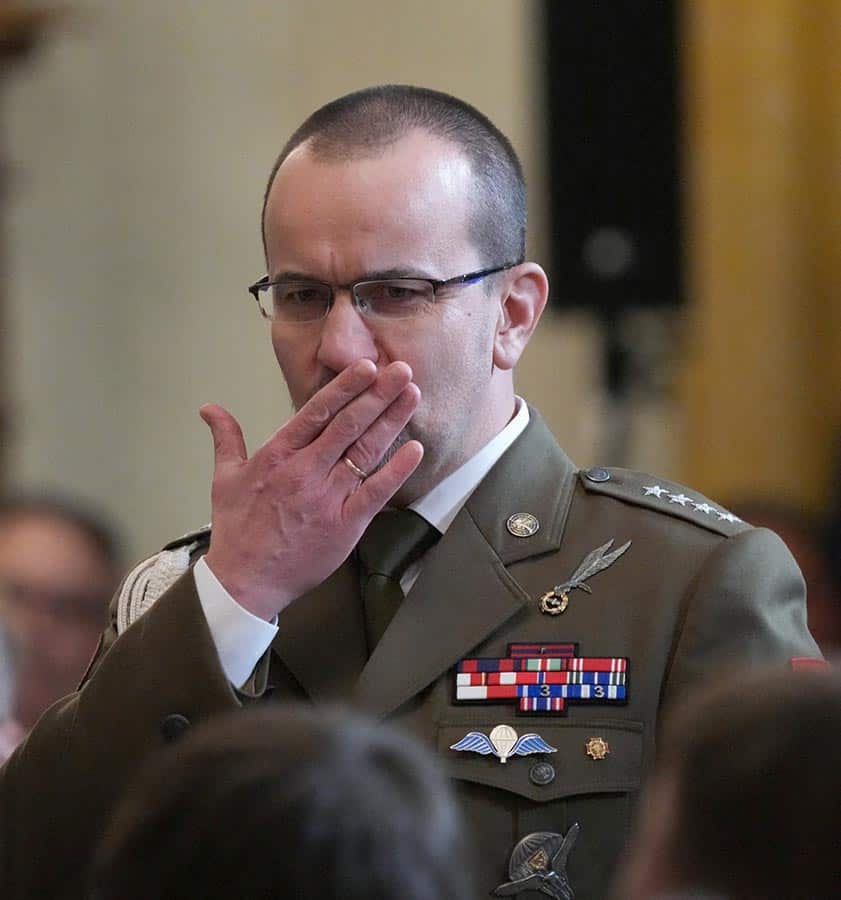
On Aug. 28, 2013, Taliban insurgents launched a coordinated attack on Forward Operating Base Ghazni in eastern Afghanistan. Coalition troops responding to the assault included, among others, soldiers from the U.S. Army’s 10th Mountain Division and Poland’s 6th Airborne Brigade. During the assault, a suicide bomber detonated explosives near Cierpica — a Polish second lieutenant. Seeing the imminent threat, Ollis ran toward the young officer and, in the final seconds before the blast, shielded him with his own body.
Ollis, 24, was killed. Cierpica survived.
“I told his friends in the hospital, ‘When you go back to America, tell them he was a real hero. He saved my life,'” Cierpica, now a captain, recalled asking this message be passed on to Ollis’ family. “It just came from my heart,” he told OSV News. Years later, that spontaneous testimony has become what he now calls his mission.
When OSV News asked Cierpica, a Catholic, if he would speak about faith and Ollis’ heroism following a White House ceremony, he replied in a brief message: “This is my main task.”
“There was in me from the beginning this mysterious need to speak about what happened,” he told OSV News March 4. “Today it is no longer a mystery. I know I live to give witness.”
Cierpica describes himself as a simple soldier, a reconnaissance commando who “ran with a rifle through the forests.” Faith was not central in his life before the mission in Afghanistan. After Ghazni, it was even less so — at least at first. He was diagnosed with post-traumatic stress disorder.
“I did not sleep. I did not speak. I had no emotions,” he said. “I could not smile.”
He calls that time his “dark night.” Medication and therapy followed.
A turning point came months later, one evening at a healing Mass in Kraków, Poland, during Eucharistic adoration.
“I prayed, ‘You must save me. You see what is happening to me. I cannot do this anymore,'” he said of asking God. “I was very calm. I did not want to leave the church,” he recalled.
Cierpica said he felt interior certainty at that moment. Since then, he admitted: “I cannot take a step or a breath without God. God is my azimuth, my direction.”
The soldier’s language speaks of hierarchy, of trust in a commander who sees more from above, Cierpica told OSV News, comparing it to everyday trust in God.
“A soldier does not need all the data of the operation,” he said. “He trusts his commander because from above you see more. In spiritual life it is very similar.”
For Cierpica, Ollis’ action on the battlefield is inseparable from that spiritual framework.
“In extreme situations, you do what you have always done,” he said. “Michael did what he always did. He was always ready to help.”
He points to what Ollis’ mother, Linda, has said publicly — that her son acted as he had been formed to act. Cierpica later read Michael’s biography “I Have Your Back” and spoke with people who knew Ollis. “Everyone said the same thing: He was always ready to serve,” Cierpica said. “He did not develop the habit of hiding.”
That habit is something Cierpica now connects both to elite military culture and to the Gospel.
“In special forces, they look not only at who is strongest or fastest,” he said. “They look at whether you see the brother on your left and right. Because one day, someone’s life will depend on your posture. That is the definition of service,” he told OSV News. “And that is the Gospel.”
The first time Cierpica met Ollis’ parents, Robert and Linda, was in the U.S. Consulate in Krakow, less than a month after the attack, in 2013. He remembers the cameras, the uniforms, the tension. But what struck him most was their own Catholic faith witness.
“I was afraid,” he said. “I thought, what if they ask me, ‘Why are you alive?'” Instead, Robert Ollis approached him and said, “Thank you for your service.” Then he added words Cierpica said engraved on his heart: “Welcome to the family.” “It was an evangelical scene,” Cierpica said. “They lost their only son. And they thanked me.”
He insists there was no bitterness in them, only grief mingled with hope. “They speak with pride. They speak with hope,” he said. “They say, ‘We will see Michael again.'” That relationship has deepened over the years. The families have visited one another repeatedly. When Cierpica and his wife welcomed a son, they named him Michael.
Soon after the baby was born, a package arrived from the United States. Inside was a teddy bear sewn from Ollis’ uniform. “We put the bear next to our little Michael and sent the photo to Linda,” Cierpica said. “She asked me, ‘May I share this with the press?” For Cierpica, it was another sign that this story did not belong only to him. “I feel there is something between us that is not ours,” he said of the bond with the Ollis family. “We tell each other we love each other. We are family.”
When Trump recognized Ollis’ sacrifice in Washington, Cierpica was present. He began his remarks with Corinthians: “What do you have that you did not receive?”
“He allowed me, in the heart of the White House, to speak God’s word,” Cierpica said. “It is not my word. It is his,” he said of God’s inspiration.
When asked to describe his primary vocation, Cierpica did not hesitate. He said his first calling now is to be a good father, a good husband and a good man. He and his wife have two sons. His oldest, Jakub, is 24 years old — exactly the same age Ollis was when he was killed in Afghanistan, Cierpica noted.
“This is a very important year for me. Symbolic,” he said, adding that the parallel in ages has deepened his sense of connection to Ollis and to the meaning of the sacrifice that changed his life.
In his memoir, “Ocalony” (“Saved”), he traces the journey from battlefield to breakdown and eventual rebuilding. Each night, he said, ends the same way — with Scripture.
“I was never faithful or consistent before,” he said. “Now every day ends with God’s word.”
He often repeats two mottos that shaped his identity. One, from Poland’s 6th Airborne Brigade, “Audaces Fortuna Iuvat” — Latin for “Fortune Favors the Bold.” The other, from the 10th Mountain Division: “Deeds not words.”
“Do not talk. Act,” he said. “Michael did not talk. He acted.”
The Polish soldier speaks of a “team of Jesus Christ,” open to all who choose service over self-preservation. “You can be in an elite unit of Christ,” he told OSV News. “It is not reserved for a few. It is for everyone.”
Read More World News
Copyright © 2026 OSV News
