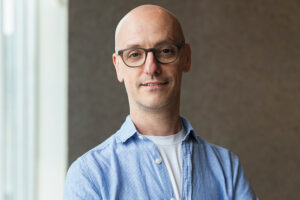
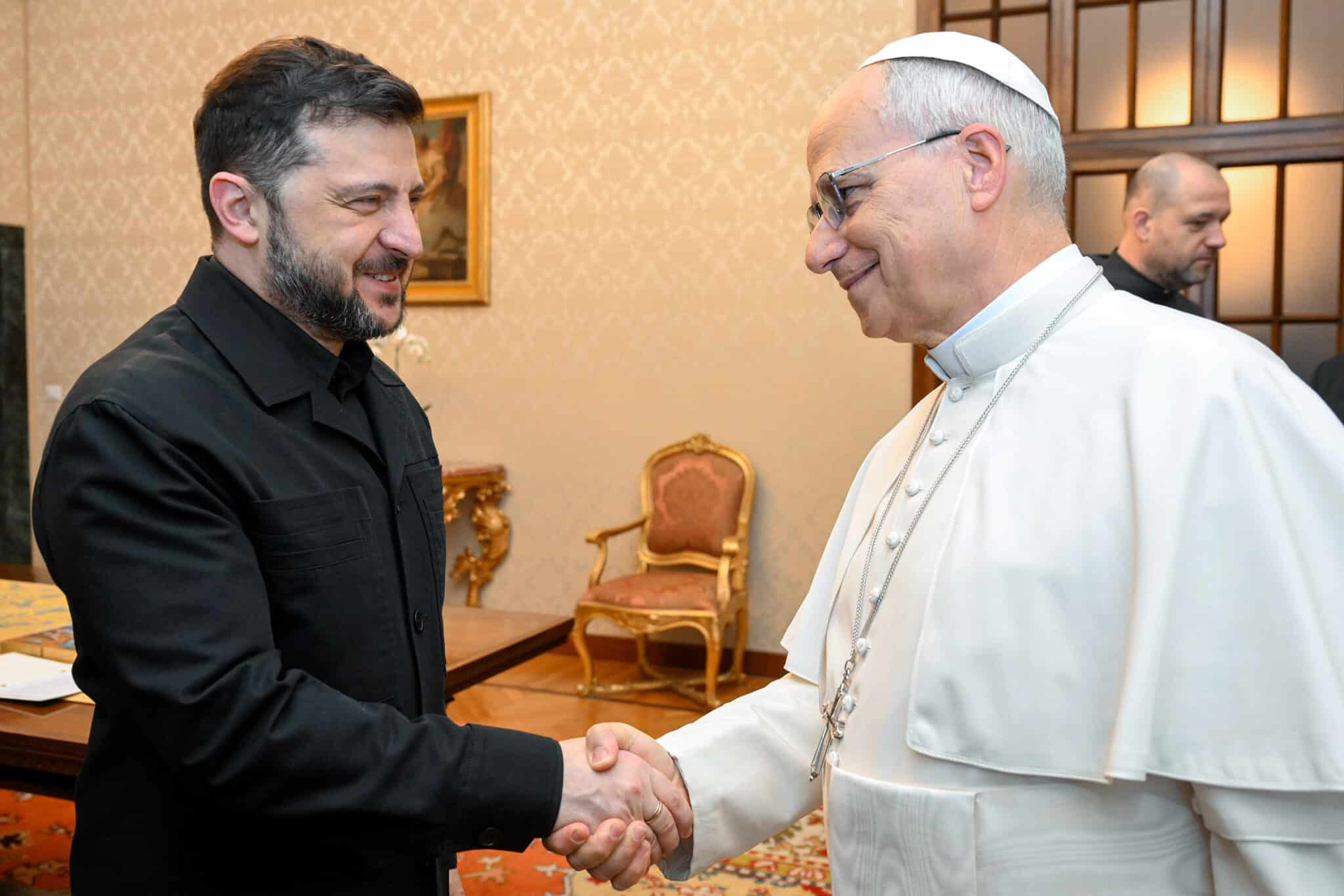
Pope Leo XIV met March 16 with Gareth Gore, the British financial journalist and author of a book that levels allegations of exploitation and human trafficking against Opus Dei, accusations that the Catholic organization calls “absolute nonsense.”
The meeting took place in the private library of the Apostolic Palace. The Vatican offered no official comment on the audience.
Since his election, Pope Leo has met twice with Opus Dei’s prelate, Msgr. Fernando Ocáriz, once six days after his election and again on Feb. 16. After the February meeting, Opus Dei described the atmosphere as one of “great trust” and said Pope Leo confirmed that the revision of the organization’s statutes, ordered by Pope Francis in a 2022 decree, remains ongoing with no publication date set.
–How the meeting was arranged
The papal audience with Gore was facilitated by Pedro Salinas, a Peruvian journalist and former member of the now-suppressed religious group Sodalitium Christianae Vitae, who knew then-Bishop Robert Prevost, now-Pope Leo, when he served as a bishop in Peru. Salinas and fellow journalist Paola Ugaz had previously exposed abuses within Sodalitium in a 2015 book, and then-Cardinal Robert Prevost had been instrumental in helping Pope Francis suppress the group.
–What Gore says he presented
Writing afterward on his personal Substack blog, Gore said he briefed the pope on allegations detailed in his book, “Opus: The Cult of Dark Money, Human Trafficking and Right-Wing Conspiracy inside the Catholic Church,” including claims that Opus Dei recruits children as young as 10 without parental knowledge, that member priests have broken the seal of the confessional, and that the organization has engaged in human trafficking by recruiting young women from Latin America into unpaid domestic work. Gore said he provided supporting documents and testimony and urged the pope to launch a formal independent investigation into the organization.
Gore wrote that the pope described his book as a rigorous piece of work. The Vatican did not confirm or comment on anything said during the private meeting.
–The Argentina investigation
Among the documents Gore said he handed to the pope was a 2024 report by Argentine prosecutors who, after a two-year investigation, found grounds for a criminal case against Opus Dei officials on charges of human trafficking and labor exploitation. The investigation stemmed from complaints filed by 44 women who alleged they had been recruited and required to perform domestic labor. Formal charges have not been filed. Opus Dei in Argentina has denied the accusations, calling them categorically false.
–Opus Dei’s response to Gore’s book
Opus Dei has rejected the book’s allegations in great detail. Following the publisher’s announcement of the book’s publication, the organization issued a statement in April 2024 calling the accusations of human trafficking, theft and political conspiracy “absolutely false.” It subsequently published a 106-page, chapter-by-chapter rebuttal of Gore’s claims.
On the allegation that Opus Dei grooms minors, the organization said its statutes require all members to be of legal age, that joining requires expressed consent on at least eight separate occasions over a minimum of six and a half years, and that members may leave at any time. On international transfers of members, Opus Dei said these require explicit written confirmation from the individual.
Opus Dei has also disputed Gore’s characterization of the late Luis Valls Taberner, a longtime president of Spain’s Banco Popular and an Opus Dei member who features prominently in the book. A spokesman for charitable foundations Valls Taberner established said donations were personal and voluntary, and described Gore’s portrayal of the banker as factually inaccurate. The spokesman also said that Gore had been introduced to numerous firsthand witnesses whose accounts contradicted his conclusions, and that Gore had set aside their testimony.
Opus Dei did not comment on the pope’s meeting with Gore, but directed inquiries to its previously published statements and rebuttal materials.
–A pope who listens
On the same morning as his meeting with Gore, Pope Leo addressed the Pontifical Commission for the Protection of Minors, telling its members that listening to victims and accompanying them must find concrete expression in every ecclesial community and institution.
The audience with Gore was also the second meeting Pope Leo has granted to book authors in recent weeks. On March 5, he met with two sociologists who co-wrote a study on Catholics who attend the traditional Latin Mass in the United States, a subject that has been a source of ongoing tension within the Church.
Spanish Augustinian Archbishop Luis Marín de San Martín, a longtime friend of the pope who was appointed by Pope Leo to lead the Dicastery for the Service of Charity, has described his leadership style as defined above all by a capacity to hear out a wide range of perspectives.
“His style of governance has always been marked by a great ability to listen,” Marín said in an interview in May 2025. “He is a man who knows how to listen, listens a lot, and listens to different opinions. This doesn’t mean he agrees with all of them, but he listens and engages in dialogue.”
–Pope Leo’s prior engagement with Opus Dei
The Diocese of Chiclayo, where Pope Leo served as bishop from 2015 to 2023, had been under the leadership of bishops with close ties to Opus Dei for decades. During his years as bishop, Prevost worked closely with several priests of the Society of the Holy Cross, the association of clergy united to Opus Dei.
Then-Bishop Prevost celebrated a Mass in June 2022 at the Chiclayo cathedral for the feast of St. Josemaría Escrivá, the founder of Opus Dei, in which Bishop Prevost gave thanks to God in his homily for the gift to the Church of St. Josemaria, whom he called “the saint of the ordinary.” Bishop Prevost went on in his homily to reflect on what he defined as the most important teachings St. Escrivá left the Church: the sanctification of work, the divine filiation of Christians and the apostolate.
Pope Francis issued a decree in July 2022 that initiated the revision of Opus Dei’s statutes and also removed the right of Opus Dei’s leader to hold the rank of bishop.
Opus Dei remains the only organization in the Catholic Church designated as a personal prelature, a status conferred by St. John Paul II in 1982. The Catholic organization has about 90,000 members present in 70 countries, the majority of which are married laypeople.
Read More Vatican News
Copyright © 2026 OSV News
