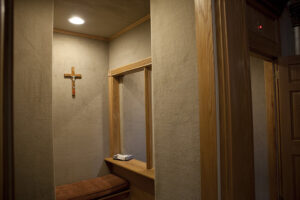
Q: Is confession required for obtaining a plenary indulgence if there is no mortal sin? A diocesan hermit, who is homebound, says his ministry is to gain plenary indulgences for the poor souls by various devotional practices which confer a plenary indulgence. He formerly had asked for confession twice a month to take care of that requirement. Now he has decided that confession is required only if there is a mortal sin to confess. Does canon law provide any guidance on this issue?
A: Yes, it would seem that a sacramental confession is indeed required for obtaining a plenary indulgence, regardless of whether the one seeking the indulgence has committed any mortal sins since his or her last confession.
I suspect the hermit might be confusing the requirements for obtaining an indulgence with Canon 989 of the Code of Canon Law, which states that: “All the faithful who have reached the age of discretion are bound faithfully to confess their grave sins at least once a year.” Since Canon 989 refers only to grave rather than merely venial sins, we can deduce that Catholics who have not committed any mortal sins in the past year are thereby “excused” from this general canonical requirement. (Though of course regular confession is always a good idea, even if it’s not strictly required!)
However, most indulgences indicate that, in addition to completing the specific indulgenced prayer or pious act, the indulgence is gained “provided the usual conditions are met.” One place where these “usual conditions” are listed is the document from the Apostolic Penitentiary — the Vatican “department” responsible for overseeing indulgences — from the Jubilee Year 2000 titled “The Gift of the Indulgence.”
In paragraph four of “The Gift of the Indulgence,” we read that: “A plenary indulgence can be gained only once a day. In order to obtain it, the faithful must, in addition to being in the state of grace: have the interior disposition of complete detachment from sin, even venial sin; have sacramentally confessed their sins; receive the Holy Eucharist; (and) pray for the intentions of the Supreme Pontiff.”
Relevant to your question, it’s useful to observe that the Church presumes that one seeking an indulgence will already be in a state of grace, meaning free from unconfessed mortal sin. Thus, since freedom from mortal sin is envisioned as a prerequisite for even attempting to earn an indulgence, logically this absence of mortal sin would not serve as a sort of loophole for getting out of the requirement to make a sacramental confession.
Likewise, another “usual condition” for obtaining an indulgence is “complete detachment from sin, even venial sin.” This condition is perhaps the most difficult one to meet, and it might be just as difficult to explain! But essentially, detachment from sin means that a person is sincerely sorry for their sins and has genuine and heartfelt desire to avoid sin in the future. True detachment from sin is therefore incompatible with being in a state of mortal sin, so here again freedom from mortal sin is portrayed as a “given” for seeking an indulgence and not as a special exception.
Fortunately, it sounds like your hermit enjoys a decent level of pastoral support, despite being homebound. Still, it’s helpful to keep in mind what “The Gift of the Indulgence” says about the timing of the requisite sacramental confession with respect to the plenary indulgence being sought: “It is appropriate, but not necessary, that the sacramental Confession and especially Holy Communion and the prayer for the Pope’s intentions take place on the same day that the indulgenced work is performed; but it is sufficient that these sacred rites and prayers be carried out within several days (about 20) before or after the indulgenced act.”
So, even if a Catholic were homebound not able to go out to go to confession, a pastoral visit from a priest-confessor within 20 days in either direction would be sufficient for the purposes of obtaining the indulgence.
Jenna Marie Cooper, who holds a licentiate in canon law, is a consecrated virgin and a canonist whose column appears weekly at OSV News. Send your questions to CatholicQA@osv.com.
Read More Question Corner

Copyright © 2026 OSV News
