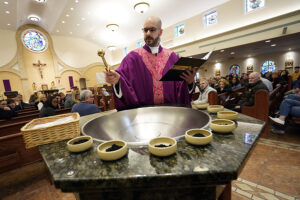
Q: In a recent homily, my parish priest suggested that we all “give up prayers of petition for Lent.” He said we’re not being good friends to God if all we do is ask him for things, and that “you’ve all said enough prayers of petition, it’s time to say some other prayers.” But I’m not sure exactly what he meant by this or how I should incorporate this guidance into my prayer life.
A: First, this may not have been made clear in the homily you mentioned, but it needs to be pointed out that a general message in a homily is very different from personal, individual guidance in spiritual direction or in the confessional.
Unless a homily is just reiterating basic requirements that are binding on all Catholics, you are free to use careful personal discernment in terms of whether or not the advice given in a homily applies to you. Since parishes are typically meant to serve all the Catholics in a given area based on simple geography rather than level of personal spiritual maturity, no parish homily is going to be able to give specific advice on prayer that will apply equally to all the souls who happen to be present to hear it.
That all being said, I suspect your priest was thinking of the four categories we traditionally use to describe different kinds of prayer: adoration, contrition, thanksgiving and petition (sometimes called “supplication”).
“Adoration” is prayer where we worship and praise God for his goodness, and in a similar way prayers of “thanksgiving” are when we thank God in prayer for the blessings he has given us. Prayers of “contrition” are when we apologize to God for having offended him and express our sorrow for our sins — the sacrament of penance is the highest form of prayer of contrition, although we can certainly pray prayers of contrition in other contexts. Prayers of petition are where we ask God for what we need or ask him to fulfill some holy or at least wholesome desire that we have.
In theory, I suppose it would be possible for someone with a very primitive and childish prayer life to lean too heavily into this last category. That is, if the only time a Christian ever turned to God in prayer was to ask him for selfish material things, then it probably would be healthy for such a person to start saying some additional prayers of thanksgiving and adoration, and at the very least to go back to confession if they haven’t been availing themself of the sacrament regularly.
But holding that someone should omit prayers of petition altogether would seem to imply a fundamental misunderstanding of this kind of prayer.
For instance, if someone were to literally give up all prayers of petition for Lent, this means that they would not be able to say the “Our Father” — the prayer that Jesus himself taught us word-for-word — until Easter, since in the “Our Father” we pray a prayer of petition that God “give us this day our daily bread.” And for priests, men and women in consecrated life, and the laity who pray the Liturgy of the Hours, each liturgical “hour” always begins with the prayer of petition: “God, come to my assistance; Lord, make haste to help me.”
Prayers of intercession, where we ask God to help other people in their needs, are also prayers of petition. Since praying for both the living and the dead is a spiritual work of mercy, it wouldn’t seem fitting to give this up for Lent!
Understood correctly, prayers of petitions are not meant to be a selfish “wish list” we impose on God, but are rather powerful ways to grow in humility and love of him. When we ask God for help, we come to understand that we are mere creatures who need him, and that he is a loving Father who always cares for us.
Jenna Marie Cooper, who holds a licentiate in canon law, is a consecrated virgin and a canonist whose column appears weekly at OSV News. Send your questions to CatholicQA@osv.com.
Read More Question Corner


Copyright © 2026 OSV News
