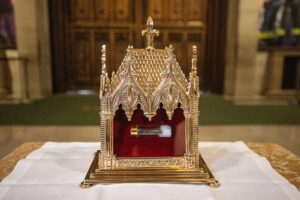
Q: Recently at a Bible study session a discussion came up about relics. Why does the Church allow pieces of a saint’s body to be distributed for relics? When the resurrection of the body happens all the saint’s remains will not be in the same place. Isn’t this the reason given as to why scattering of a person’s ashes is not OK?
A: As counterintuitive as it might seem at first, we as Catholics venerate relics for the very same reason why we prohibit the scattering of a departed person’s ashes. Both of these points reflect our Catholic belief in the fundamental dignity of the human body and the necessity of always seeking to show it a fitting degree of respect and reverence.
Regarding the dignity of the human body, the Catechism of the Catholic Church expresses this beautifully when it tells us that: “The human body shares in the dignity of ‘the image of God’: it is a human body precisely because it is animated by a spiritual soul, and it is the whole human person that is intended to become, in the body of Christ, a temple of the Spirit.”
This sentiment is echoed in an otherwise rather prosaic 2017 document from the Congregation for the Causes of Saints in Rome, titled “Relics in the Church: Authenticity and Preservation.” Before launching into a discussion on the proper verification and care of relics, this document notes that: “Relics in the Church have always received particular veneration and attention because the body of the Blesseds and of the Saints, destined for the resurrection, has been on earth the living temple of the Holy Spirit and the instrument of their holiness.”
Another reason why we have the practice of preserving or venerating saints’ relics is because it harkens back to the ancient custom of the Church’s first few centuries of celebrating Mass in the catacombs over the tombs of the martyrs. Even today, every Catholic church will ordinarily have a relic contained within or underneath the altar. The presence of these saints’ relics reminds us of the communion of saints, that is, our “family bond” with the faithful Christians who have gone before us and are now directly present with God in heaven.
Still, I can see where our practice of preserving and venerating relics — or at least what we call “first-class relics,” which are typically some piece of the saint’s physical body — might seem to complicate our belief in the resurrection of the body, insofar as it might be hard to imagine the “logistics” of how a body that exists in small portions in multiple locations might be resurrected.
But as the catechism teaches us: “This ‘how’ exceeds our imagination and understanding; it is accessible only to faith.” And in the New Testament we read that Christ “will change our lowly body to conform with his glorified body” (Phil 3:21). So it seems that, while our future resurrected bodies will truly be ours, they will also be renewed in a profound and mysterious way.
With respect to how the veneration of relics compares to the scattering of ashes, we can observe how respectfully saints’ relics are kept. Generally, they are carefully guarded and always treated with fitting honor. On the other hand, the scattering of cremated ashes would seem to be fundamentally less respectful to the deceased, since at least on a surface level this could give the appearance of simply discarding the body.
Additionally, the 2016 document “Ad resurgendum cum Christo” from the Congregation of the Doctrine of the Faith tells us that: “In order that every appearance of pantheism, naturalism or nihilism be avoided, it is not permitted to scatter the ashes of the faithful departed in the air, on land, at sea or in some other way.” That is, the Church is concerned that the scattering could reflect or foster false beliefs on the nature of death and resurrection.
Read more Question Corner

Copyright © 2026 OSV News
