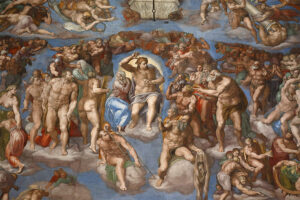
Q: I have a question about the last judgement. When Jesus comes again to judge us all, how public will this be? As in, will everyone know each other’s sins when this happens? (Ohio)
A: There is a lot that we simply don’t — and indeed, can’t — know about what our first-hand experience of the last judgment will be like. But based both on sacred Scripture and the Church’s perennial teachings, I think it’s safe to conclude that the last judgment will be a fairly public event, so to speak.
For background, when we speak of the “final” or “last judgment,” this refers to our Catholic belief that just as Jesus came to earth the first time in his incarnation when he was born in Bethlehem, he will return again to earth at the end of time.
We openly profess this truth of the faith every Sunday when we recite the Nicene Creed, in which we state our belief that “He will come again in glory to judge the living and the dead and his kingdom will have no end.”
The Catechism of the Catholic Church also describes how the last judgment will “come when Christ returns in glory” (CCC 1040).
Sometimes the last judgement is also referred to as the “universal judgment,” as opposed to the “particular judgment” each soul faces individually at the time of his or her actual death (CCC 1051). Our own particular judgement is when it is determined whether the choices we made in our earthly lives have set us on the path to an eternity with God in heaven, with whatever purification in purgatory may be necessary to prepare us for that eventual happy end; or whether, through a life of unrepented sin, we have made the decision to separate ourselves from God for an eternity in hell.
The particular judgment would seem to be more “private,” insofar as those of us still on earth generally don’t have direct insight into the experiences a recently departed soul is having.
But in contrast, the catechism makes the universal last judgement sound quite public: “In the presence of Christ, who is Truth itself, the truth of each man’s relationship with God will be laid bare. The Last Judgment will reveal even to its furthest consequences the good each person has done or failed to do during his earthly life” (CCC 1039).
Jesus himself seems to allude to the public nature of the last judgement in the Gospels. For example, in St. Luke’s Gospel Jesus tells us: “For there is nothing hidden that will not become visible, and nothing secret that will not be known and come to light” (Lk 8:17); and: “There is nothing concealed that will not be revealed, nor secret that will not be known. Therefore whatever you have said in the darkness will be heard in the light, and what you have whispered behind closed doors will be proclaimed on the housetops” (Lk 12:2-3).
The final book of the New Testament which describes Christ’s role in the ultimate conclusion of history is the Book of Revelation, sometimes alternatively called the Book of Apocalypse, a Greek term which literally translates into “unveiling.” The entire theme of this book is that Christ’s second coming will, by its very nature, involve the unveiling or open revealing of things that had been hidden.
From a purely human perspective, it’s only natural that this awe-inducing judgment at the end of the world might sound like something we should dread. Yet on a theological level, the Church presents Christ’s second coming as judge as a fundamentally good thing.
“We shall know the ultimate meaning of the whole work of creation and of the entire economy of salvation and understand the marvelous ways by which his Providence led everything towards its final end,” the catechism states. “The Last Judgment will reveal that God’s justice triumphs over all the injustices committed by his creatures and that God’s love is stronger than death” (CCC 1040).
read more commentary





Copyright © 2026 OSV News
