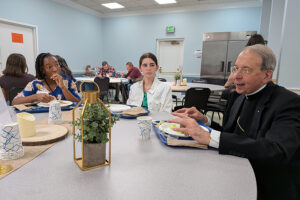
SPARKS – After talking with Archbishop William E. Lori and 11 other teens about artificial intelligence, technology and faith, Benjamin Virgilio, 17, left even more convinced that while AI can process information and generate answers, it can never replicate what makes people human.
“AI could never replicate true emotions or the soul God gave us to create,” said Virgilio, a student at Calvert Hall College High School in Towson and a parishioner of St. Ursula in Parkville.
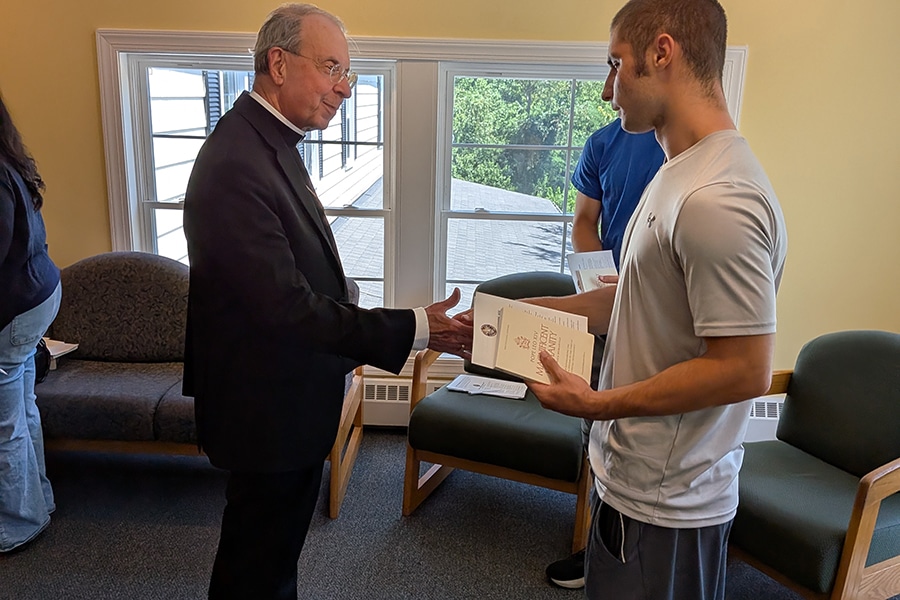
Virgilio was one of 12 teens from around the Archdiocese of Baltimore who gathered July 23 at O’Dwyer Retreat Center in Sparks for the discussion.
The archbishop was quick to make a confession after sitting down with the teens in a comfortable upstairs living area. “I think I will learn more today than you will,” he said to chuckles.
Monitored by Rena Black, coordinator for missionary discipleship for the Office of Family, Youth and Young Adult Ministry within the archdiocese’s Institute for Evangelization, the discussion was prompted with questions – When was the first time you used AI for an assignment or task? What worries you most and excites you most about AI? When you need peace and quiet, where do you find it?
The young participants were encouraged to share their thoughts freely, with no judgement.
“This is a dialogue, not a debate,” Black informed the group at the start. “We are not really looking for right and wrong answers. If you feel strongly about something, we respect that.”
The 90-minute discussion flew by as the teens relaxed, nodding in agreement or offering another perspective to someone’s comments. When asked what human trait AI technology could never replace, each was quick to provide a different one including empathy, passion and dignity, as well as individuality, personality and intelligence.
While all agreed that AI was a useful tool, they all stressed that it was nothing else. With so much information available quickly, one teen hoped people would still be curious and discover things on their own.
As the discussion ended, the archbishop told them his “heart was filled with joy.”
“What I heard around the room was not a lot of technical explanations about what AI is. What I heard was wisdom,” the archbishop said. “Wisdom about how to use AI. What its strengths are but also what its limits are. I heard faith. I heard relationships with God. What you know here is the difference between using technology to assist us, to enhance our lives versus substituting for the things we alone can do because of our humanity or replacing us.”
As AI continues “its march,” the archbishop noted that the technology could give back “big parts of our day.” The question then, he said, is “What will we do with the time it gives us?”
“What I see around the room are really generous hearts. Some prayerful hearts and I think you are going to know what to do with the most precious commodity of all, our time,” Archbishop Lori said. “I really, really think the future is in good hands here.”
A member of the diocese’s Office of Family, Youth and Young Adult ministry took notes during the discussion to share with the National Federation for Catholic Youth Ministry (NFCYM). The Archdiocese of Baltimore was invited to participate in the NFCYM’s initiative to better understand the lived experiences of young people and the church’s discernment regarding AI, digital technologies, faith and human flourishing.
“I am hopeful that there are so many Catholic kids like me who share my thought process behind being cautious around AI,” Makayla Abel, 16, a homeschool student who attends St. Katharine Drexel in Frederick, said afterward. “I am excited for the things it can do to help us succeed in different facets of our academic life, but I would advise everyone to be very cautious and to stay connected to their family and their friends. Put God and your family before everything. Keep AI as a tool in your back pocket but have the people around you as the thing you utilize.”
Virgilio also found it interesting that the group had similar, but also unique, thoughts.
“It shows how we are as humans,” he said. “AI could never be that nuanced and have so many different perspectives as people do because it is a program and an algorithm and there aren’t misunderstandings or nuances.”
Black said her department planned to continue hosting dialogues, both virtual and in-person, between archdiocesan church leaders and middle and high school-age youths about AI and technology and other topics in the future.
“The experience that I just had just confirms everything I already believe about young people,” Black said. “They bring hope. They bring wisdom. And our future is in good hands.”
Email Katie V. Jones at kjones@CatholicReview.org
read more ai


Copyright © 2026 Catholic Review Media
