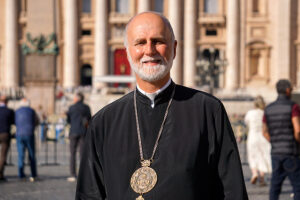
ROME (CNS) — “The clock is ticking” for more than 100,000 Ukrainians whose temporary protections allowing them to live and work in the United States are set to expire Oct. 19, the head of the Ukrainian Catholic Archeparchy of Philadelphia said.
Without a policy change, people who relied on just temporary measures, including the Uniting for Ukraine humanitarian parole program, may be “constrained to leave the country; but many of them have no home to go back to,” Archbishop Borys Gudziak told Catholic News Service during a visit to Rome and the Vatican Oct. 13.
If they fail to apply to other legal channels to stay, U.S. Immigration and Customs Enforcement, known as “ICE, might subject them to deportation,” he said.
According to the U.S. Citizenship and Immigration Services, the temporary protected status (TPS) designation of Ukraine and related benefits were set to terminate Oct. 19. A bipartisan bill introduced in the House of Representatives Oct. 5 would extend temporary protected status for eligible Ukrainians by redesignating protections until July 1, 2029.
The U.S. administration has until Oct. 19 to renew or remove the temporary protected status for more than 100,000 Ukrainians. But some U.S. lawmakers have also been considering allowing a six-month extension to take effect automatically if the White House administration does not make a decision by the deadline.
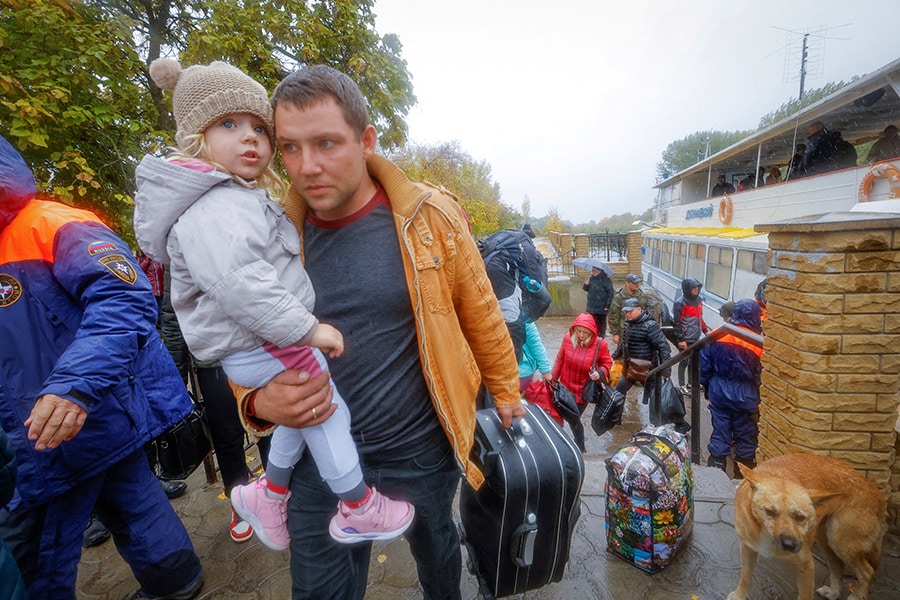
The humanitarian crisis remains severe as Ukraine enters the fifth year of full-scale war, according to the United Nations Office for the Coordination of Humanitarian Affairs (OCHA).
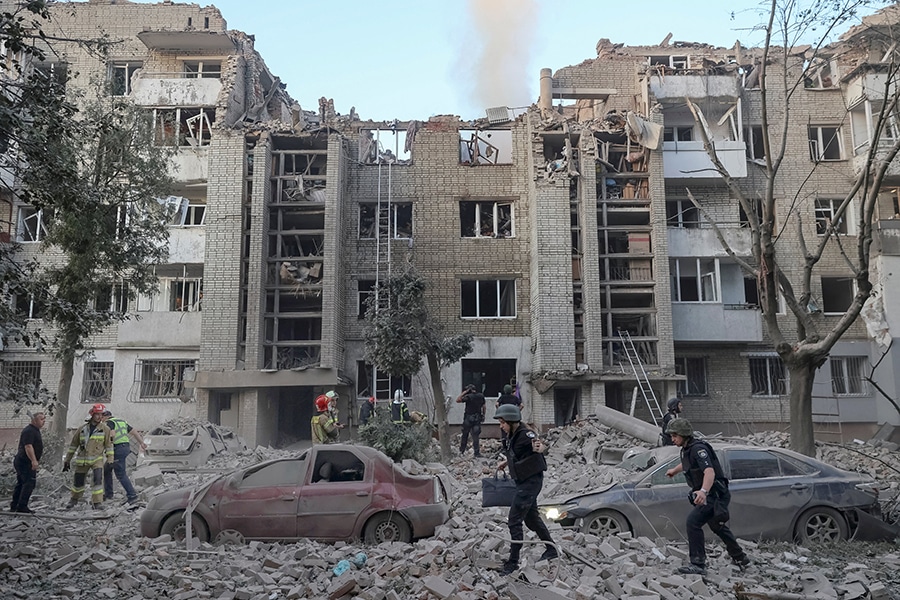
Russian forces continue to attack civilians and critical civilian infrastructure, leading to thousands of deaths, displacement and the breakdown of essential services, like running water, electricity, heating and transport, it said.
Humanitarian workers are also attacked, and delivering aid has become too dangerous, leading to “delayed assistance, fewer evacuation options and growing isolation,” OCHA reported Oct. 9.
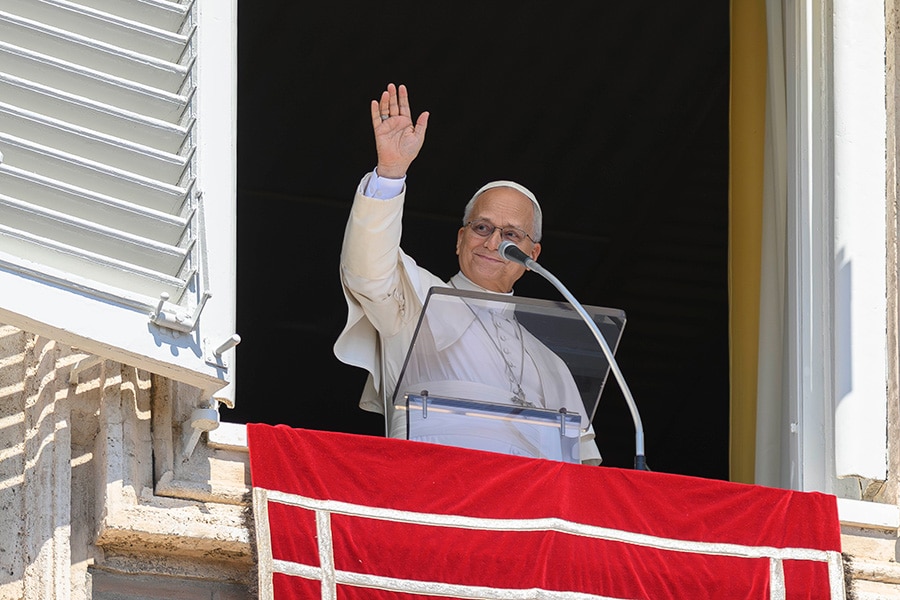
Throughout his pontificate, Pope Leo XIV has called for peace in Ukraine through diplomacy and the protection of civilians, most recently from his hospital room recovering from lung cancer surgery. On Oct. 16, the pope spoke to Russian President Vladimir Putin by phone, pushing for a ceasefire in Oleshky, Ukraine, to allow humanitarian aid to reach civilians and permit their safe evacuation, the Vatican said.
According to the nonpartisan Migration Policy Institute based in Washington, D.C., more than 101,000 Ukrainians held temporary protected status as of March 2025, “while 240,000 had received humanitarian parole through the now-paused Uniting for Ukraine program,” which gave them “relief from deportation and access to a work permit.”
“Both populations faced an uncertain future under the Trump administration,” the institute added.
“There’s probably 400,000 baptized Ukrainian Catholics in the United States,” Archbishop Gudziak said during his visit.
They are constantly checking social media “to see if people that they know or even their closest relatives are safe, whether a bomb hasn’t hit their town or home, whether a drone hasn’t destroyed their school or their hospital back home,” he said.
“They pray, they try to advocate, and they organize humanitarian assistance,” he said, but “there is just constant anxiety and stress,” especially now when there is “no clarity about what’s going to happen” to those who came in on the humanitarian parole program or have TPS.
“The prospects of having to leave the country are there,” he said, and many people “are getting fired already, even though they are performing jobs that are beneficial to the American economy.”
Archbishop Gudziak underlined the importance of the special message on immigration issued by the U.S. bishops at their plenary assembly last fall, which emphasized the “Gospel principles regarding the human dignity of every person, including the migrant, and our moral responsibility to help those who are fleeing life-and-death situations.”
“Individually, each one of us is not only speaking out, but we’re trying to help migrants” of any or no faith, not just Catholics, he said.
“Most Americans are the successors of migrants, and so we should remember our identity and understand that the hospitality of others to our ancestors has made our life possible,” said the U.S.-born archbishop whose parents were World War II refugees from Ukraine. “We should make the life of others possible as well, not cancel it.”
After Russia’s full-scale invasion of Ukraine in February 2022, an estimated 6.9 million Ukrainians had left their country as of December 2025 and another 3.7 million Ukrainians were displaced internally, the Migration Policy Institute reported in February 2026.
“Russian rule leads to genocide,” Archbishop Gudziak said. “In the 20th century, 15 million people were killed or died an unnatural death in Ukraine” due to “rule from Moscow, war through Moscow’s first alliance, and then a war with Nazi Germany.”
Also, “over the last 300 years, every time there’s been a Russian occupation of any part of Ukrainian territory where the Ukrainian Catholic Church lived and ministered, the church has been eliminated,” he added.
“So the story of Ukraine today is the story of a colonized people that finally is saying a final ‘No! We’re not returning to colonial rule,'” he said.
While Russian troops seem to be making “no progress on the front” in occupying more of Ukraine’s territory, “the aggressor has added tactics of terrorizing the civilian population, regularly bombarding a few of the main cities, and hitting other small cities and towns randomly to create a sense that you are safe nowhere in Ukraine,” whose territory “is comparable to that from the Carolinas to Maine,” he said.
Despite living with so much stress, trauma and fear, the people have been showing great resilience, the archbishop said, adding that the church plays a very important role in calling for greater solidarity, a sense of responsibility and “reminding everybody that the struggle is for the common good.”
“If we know that we are the beloved children of God, we live everything in a different manner,” he said. “A terrorist tries to convince you that you are nothing, that you’re doomed, that you’re going to die. And a terrorist wants you to be in despair.”
“God wants us to flourish. He wants us to know his love,” he said. “And that is what we need to call each other back to: the blessing that God gives, and also a confidence that God’s truth will prevail.”
Read more
Copyright © 2026 OSV News
