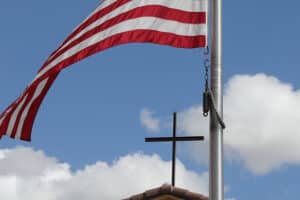
In 1984, the late Richard John Neuhaus published a highly regarded book called “The Naked Public Square.” Six years later, Neuhaus founded the journal, First Things, which remains an important voice to this day, publishing thoughtful articles and reviews on matters of religion in public life.
Until shortly before his 2009 death from cancer at the age of 72, Neuhaus wrote a monthly column for First Things called “The Public Square.” The column was a running examination of public events in the U.S. through the lens of Catholic moral theology, but with a broader ecumenical audience in mind.
Also in 1990, Neuhaus converted to Catholicism, and was ordained a Catholic priest for the Archdiocese of New York about a year later. These events followed the 1987 publication of his book, “The Catholic Moment,” in which Neuhaus argued that only the Catholic Church has the institutional structure, intellectual depth and theological vocabulary to be an authentic witness against the rising tide of secularism in American public life.
Our current political crises — and vexatious responses to them from both ends of the political spectrum — invoke the need to revive Father Neuhaus’ legacy. The intervening years have demonstrated that “The Naked Public Square” and “The Catholic Moment” are as salient in 2025 as they were when Father Neuhaus published them. And the problems he addressed in his “The Public Square” column have, if anything, become more chronically debilitating for American political, legal, and social discourse.
I am less sanguine than Father Neuhaus was about the possibility of retaining something like America’s experiment in ordered liberty, even if informed by rigorous, unflinching Catholic witness. I am not optimistic that liberalism can be redeemed in either of its conservative or progressive variations. Put another way, I fear that the radical individualism of the liberal theory at the heart of the American founding is so corrosive that Neuhaus’ plea for a “Catholic moment” may be a more difficult agenda by some magnitude than it was in 1990.
In my mind, therefore, the task is less to try to forge a Catholic-American consensus, than it is to articulate why Catholicism offers a richer, more vibrant, more stable set of moral and political principles than the liberal theory of the American founding.
Catholicism cannot complement liberalism; it can only critique it. Catholicism is not liberalism’s ally, but its rival. This is because the political, legal and regulatory structures in the U.S. are built upon the foundation of a false moral anthropology.
American politics starts with the theory that we are all enemies of one another in our respective assertions of individual rights claims. It cannot be surprising that such a foundation has resulted in a polarizing — even violent — political culture. To put it Augustinian terms, the morality of the Civitas Terrena (city of earth) can never be a complement to the Civitas Dei (city of God). They will always be rivals. Attempts to forge a synthesis between liberalism and Catholic Christianity results in the triumphant advancement of the former and the corrupting compromise of the latter. This leads, eventually but inevitably, even to the corruption of all politics.
There is no such thing as the “naked” public square that liberalism claims to establish and protect. Rather, the public square will always reflect a consensus of moral opinion and its advocates will jealously guard that consensus against all rivals. To take up Father Neuhaus’ charge in both “The Naked Public Square” and “The Catholic Moment,” we must attempt to articulate a distinct Catholic vision of public life through the whole lens of the church’s moral teaching, especially on social doctrine.
In perhaps the most famous sentence in “The Naked Public Square,” Father Neuhaus declared, “Pluralism is a jealous god. When pluralism is established as dogma, there is no room for other dogmas.” American institutional pluralism, expressed through assertions of radical individual rights claims, is the dogma at the very heart of American public life. Catholic moral theology is its rival, not its complement. That is the point of departure for a robust discussion of what it means to be Catholic is liberal America.
The rich tradition of Catholic moral thought, if applied seriously, is the only antidote to the individualism that divides us.
Read More Commentary

Copyright © 2025 OSV News
