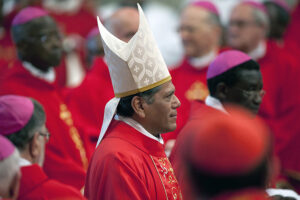
(OSV News) — Just days before Pope Leo XIV’s arrival in Peru, two Catholic bishops in the South American country died following illnesses, including Archbishop Richard Daniel Alarcón Urrutia of Cusco, whose archdiocese is preparing to welcome the pope Nov. 15.
Archbishop Alarcón passed away Oct. 30 after a long illness, according to Peruvian media. He was 74.
Bishop Jorge Pedro Carrión Pavlich of Puno, whose diocese serves communities along Lake Titicaca, the highest navigable lake in the world, died Oct. 31, according to a social media statement by the cathedral in Puno. Bishop Carrión, 76, also succumbed to an undisclosed illness, according to Peruvian media.
Pope Leo expressed his condolences in a Nov. 1 telegram to Coadjutor Archbishop Lizardo Estrada Herrera of Cusco, describing Archbishop Alarcón as a “self-sacrificing shepherd who, for years and with great faithfulness, dedicated his life to the service of God and the Church. I offer prayers for the eternal repose of his soul, that the Lord Jesus may grant him the crown of glory that does not fade.”
Pope Leo elevated Archbishop Estrada Herrera to coadjutor archbishop in August. This means Archbishop Estrada Herrera would automatically succeed Archbishop Alarcón upon retirement or death.
The pope visits Cusco on Nov. 15 — a trip which will take him more than 11,000 feet into the Andes barely a month after he had the lower part of his right lung removed. Doctors have given Pope Leo permission to travel to Uruguay, Argentina and Peru from Nov. 6 to Nov. 17 for the longest trip of his papacy.
The visit to Cusco includes a large gathering at the Saqsaywaman archaeological site, where Pope Leo is scheduled to speak about popular piety. He is also scheduled to pray the Angelus with the faithful outside the local cathedral.
“Cusco is a Marian people; I would say the entire southern part of Peru is a Catholic, Marian people,” Archbishop Alarcón said in a 2026 interview with Fe y Realidad, an Archdiocese of Lima program. “The Holy Father is going to speak about popular Marian devotion, with the aim of providing some guidance on how such devotion can be channeled into a Christian commitment, ensuring it doesn’t remain merely a matter of folklore or culture.”
Archbishop Alarcón was born in Lima, the Peruvian capital, and joined the Franciscan Order of Friars Minor. He said he was drawn to missions and began his pastoral service as a parish priest in Cusco, according to a video produced by the Archdiocese of Cusco. St. John Paul II appointed him bishop of Tarma in 2001, and Pope Francis later appointed him archbishop of Cusco in 2014.
In Cusco, Archbishop Alarcón said that he spent his first year in Cusco traveling the diocese, which covers urban areas, remote mountain villages with Quechua-speaking populations and several parishes in a jungle region.
“He didn’t speak Quechua especially well, but that didn’t stop him from being close to the people,” Veronique Lecaros, head of the theology department at the Pontifical Catholic University of Peru, told OSV News. “He reached out to the people and was very egalitarian in his interactions.”
Archbishop Alarcón told Fe y Realidad of his first year in Cusco: “I wouldn’t give any advance notice, I would simply arrive and knock on doors to see how everyone was doing. … That really helped me understand that we have a strong presence everywhere.”
Archbishop Alarcón embraced the vision of synodality promoted by Pope Francis and continued by Pope Leo, saying it produced both “beautiful things,” but also pointed questions.
“We are reaching out to the most humble, remote parishes, communities where Quechua is spoken, enabling them to find their own voice within that space,” he said. “We are broadening participation, allowing them to become active members of the Church rather than mere spectators.”
Read more world news

Copyright © 2026 OSV News
