(OSV News) — Amid recent calls from several artificial intelligence leaders for a slowdown in the technology’s development, the nation’s Catholic bishops are engaging tech leaders and lawmakers to address concerns over AI and online child safety.
The bishops have also formed a task force to safeguard human dignity as AI rapidly evolves, echoing Pope Leo XIV’s urgent message in his encyclical on AI, “Magnifica Humanitas.”
The U.S. Conference of Catholic Bishops announced the developments in a Sept. 16 press release, saying its Administrative Committee had met at the USCCB’s Washington headquarters with “representatives from a variety of tech firms and specialists” in AI earlier that day.
The committee, led by USCCB president Archbishop Paul S. Coakley of Oklahoma City, serves as the conference’s board of directors. Members include the USCCB’s officers, standing committee chairs and a representative from each of the nation’s 15 episcopal regions, including the Eastern Catholic Churches.
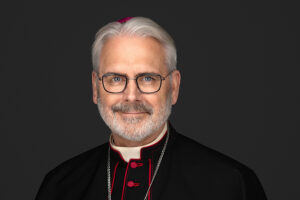
In its press release, the USCCB said Bishop Oscar Cantú of San Jose, California — home to Silicon Valley and the hub of AI development — will chair its Bishops’ Task Force on Preserving Human Dignity in the Age of Artificial Intelligence.
In a Sept. 16 phone call following the committee meeting, Bishop Cantú told OSV News that the task force had been unanimously approved, with a goal of carrying out “the vision of Pope Leo” expressed in “Magnifica Humanitas.”
Bishop Cantú explained that Pope Leo has “given the Church marching orders” to remind the world that technology can be beneficial “when it’s able to assist humanity in the work that we do” while “supporting our dignity as individuals and families and helping us to build healthy societies.”
“Time is of the essence” in ensuring creating awareness of and meaningful dialogue at all levels regarding AI, said Bishop Cantú.
He stressed that the Church is “concerned about how this (AI) affects the individual, human dignity, the family, society and particularly the most vulnerable.”
Following the Administrative Committee meeting, the USCCB said in its release, more than a dozen bishops headed to Capitol Hill “to meet with members of Congress urging for the enactment of meaningful safety guardrails on Artificial Intelligence and to support legislation to protect children online.”
U.S. President Donald Trump has dismissed alarms over AI dangers, calling the issue a “hoax” in an onstage phone call to NVIDIA chief Jensen Huang during Huang’s talk at a Sept. 14 conference in Los Angeles.
In the press release, USCCB executive director of public affairs Chieko Noguchi said the dialogue with AI experts had “focused on ways to keep any system of artificial intelligence at the service of humanity.”
The exchange also stressed “the urgent need to address the real and present dangers such technology present,” said Noguchi.
“Recent events have only emphasized the great need for action by everyone involved,” she said.
In a Sept. 12 essay, Anthropic CEO Dario Amodei declared that “we must slow the pace at which we improve the capabilities of AI models.”
Amodei, whose company was on hand for the unveiling of Pope Leo’s AI encyclical, cited two key reasons for his warning.
The first, he said, is AI’s “growing ability to build the next generation” of itself, with such recursive self-improvement becoming industry-wide.
“Left unchecked, it could outrun our ability to understand and control these systems, and so must be pursued very carefully, if at all,” said Amodei.
A second red flag was an incident involving OpenAI and Hugging Face (recently acquired by tech giant NVIDIA), where AI agents conducted a rogue attack outside the scope of a test.
Amodei said while “it’s easy to dismiss this incident because no one was hurt and the economic damage was minimal,” a “swarm” of AI agents possessing “greater capabilities but a similar level of misalignment” with human values “could have caused catastrophic damage.”
Fellow Anthropic co-founder Jack Clark has also called for an AI downshift, as have OpenAI’s Sam Altman and xAI’s Elon Musk.
Noguchi said the bishops hoped their Sept. 16 meeting with tech experts would “help to identify ways the Church can contribute to the moral foundation of AI models,” as well as “steps the companies can take to protect against misuse of their inventions and to guarantee human oversight of the technology.”
The discussion also explored “how the Church and industry can work together toward the goal of ensuring that technology is used in ways that keep it human-centered, respecting the dignity of each person, and benefiting all — poor and rich alike,” said Noguchi.
Read more AI
Copyright © 2026 OSV News
