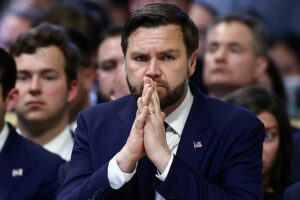
WASHINGTON (OSV News) — Vice President JD Vance’s new book, “Communion: Finding My Way Back to Faith,” is a story of several of his conversions: from Protestant Christian to atheist to Christian again as a Catholic; from Appalachia to Washington; from a vocal skeptic of President Donald Trump to his running mate.
Vance joined the Catholic Church in 2019 after receiving private instruction from Dominican priests in Ohio and Washington. He has repeatedly appealed to his Catholic faith during his vice presidency. At times he has also publicly set himself at odds with Church leaders, including the U.S. Conference of Catholic Bishops and Pope Leo XIV, especially on the issue of immigration.
In “Communion,” a 304-page sequel published by HarperCollins to his 2016 breakout bestseller “Hillbilly Elegy,” a memoir of growing up in his Appalachian family, Vance weaves his faith journey, beginning in his childhood, through his recent life changes and with his own policy and cultural views, ranging from immigration and abortion to U.S. birth rates and supporting young families.
Vance wrote that without connection to his Christian community at home during a deployment to Iraq as a U.S. Marine, he came to see himself as an atheist. But, he said, he came to feel a pull to belong to the communion of believers. He recounts parts of conversations with the priests who formed him, and shares observations of practicing the Catholic faith as a family.
His account of his faith journey, at times, seems to focus on his return to Christianity more broadly, with Catholicism presented as the variety he chose.
“I’m not a particularly sectarian person, and this is not a particularly sectarian book,” Vance said in the book’s opening chapter. Although he said he became Catholic for “what I believe are good reasons,” he credited his Protestant spiritual foundation as a key factor in his journey back to God.
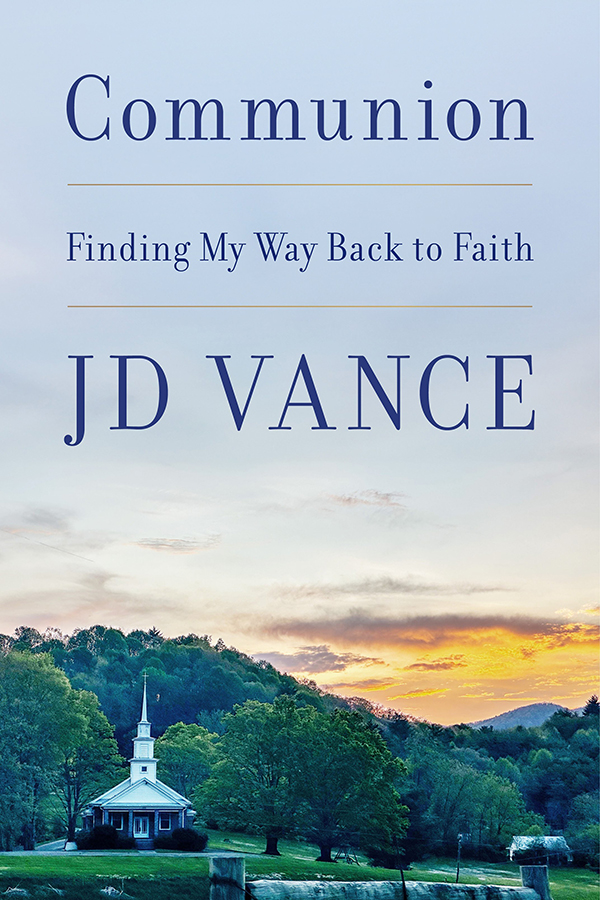
The cover art features the Mount Zion United Methodist Church in Elk Creek, Virginia, and a publisher’s note at the beginning of the book states that each Bible passage contained within is from the King James Version, a translation that comes out of the Protestant tradition.
Vance said during a June 16 interview on Fox & Friends as part of his book promotion, “That’s one of the things I love about the American church, is there are all of these different pathways to God.”
“Sometimes with snake handlers, sometimes with speaking in tongues, sometimes with a beautiful Catholic Mass — but I think all of these pathways really matter,” he said in that interview. “And they’re part of the reason why we do find our path to God.”
But explaining his conversion to Catholicism in “Communion,” Vance wrote, “Catholic teachings touched the part of my heart and mind that demanded I focus on the things that actually matter.”
“And for me, at least, Catholicism was the right home in which to do that,” he said.
Vance, who is widely expected to seek the Republican Party’s nomination for president in 2028, also discusses his faith journey in the context of his policy views.
In a notable chapter detailing his 2025 meeting with Pope Francis the day before the late pontiff’s death, Vance described their encounter as meaningful, contrasting it with the “vagueness” he said he experienced in discussions with unnamed Vatican diplomats on the subject of immigration.
“Here I was, the most senior Catholic in the United States government, and the Vatican seemed unwilling to move its moral guidance past the point of trite platitudes,” Vance wrote.
Vance, who elsewhere in the book says he favors low rates of migration and prioritizing immigrants he claims will more seamlessly assimilate in American society, also addressed the U.S. bishops’ November 2025 “special pastoral message on immigration,” in which they voiced “our concern here for immigrants.”
Vance acknowledged the statement was “widely viewed as a critique of our administration’s immigration policies,” but argued that the bishops’ message was “admirably measured. Or almost too measured.” He did not note that the U.S. bishops explicitly condemned “indiscriminate mass deportation” in that message.
“The immigration question, like so much of our politics and public life, calls out for engagement from the bishops and clergy,” Vance said.
The vice president also characterized himself as “one Christian statesman who would welcome an institutional faith less focused on platitudes and more focused on reality.” He argued in the book that “any application of moral principles in the real world requires a constant evaluation of trade-offs.”
“The Church’s invocation of the dignity of migrants forces deliberation over the moral trade-offs,” he said. “And one can believe those trade-offs result in favoring a strict migration policy without dehumanizing anyone.”
Although Vance said he pressed Church leaders from the Vatican for specifics on immigration policy and did not receive them, individual and groups of U.S. bishops have publicly expressed concern about and directly addressed multiple immigration-related policies, such as ensuring families of mixed immigration status are not separated, that sensitive locations — such as houses of worship, schools and hospitals — are protected from enforcement actions, and that those in detention have access to the sacraments and pastoral care, among others.
With the exception of differentiating the current pontiff from Pope Leo XIII as he quoted from his 1891 encyclical “Rerum Novarum” at length, and referencing his attendance at the papal inauguration Mass in May 2025, Vance does not otherwise mention Pope Leo XIV, the first U.S.-born pope.
Although the book contains source material as recent as April 2026, the same month Trump first publicly lashed out at Pope Leo over his opposition to the Iran war, the book does not address that controversy, nor Vance’s related comments about just war theory where he appeared to warn the pope to “be careful” about theology.
Elsewhere in the book, Vance apologized for a controversial remark he made while discussing low birth rates.
“One of the dumbest things I ever said came when I argued that ‘childless cat ladies’ across the Democrat Party were running our country into the ground,” Vance wrote, adding, “It was a boneheaded comment, intentionally (and successfully) provocative rather than illuminating.”
The birth rate, and having and raising a family, are frequent topics for Vance in the book. He described the death of conservative activist Charlie Kirk as a factor in the second couple’s decision to have a fourth baby.
On the topic of abortion, Vance stated, “Roe v. Wade’s demise has revealed the political unpopularity” of the pro-life position. He said abortion opponents must move forward “by reflecting Christian charity in the way we champion the unborn,” pointing to the work of pregnancy resource centers.
“We’ll need to elevate these Christian charities and the spirit of the people who fund and operate them, and we’ll need to make a better Christian argument about building the kind of culture and economy that can actually sustain young families and the life they bring into the world,” he wrote.
Over the course of the book, Vance at multiple points writes that his wife, Usha Vance, a Hindu, supported his journey to Catholicism. The book is dedicated to her.
read more books

Copyright © 2026 OSV News
