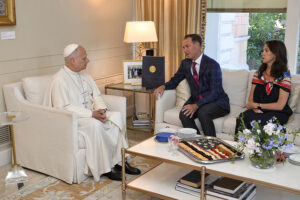
(OSV News) — Pope Leo XIV marked the United States’ 250th anniversary with a relaxed July 4 dinner at the Rome residence of U.S. Ambassador to the Holy See Brian Burch, offering a rare glimpse of the first U.S.-born pope in an informal setting.
According to Burch’s interview with La Stampa, the evening featured American favorites, including Chicago-style hot dogs, ribs and blueberry pie, along with conversations about Chicago, baseball and the World Cup.
The Fourth of July “seemed like a unique opportunity to host him, since he would be in Rome, and to welcome him to the residence,” Burch said, adding that the dinner was scheduled the previous month.
The pope arrived around 7:30 p.m. to the historic villa that since the late 1940s has served as the residence for 18 American ambassadors and is protected by Italian law for cultural heritage.
Apple pie, sparklers and Chicago memories
“We took a photo with the family, he blessed some religious objects for us, and then we had an aperitif. There was a charcuterie board arranged in the shape of the American flag, and he sampled some of it,” Burch said, saying that the conversation spanned from Chicago roots to World Cup emotions. “Then we had a very American dinner: watermelon salad, beef ribs, and Chicago-style hot dogs,” the ambassador said.
“At one point during the dinner, the pope commented that it had a great selection of dishes. I don’t know if it was just out of politeness or not, but he ate everything, and it was truly a lot,” Burch said, listing apple pie, ice cream and blueberry pie as the desserts.
After dinner, the ambassador met privately with the Holy Father, who had returned that day from the Italian island of Lampedusa, where he had met and comforted migrants who made the perilous boat journey by sea to Europe, and remembered those who lost their lives on the treacherous trip.
Then the pope and the ambassador joined others outside, where the children held sparklers, and they sang “God Bless America,” Burch said. The pope also signed baseballs.
“It was his idea to date them, which was very significant — a unique number, I think, 7-4-26, the 250th anniversary. And then he left around 10 p.m.,” the ambassador said, adding that the pope was “extraordinarily kind to our family. The atmosphere was very relaxed, and we laughed about many things.”
“I think that sometimes, both in the Church and on the broader world stage, there is this perception of the pope that makes us forget that the pope is a man, like all of us,” Burch said. “He joked about sports and the White Sox, who are his hometown team; we are from Chicago, so we talked about it.”
They also talked about the World Cup, this year organized in the U.S., Canada and Mexico.
“He told me he hadn’t been able to sleep recently; he woke up and watched the Argentina-Cape Verde game, the score was tied, and he couldn’t get back to sleep because he wanted to see how it would end,” Burch told La Stampa. “This is a pope who uses his smartphone, checks World Cup results in the middle of the night, and is interested in baseball.”
A truly American pope
Calling Pope Leo “very American” the U.S. ambassador to the Holy See said the pope’s roots are visible “in his character, in his history, in his memories, in his family.”
But at the same time, Burch said that while he “loves the United States” and “has a deep and still living love for his homeland,” Pope Leo “wants to be careful not to appear too favorable or too aligned with the United States,” and “truly wants to faithfully live out his role as pope for the world, as supreme pontiff of the Church.”
Burch added: “This is very different from any other pope who has ever been here: He understands us intuitively, and this, I believe, creates a real moment, an extraordinary moment of opportunity. In his letter to the United States, he specifically praised the sacrifices Americans have made for Europe, including that of his father, who was a hero in World War II.”
The pope and the president
Despite President Donald Trump’s direct attacks on Pope Leo on the eve of his Africa apostolic journey, Burch said, “the most important aspect” of the July 4 dinner was that it “was never intended as a forum to resolve profound political issues.”
“The best way to describe it is as an extraordinary gesture of affinity and warm closeness to the United States. This closeness … was manifested in the acceptance of the invitation and in the entire tone of the evening,” he said.
Asked by journalist Giacomo Galeazzi whether Trump and Pope Leo could still cooperate, the ambassador said, “They’re already doing so in dozens of scenarios.”
“The pope’s relationship with the United States and with the president has been exploited as if it were a massive conflict,” Burch said, explaining that “the Holy Father plays two roles” — he is the head of the Catholic Church but also the head of the Holy See — and “is therefore a sovereign leader who interacts with the world as such.”
“I think one of the challenges related to criticism of the pope, or the president’s criticism of the pope, has been: ‘How dare you criticize the pope?’ when they portray him as the head of the Catholic Church who simply preaches the Gospel; but the pope has this other role as a sovereign leader that we respect,” he said.
Burch said in his July 7 interview that “President Trump has a particular way of relating to foreign leaders; it’s not as if the pope is the only one he feels frustrated with when it comes to certain aspects of our Iran policy.”
Asked by Galeazzi, “Are Prevost and Trump incompatible?” the ambassador replied: “I think the pope’s brother put it best: They have much more in common than people realize, particularly in their personalities and leadership styles.”
“I think that’s precisely why Americans elected President Trump; I think it’s why the cardinals chose Robert Prevost as their leader. They saw him as someone capable of addressing these thorny issues and engaging with them concretely, rather than simply avoiding conflict,” the ambassador said.
“There are many Catholics throughout the administration,” Burch added, and “there will always be disagreements, particularly over how to reconcile U.S. policy with Catholic social doctrine, but I think having an American pope creates an extraordinary opportunity for the Vatican, which can have a unique appreciation and understanding, and he certainly does.”
Trip to the U.S. ‘at the right time’
Asked about the possibility of Pope Leo visiting the United States, Burch said, “I think there’s some hesitation about going to the United States immediately, not because of hostility toward the president, but because he wants to do it at the right time” and “after a series of other apostolic journeys that demonstrate the broader universal principle regarding his role in the world.”
Burch said the pope expressed “his frustration” during the July 4 conversation with “the way he’s being portrayed: Everything he does is seen as a kind of direct attack, criticism or attention-grabbing of the United States. Whether it’s his homilies in Africa or even his trip to Lampedusa, which we discussed specifically. He told me that it wasn’t his intention for this to be an attack on the United States.”
Asked about contradictory approaches of the Holy See and the United States toward migrants, Burch said that such is the “role as a shepherd of the world,” which “serves to highlight the challenge of migration globally.”
Hence, the pope reiterates “his call on humanity and leaders to focus attention on the plight of migrants in the midst of this difficult moment we are living in, where migrants are fleeing from places hostile to their survival,” but at the same time the ambassador said he thought Pope Leo “has a deep desire for greater cooperation with the United States.”
A common thread
Reflecting on where the U.S. and the Holy See can meet in their policies, Burch said that “the U.S. wants Iran to be free of nuclear weapons,” and the Holy See at the same time “wants no one to possess nuclear weapons and is firmly in favor of nuclear nonproliferation.” He named support of Christians in the Middle East, and peace between Russia and Ukraine as issues common to the two states.
Burch expressed his hopes that management of migration could also become a meeting point between the U.S. and the Vatican.
“This process must respect both the dignity of migrants and the right of a nation to enforce its laws and protect its people. I believe the Holy Father respects this balance,” Burch said. “He understands that there is often a tension between these two aspects, and that resolving this tension is largely the responsibility of the country’s sovereign.”
Meeting reporters outside his villa in Castel Gandolfo Nov. 18, 2025, Pope Leo said, “No one has said that the United States should have open borders,” adding: “I think every country has a right to determine who and how and when people enter.”
However, immigration policy should “look for ways of treating people humanely, treating people with the dignity that they have.”
“If people are in the United States illegally, there are ways to treat that,” he said at the time when raids by Immigration and Customs Enforcement became a No. 1 concern throughout the U.S.
At the same time, “When people are living good lives — and many of them (in the United States) for 10, 15, 20 years — to treat them in a way that is extremely disrespectful, to say the least,” is not acceptable, the pope said.
While “there are clearly differences of opinion” on how best to achieve various policy goals, Burch said that “broadly speaking, the pope has deep respect for our country and, where our differences remain, desires greater cooperation.”
read more america 250

Copyright © 2026 OSV News
