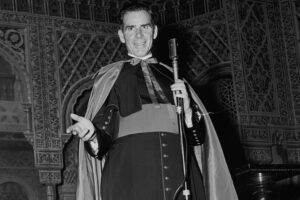
Venerable Fulton J. Sheen is remembered as one of the most influential and innovative evangelists in American history. Once dubbed “God’s microphone,” Archbishop Sheen announced God’s truth in a nonconfrontational, yet no less life-giving, manner to untold millions through radio, print and television.
Born in El Paso, Ill., on May 8, 1895, Archbishop Sheen resolved to serve the Church as a priest from an early age. Known to always have “his nose in a book,” Archbishop Sheen fittingly was assigned to academic ministry following his ordination to the priesthood on Sept. 20, 1919, for the Diocese of Peoria. A philosopher at heart, Archbishop Sheen said his goals for his priesthood were “to know two things: what the world is thinking about, and how to answer errors in the light of the philosophy of St. Thomas (Aquinas).”
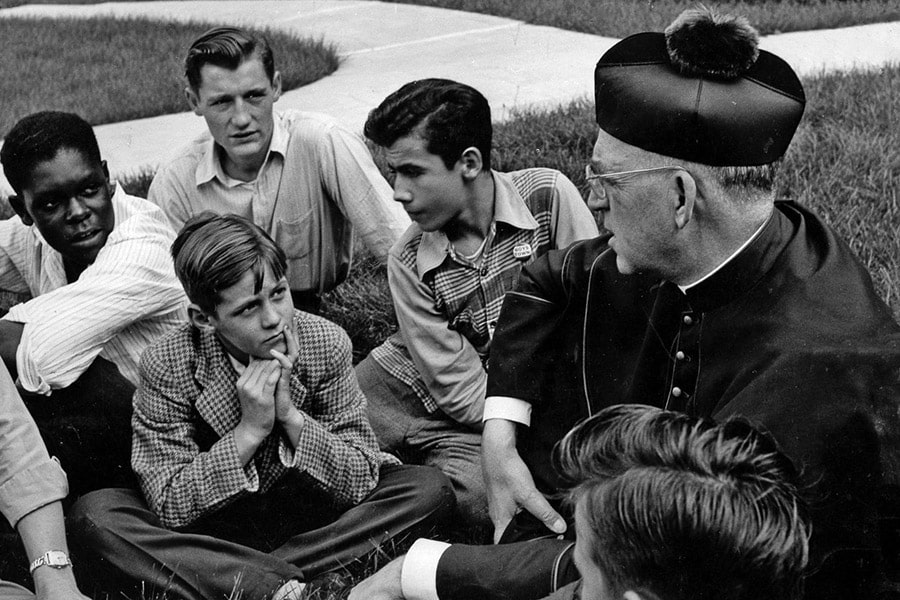
After he pursued studies in Europe, a promising future awaited him as a professor. He was called back home to Peoria, however, for service as an assistant priest at a poor, inner-city parish — a true test of his obedience. Archbishop Sheen threw himself into the work, exhibiting an extraordinary zeal for souls. As part of his parish ministry, he launched a door-to-door evangelization campaign.
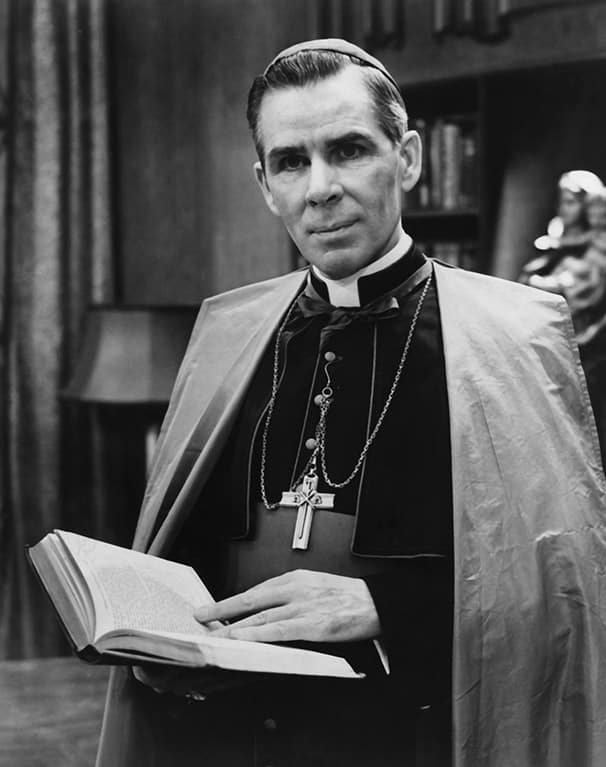
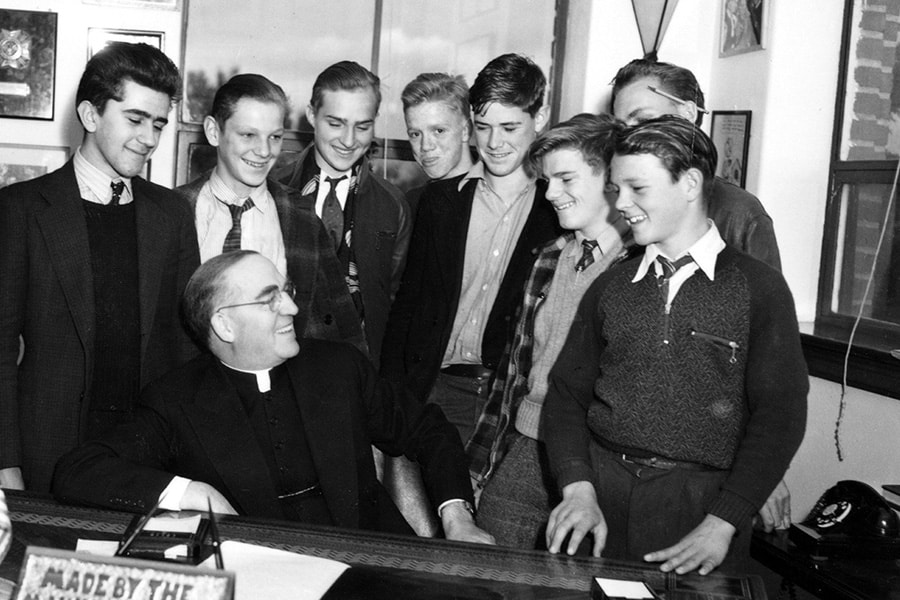
In less than a year, Archbishop Sheen landed a professorship at The Catholic University of America in Washington, which he held for 25 years. He quickly became one of the most popular professors on campus, known for his engaging and stimulating lectures. During that time, he authored more than half of his nearly 70 books.
Archbishop Sheen’s oratory prowess was successful, in part, because of his commitment to using no notes. His command of material came after hours of preparation and memorization.
During the 1930s and ’40s, Archbishop Sheen became a household name as host of “The Catholic Hour,” broadcast nationally from NBC Radio in New York. He emerged as a national voice — a prophetic truth-teller who spoke out on a host of issues, particularly the threats posed by Communism. For that, he even came under investigation by the FBI.
After his appointment as director of the Society for the Propagation of the Faith in 1950, Archbishop Sheen had to give up his work as a professor and move to New York City. The next year, he was appointed an auxiliary bishop of New York, ordained in Rome on June 11, 1951. Archbishop Sheen began his work on behalf of the global missions with great energy, and his innovative efforts enabled him to evangelize at the same time.
On Tuesday evenings from 1952 to 1957, Archbishop Sheen propagated eternal truths to an estimated audience of 30 million via his “Life Is Worth Living” television program. With apparent ease and captivating eloquence, he helped viewers find the meaning of life and drew them toward the divine — always equipped with his famous cape and chalkboard.
In addition, Archbishop Sheen made millions of dollars in advertising — all of which (along with the profits from his books) directly supported the missions. He spent an hour in preparation for each of his 30 minutes on the air. As in the classroom, he refused to use notes; instead, he practiced scripts in Italian and French to assure his mastery of the subject matter in preparation for his televised lessons. After his first year on the air, Archbishop Sheen won an Emmy for best television personality. Upon acceptance, he famously thanked his writers: Matthew, Mark, Luke and John.
Archbishop Sheen’s writings and preaching were inspired by a lively and heroic faith. When he traveled the globe visiting the missions, he drew massive crowds. He was a much sought-after preacher — particularly legendary were his Good Friday sermons at a packed St. Patrick’s Cathedral in New York City.
As a pastor of souls, Archbishop Sheen’s selfless ministry was marked by great faith, hope and charity. He was an attentive pastor to greatest and least alike. A rare combination of intelligence, wit and humor made him an effective evangelist. And with clear teaching and common sense, Archbishop Sheen helped people make sense of life’s problems. His media efforts helped erase widespread anti-Catholicism in America.
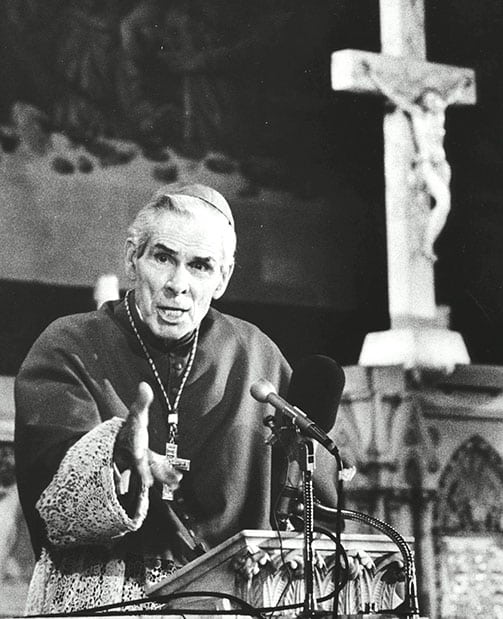
In all that he said and did, Archbishop Sheen remembered his work was the Lord’s. Once asked by Pope Pius XII how many converts he assisted, Archbishop Sheen replied, “I am always afraid if I did count them, I might think I made them, instead of the Lord.”
Like St. Paul, Archbishop Sheen could not pass on what he did not already first receive in Christ. Throughout his priesthood, he sought to conform himself more closely to Christ by observing a daily Eucharistic Holy Hour, what he called “the hour that makes my day.” The practice brought him into a variety of circumstances, some even comical, such as when he was forced into jumping out of a window after the pastor of a Chicago church accidentally locked him in. He also was intensely devoted to the Mother of God.
Archbishop Sheen battled various temptations and difficulties throughout his life, many of which came as the result of his fame. This included the hidden suffering from a decade of hostility from Cardinal Francis Spellman of New York. But in the face of his troubles, Archbishop Sheen persevered in virtue. He understood his sufferings in light of God’s providence: “Christianity begins not with sunshine, but with defeat. During those days when my life was backed up against the Cross, I began to know and to love it more.”
In what would be his last Good Friday sermon, Archbishop Sheen said: “There has been physical suffering. And other kinds … but as I look back over the years, I have never received the punishment I deserved. God has been easy with me. He has never laid on me burdens equal to my faith.”
Given his talents and reach, many expected Archbishop Sheen to become a cardinal. After his retirement, when asked why he did not rise higher in the Church hierarchy, he said: “I refused to pay the price. … I felt it would be disloyalty to my own principles, and I think to Christian practice.”
From 1966 to 1969, Archbishop Sheen served as bishop of Rochester, New York. It was a brief tenure, regarded by many as an exile. Archbishop Sheen had been an active participant at the Second Vatican Council and as a diocesan bishop worked to implement some of its main themes, including reform of priestly formation and increase in lay participation.
Attentive to the times, his priorities often were rooted in social consciousness. He ministered to the poor, worked to improve race relations, and was a vocal opponent of the Vietnam War. But despite Archbishop Sheen’s best efforts, his brief tenure there was met with great resistance and resulted in a good deal of self-described failure.
After his request for early retirement was accepted in 1969, Archbishop Sheen was granted the title “archbishop” by St. Paul VI. He continued preaching far and wide in his last decade, delivered retreats aimed at renewal of the priesthood throughout the country, and maintained a voice in the public square through regular media appearances.
The temptations and sufferings Archbishop Sheen faced purified him and intensified his union with Christ, he maintained. Toward the end of his life, writing in his autobiography, Archbishop Sheen apologized for his failures, wondering, “Was I inspiring anyone to imitate Christ in the daily carrying of his Cross?”
Two months before Archbishop Sheen died, St. John Paul II embraced him during a visit to St. Patrick’s Cathedral in New York City and said: “You have written and spoken well of the Lord Jesus. You are a loyal son of the Church.”
After nearly two years in and out of the hospital following open-heart surgery, Archbishop Sheen died at the age of 85 on Dec. 9, 1979, in New York City, in the presence of the Blessed Sacrament. His devotees have multiplied in number after his death, and many have turned to him for inspiration and intercession. In 2002, a cause of canonization was opened. Archbishop Sheen was declared venerable a decade later.
Archbishop Sheen’s cause has experienced setbacks on account of two controversies, including a public battle to relocate his remains from St. Patrick’s Cathedral in New York to the Cathedral of St. Mary of the Immaculate Conception in Peoria, as well as concerns — ultimately unfounded — related to management of the clergy sexual abuse crisis from his time as bishop of Rochester. The Holy See requested the “postponement” of Archbishop Sheen’s beatification, without explanation, just weeks before the event which was scheduled for December 2019.
On Feb. 9, 2026, Bishop Louis Tylka of Peoria announced that the cause for the revered archbishop had been approved to proceed to beatification, and he is working with the Dicastery of the Causes of Saints at the Vatican to determine details. The date and event details are expected to be released soon at celebratesheen.com.
Read More Saints
Copyright © 2026 OSV News
