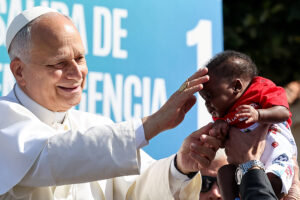
(OSV News) — The world must no longer look at the plight of migrants, especially children, as a problem to be managed or quantified, but as a call to protect human rights and dignity, Pope Leo XIV said.
“Minors are the most vulnerable group within the global movements of migration. They are concrete faces, who have unique stories, and call on our conscience,” the pope wrote in his message for the Sept. 27 celebration of the World Day of Migrants and Refugees.
“We cannot remain indifferent, nor can we become accustomed to such suffering,” he wrote.
Pope Leo’s message, which focused on the theme, “Even just one of these children,” was released by the Vatican Aug. 14.
In his message, the pope lamented the increasing number of children and adolescents forced to flee their homes due to “war, poverty, violence, environmental disasters and other tragedies.”
The suffering of migrant children, Pope Leo noted, doesn’t end with their relocation, as the majority have endured the loss of family and friends due to violence or separation and are often “exposed to extreme and traumatic conditions.”
“To this already appalling situation are added further tragedies: deaths along migration routes, trafficking and exploitation, the recruitment of minors for use in armed conflicts, sexual violence, forced marriages, and the atrocities they have suffered or witnessed during their travels. Their dignity is trampled upon in countless ways,” the pope wrote.
According to UNHCR, the U.N. refugee agency, an estimated 45 million children were among the people forcibly displaced worldwide at the end of 2025. Forced displacement can result from “persecution, conflict, violence, human rights violations or events seriously disturbing public order,” UNHCR states.
Citing UNHCR data, UNICEF USA said on June 17, 2026, that “while children represent 29 percent of the global population, they comprise 38 percent of the total 117.8 million forcibly displaced people in the world.”
In his message, the pope also praised the witness of individuals, families, institutions and ecclesial communities who bring the “light of solidarity” amid the darkness experienced by child migrants.
Their commitment, he added, shows “that love can overcome indifference.”
Noting that migrant children are “more easily ignored,” especially because they lack adults who can protect and support them, Pope Leo called on their countries of origin to “remove the causes that compel them to flee” while also calling on countries of destination to offer protection and welcome.
“The cry of displaced children rises to God today, just as did the cry heard in the Book of Exodus: ‘I have observed the misery of my people who are in Egypt; I have heard their cry on account of their taskmasters. Indeed, I know their sufferings, and I have come down to deliver them,'” he wrote.
“God hears their cry and, in order to bring about liberation, he forcefully appeals to the conscience and action of each one of us, just as he did with Moses,” the pope added.
The pope also called on society to see the reality of displaced children and young people and to overcome “that detachment which reduces the human person to a statistic that does not directly concern us.”
For Christians, migrant children serve as a call to “transform welcoming from an abstract concept into a stable pastoral practice.”
“We cannot simply delegate this task to institutes or associations endowed with a particular charism,” the pope wrote. “Before the concrete faces that confront us in daily life, the entire Christian community is called to regard these children as its own sons and daughters, and to engage with the concrete story of each one of them.”
For other faiths and religious traditions, he continued, creating supportive environments for migrant children and youth can become “fertile ground for a concrete interreligious dialogue” and decrease the risk of those who wish to take advantage of their vulnerability.
“Faith communities are called to create spaces in which every boy and every girl is respected and valued in his or her own cultural identity, thereby preventing the risk of radicalization by extremist groups. Ultimately, to protect a child is to safeguard the divine image imprinted within him or her,” he wrote.
Pope Leo also called on civil institutions to prioritize the protection of every child and adolescent’s dignity and the “prevention of the trauma caused by separation.”
“An urgent change of perspective is needed: the focus of the debate must shift from the mere management of migration to the full and immediate protection of human rights,” the pope wrote.
Read More Vatican News
Copyright © 2026 OSV News
