Living in downtown Baltimore, I daily witness the fulfillment of the Lord’s words, “The poor you will always have with you …” (Mt 26:11). Every night, people are sleeping on sidewalks, in front of the central branch of the Pratt Library, in the alley between the Basilica of the National Shrine of the Assumption of the Blessed Virgin Mary and My Sisters’ Place, and sometimes on my doorstep. Daily I encounter the poor, but do I love them as Christ loves them?
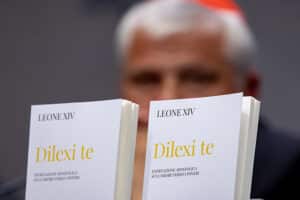
In his first exhortation, “Dilexi Te” (“I Have Loved You”), Pope Leo XIV wrote movingly of Christ’s love for the poor and of our calling as Catholics also to love and serve the poor. His exhortation hit home personally. He challenges me and you to set aside the logic of the world that sees the poor as a problem to be solved or as a danger or a nuisance and instead embrace “the logic of the Kingdom of God” that sees and cherishes “the divine within” those most in need. I encourage you to read his exhortation. In the meantime, let me share with you a few points I’ve been reflecting on.
First, Pope Leo shows us how Jesus identified with the poor and marginalized. St. Paul tells us that Christ, “though rich, became poor for our sake so that we might be filled with spiritual riches” (cf. 2 Cor 8:9). From the Gospels we learn that Jesus had nowhere to lay his head (cf. Mt 8:20). When Jesus said, “Blessed are the poor” (Lk 6:20), he was revealing himself to us. Christ taught that whatever we do for those in need, we are doing for him (cf. Mt 25). Indeed, God’s preferential love for the poor is inscribed in the pages of Scripture. One could even say that “ignorance of the poor is ignorance of Christ.”
Second, Pope Leo also demonstrates how ancient Christian writers and founders of religious communities firmly linked the profession of faith and eucharistic worship to care for the poor. One cannot worthily enter into the sacrifice of Christ while ignoring those in need. To unite ourselves worthily with the eucharistic Lord, we must also love him in the poor. Before I celebrate Mass, I must ask myself if I have loved the poor – not just in theory, but in practice.
Third, Pope Leo speaks of the many faces of poverty: the abject poverty of those lacking life’s necessities; the poverty of the immigrant; the poverty of the outcast; the spiritual poverty of those who have enough material possessions but are spiritually impoverished. These and other forms of poverty are all around us and have a claim on our consciences, mine and yours.
Fourth, Pope Leo reminds us that love for the poor means respecting their dignity and individuality. They are persons made in God’s image and are precious in God’s eyes. They have a name, a face, a history and destiny. To love the poor means encountering them and listening to their stories. I am inspired by the attentiveness of the Sisters Poor of Jesus Christ and the Source of All Hope Missionaries to the homeless in downtown Baltimore. I see the same personal care and attention among those who provide services in Catholic Charities of Baltimore. It is the same attentiveness I must have when I encounter the poor while rushing to the office or departing for a parish Mass.
One last point: Loving the poor is not a one-way street. When we encounter the poor, we meet Jesus. He reveals himself in the faces of the poor, the homeless, the addicted. Mother Teresa often spoke of “Jesus in his distressing disguises.” Helping the poor doesn’t just make us feel better about ourselves. It is a path to holiness and joy in the Holy Spirit.
Read More Commentary

Copyright © 2025 Catholic Review Media
