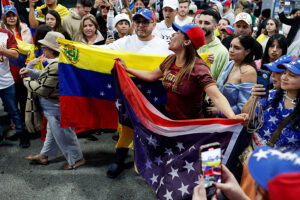
WEST PALM BEACH, Fla. (OSV News) — Years from now a question likely to still circulate among the Venezuelan diaspora in Florida will be: Where were you when you first learned of the apprehension and arrest of Venezuela’s swaggering dictator?
It’s a moment many displaced Venezuelans in the U.S. and other countries in the Western Hemisphere have been dreaming about for years, and it arrived in the early morning of Jan. 3, beginning about 2 a.m. local time.
President Donald Trump was in his home in Palm Beach that weekend when he gave the green light to a military raid that snatched the Venezuelan President Nicolás Maduro and his wife from their Caracas residence and deposited them both in a New York City jail cell. The two have pleaded not guilty to various charges stemming from drug trafficking, terrorism and corruption.
In Miami, newly ordained Deacon Gustavo Adolfo Roversi and his family were together that first weekend of January when they heard the news.
A native of Valencia, Venezuela, Deacon Roversi went to college at the University of Kansas in the 1980s before returning to South America to help run the family paper products manufacturing business. They later expanded the business to Florida in the late 1990s when they saw the social revolution being rolled out under Hugo Chavez in part owing to popular dissatisfaction with political corruption in those years.
“It turned out to be a good decision because when Chavez took over the whole country started to decline and decline,” Deacon Roversit told OSV News.
Chavez was president of Venezuela, serving from 1999 until his death in 2013, which is when Maduro came to power.
“I always went back home at least four or five times a year,” the permanent deacon said, “but it went from bad to worse year after year — you could see it in the inflation — what I used to pay for my monthly apartment mortgage in the 1980s could not even buy one cup of coffee for that same amount years later. I think it was the highest inflation rate ever recorded on Earth.”
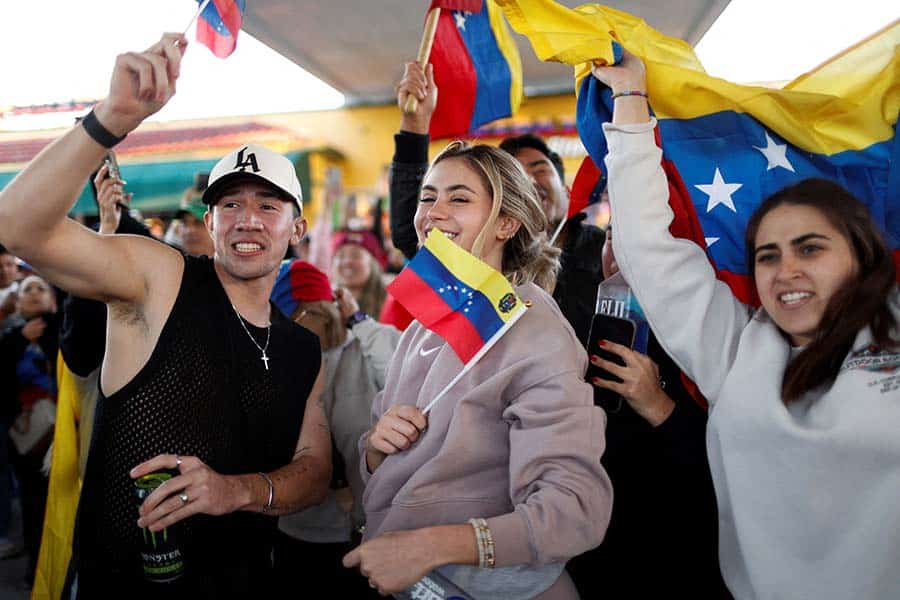
Deacon Roversi said that while he can’t speak for the entire South Florida Venezuelan community, most seem elated at the turn of events, he said, and hopeful for a better future.
He added that he has “personal friends who were thrown into jail, who were tortured, who saw their businesses torn apart, and those things do happen.”
The electorate in Venezuela now must also be ready to learn some lessons of the past about political corruption on the one hand and the false promises of socialism on the other.
“We still have family and friends there and we have been touched by this regime in several ways and we feel there is confidence right now that things are going to be better. The whole latin american and Venezuelans in particular are pro U.S.,” he said. “What comes next depends on what we have learned from our mistakes.”
The ongoing emigration of millions of Venezuelans from their native country is the largest recorded refugee crisis in the Americas. According to The Associated Press, about 8 million people have fled the country since 2014.
The Miami suburb of Doral, population about 80,000, has been nicknamed “Little Venezuela,” or “Doralzuela,” because of its large Venezuelan population, and many prayed at Our Lady of Guadalupe Church for the future of their native country during Mass Jan. 4.
According to news reports, their Venezuelan-born pastor, Father Israel Mago, told worshippers to pray for “a fair and peaceful transition in Venezuela, so peace and justice can reign.”
Mariela Castillo is an Orlando resident who fled Venezuela with her family in 2014 when the economic and social collapse there made it too difficult to acquire needed diabetes medications.
“I was in bed at 1:30 a.m. when my mom in Jupiter, Florida, called me,” she told OSV News. “I thought something was wrong at first because she was crying and screaming that Maduro was no longer in Venezuela.”
“We were living in the heart of the port city of Mariacobo and saw a lot of disasters happening as the army took to the streets and closed avenues, closed universities, there was no food,” Castillo recalled. “My mother decided to come to the USA because we had family in Jupiter, Fla., and they invited us to come and see if we like it.”
“The transition to coming here was a little rough,” she said. “Obviously we were leaving behind Venezuela in the worst moments; it was pretty bad.”
Arriving with no English comprehension, the now-married young adult said she slowly learned English by working in Florida restaurants until she married and went to work assisting her husband in his business in central Florida.
Castillo said she and her family support the United States’ audacious if not controversial capture of Maduro, but that it is hard to know how all the events will unfold in the coming months and years.
The remaining government in power, headed by Maduro’s Vice President Delcy Rodriguez, who was sworn in as the country’s interim president Jan. 5, has declared a state of emergency banning any celebration of the U.S. military operation. Meanwhile, the media reports that roving gangs of pro-Maduro thugs are intimidating citizens amid a tense repression of the local press.
“It is hard to understand all these (developments), but for us this a plus, while others are wondering about the oil, or what President Donald Trump will be doing. What we are celebrating is being free of having a president who didn’t know how to run a country, coming from (Venezuelan President Hugo) Chavez to something worse — Chavez was at least a little bit smarter,” Castillo said.
“We have that hope that it will get better but it will take time and obviously nothing will be perfect right now,” she added.
In Fort Myers, Luis Aparcedo, a businessman who came to the U.S. with his family when he was 10 years old, said he is “still in shock to be honest,” regarding the U.S. strike on Venezuela and removal of Maduro. Aparcedo has not traveled to Venezuela since 2014.
“We were all waiting for this to happen but had doubts, and thoughts that (regime change) was all talk — and then it happened,” he told OS News. “It is good news for us; I am happy. I know the regime and persecution is still going on but this is a huge step forward.”
Aparcedo said virtually everyone he knows from the Venezuelan community is celebrating, but the majority also remain confused and anxious about what is going to happen now and what the transition will look like.
Meanwhile, Aparcedo said he is patiently waiting for a time when he feels safe enough to visit Venezuela — possibly in six months, maybe a year or even more.
“I am no expert but the new interim president will probably try to wait it out until Trump leaves office. The smart thing right now might be a soft transition, a slow transition until they work everything out,” he said.
“And I think the U.S. will negotiate with them. The U.S. is stopping the oil going to Cuba, Russia, China so that will also be beneficial for the U.S. and for Western Hemisphere. We are all waiting for a time again to at least visit. It has been scary with these people — you don’t know if they will arrest you for whatever reason. I want to go there (Venezuela) so bad.”
Read More Conflict in the Caribbean
Copyright © 2026 OSV News
