
Before Maryland Lt. Gov. Aruna Miller took the stage Feb. 20 at St. Frances Academy in Baltimore, Deacon B. Curtis Turner, head of school, admitted to the student body and gathered guests that his entire opening remarks were generated by ChatGPT.
“It’s the first time I’ve ever done anything like this,” Deacon Turner said. “What is remarkable to me is that AI knew enough about us to even generate the way we uniquely end our prayers.”
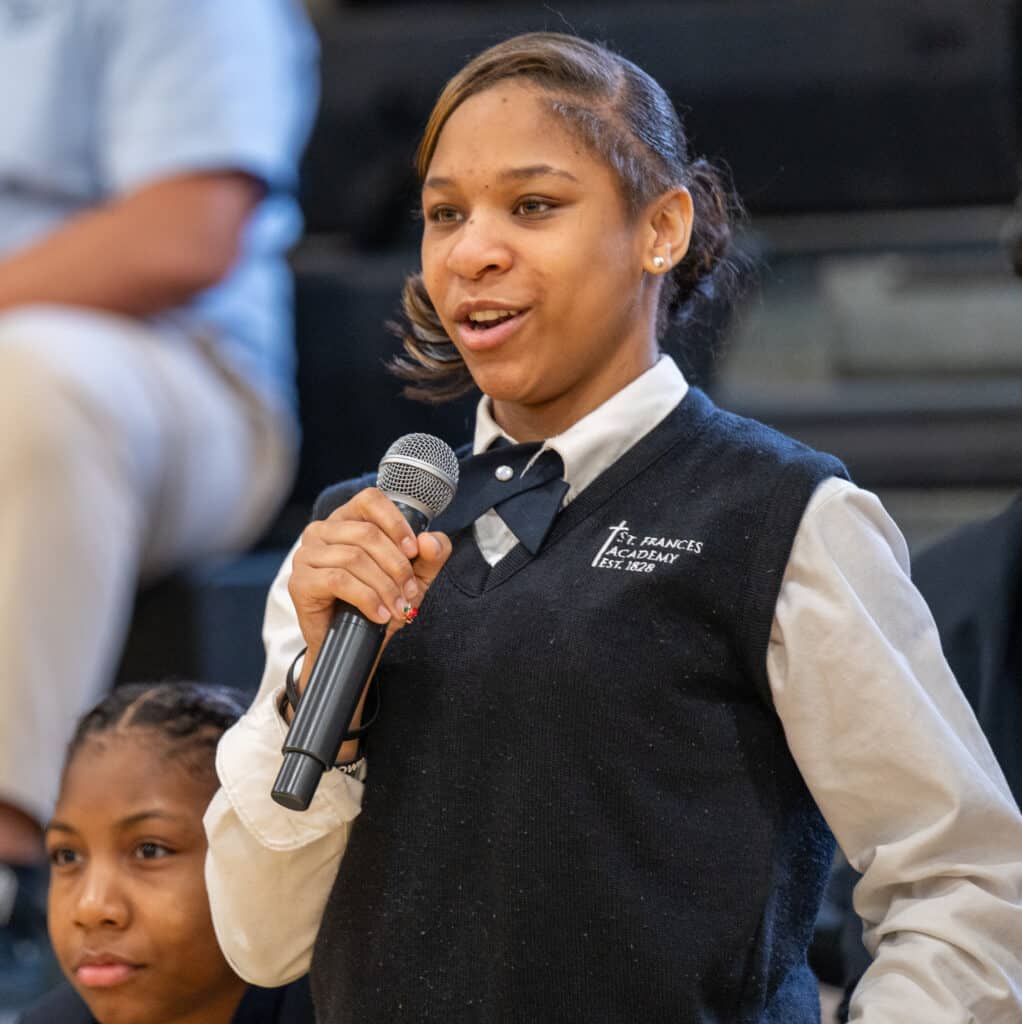
The school always ends its prayers with “Mother Mary Lange, pray for us and Jesus in our hearts forever,” he explained, and “somehow the artificial intelligence knew that about our prayers.”
“The question before us is not what we can do – I discovered that myself – but more importantly, what we will do with it?” Deacon Turner said.
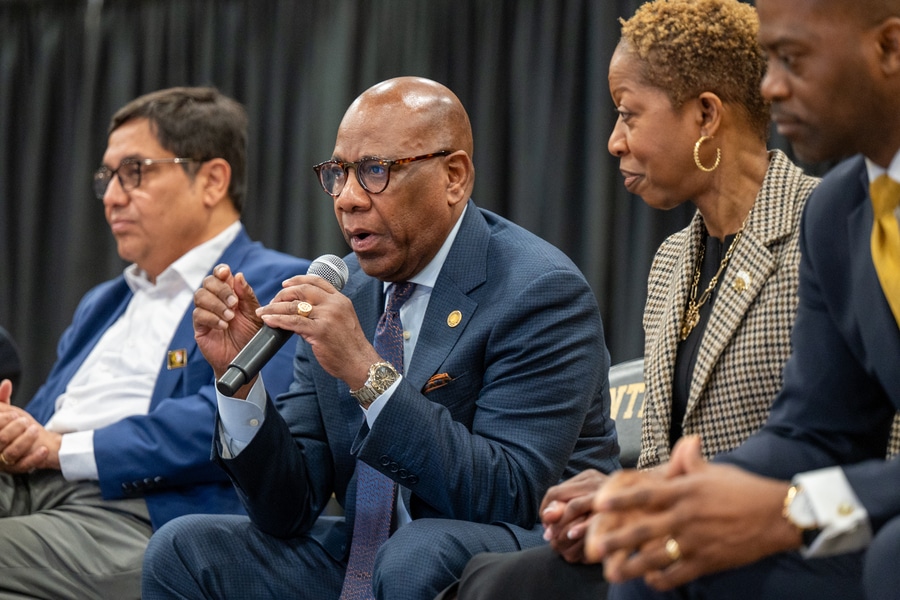
To answer that question, the school hosted Maryland’s “AI Future: Education, Equity and the Emerging Workforce” students’ town hall event with Miller and a panel of college presidents including Valerie Sheares Ashby, president of University of Maryland, Baltimore County (UMBC); Anthony L. Jenkins, president of Coppin State University in Baltimore; Dr. David Wilson, president of Morgan State University in Baltimore; Anupam Joshi, provost and chief AI officer for UMBC; and Sanjay Rai, secretary of higher education for the state of Maryland.
John D’Adamo, president of Educational Vitality Partners, a consulting service, led the discussion, which started with comments from Miller followed by questions from students and comments from the panel.
“Your voice matters,” D’Adamo emphasized to the students at the start. “What you share today will directly inform how Maryland helps to shape its AI application strategy. You have powerful people in the room who are eager to listen to you and the questions that you have to ask.”
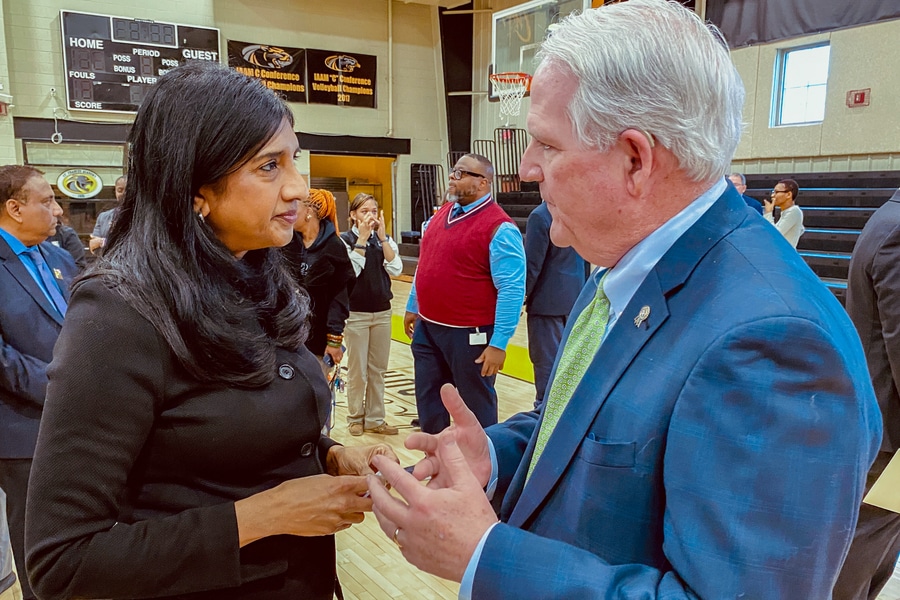
While AI has been around for decades, “It’s moving faster and reaching farther than ever before” and crossing over into everyday life, said Miller, a Montgomery County Democrat. Its impact, she said, is underestimated, as it touches everything from economies to security measures and detecting diseases. The rules, she said, are changing, and the question is “who’s going to write those rules?”
“The answer is you,” Miller told the students. “Because this isn’t just about technology, it’s about responsibility. It’s about judgment. It’s about values and ethics. (In) the age of artificial intelligence, the most important operating system is still the human conscience.”
Students asked Miller and the panel about AI’s effect on the environment, how it was being used in public agencies and what the standards for AI were. Students also expressed concerns about AI’s impact on integrity and what its limits and values were.
“I learned a lot from this – how AI can help and hinder us,” Zyron Bell, 18, a senior, said afterward. “If we know how to use it right … it looks like AI is heading in the right direction for us.”
Gregory Farno, chancellor of Catholic schools in the Archdiocese of Baltimore, said afterward that “we are all learning what the rules ought to be for AI” and was impressed with the students and Miller.
“What was the most enjoyable was when you see the students get up in front of all their peers and ask really good questions about AI,” Farno said. “I’m just glad they didn’t ask me.”
Toward the end of her talk, Miller admitted with a smile that she had used “a lot of tech talk” and could see some of the students “dozing off.” She then issued a challenge to each of them.
“Use AI to check your work. Use it to ask better questions. Use it to learn, but never use it to replace your own efforts,” she said, emphasizing that it was always better to take the long road than shortcuts.
“The level of depth of their questions regarding AI made me feel really confident that they know exactly what’s ahead of them and they just need some guidance on how to navigate this new future,” Miller said afterward.
The students at St Frances, she said, also have faith “as a central part of their lives.”
“That is what is going to guide them as we go through this new phase of AI. We need ethics. We need compassion. We need empathy. And they have that. They are already being taught all of that at St. Frances Academy,” Miller said. “They’re going to do great.”
Email Katie V. Jones at kjones@CatholicReview.org
Also see



Copyright © 2026 Catholic Review Media
