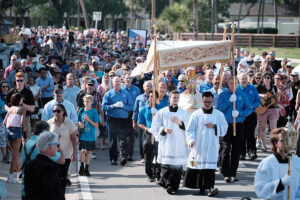
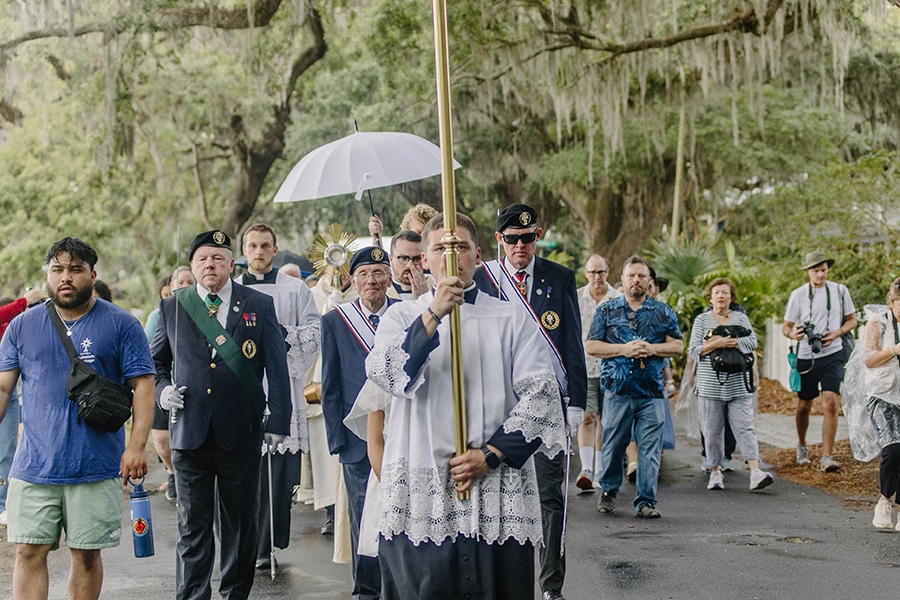
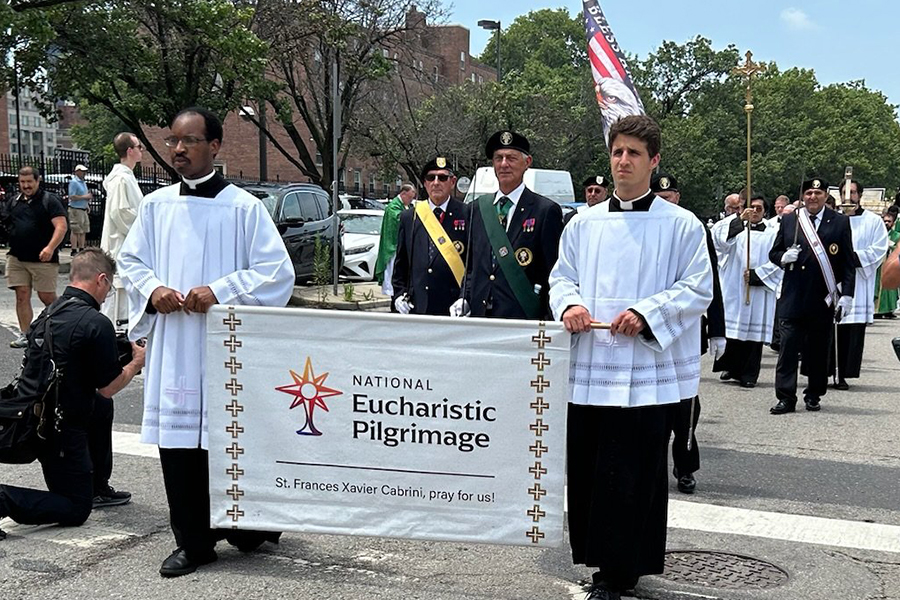
(OSV News) — After a Pentecost launch, the National Eucharistic Pilgrimage is marking its first full weekend with events in the Diocese of Charlotte, North Carolina. Four parishes in the Tar Heel State are hosting Mass and Eucharistic adoration as the nine perpetual pilgrims traveling this year’s route head north along the East Coast.
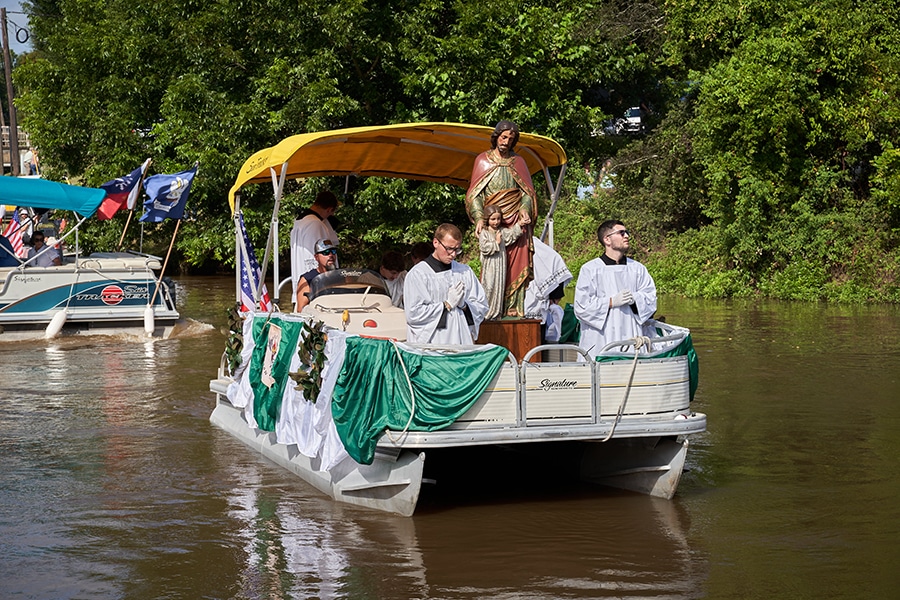
The pilgrimage’s May 24 kickoff in St. Augustine, Florida, tied its six-week journey to the early Franciscan missionaries who helped the Catholic faith take root along the coast of what is now Florida and Georgia. After Mass, processions and adoration in St. Augustine, the longest continual Catholic community in the U.S., the route’s nine “perpetual pilgrims” participated in Mass and a Eucharistic procession in Jacksonville before a river procession via boat from Fernandina Beach, Florida, into Georgia.
The perpetual pilgrims expect to accompany Jesus in the Eucharist from Florida to Maine, with the pilgrimage concluding in Philadelphia with events coinciding with the United States’ 250th birthday celebration. The pilgrimage’s theme is “One Nation Under God,” a phrase from the Pledge of Allegiance.
For Americans, “the Catholic contribution for us started with Mass,” Jason Shanks, president of the National Eucharistic Congress organization, which operates the National Eucharistic Pilgrimage, said of starting this year’s pilgrimage in St. Augustine.
“I think with these times of polarization and ideology … it’s really important for us to go back to the roots,” he told OSV News. “And for us as Catholics, it’s going back to the roots of Mass and the Eucharist.”
The water crossing from Florida to Georgia with the Eucharist was especially moving for Mary Carmen Zakrajsek, a perpetual pilgrim from the Diocese of Fort Wayne-South Bend, Indiana, who told OSV News that the experience of being with Jesus on a boat was “living the Gospels … in a very tangible way.”
Pilgrim Raymond Martinez from Midland, Texas, noted that the boat procession required a particular trust.
“Like the apostles, there were some times in which I felt quite unsure and frankly quite nervous, maybe this is because I live in a desert and have never been on a boat before,” he wrote in a reflection for OSV News’ blog chronicling the 2026 National Eucharistic Pilgrimage. He noted that in his anxiety he found security in Jesus in the monstrance.
In southeastern Georgia, the pilgrimage focused on the Georgia Martyrs, five Franciscans slated for beatification Oct. 31, before continuing into Savannah. A May 27 procession highlighted aspects of the diocese’s history, starting in Savannah at Our Lady of Good Hope, founded by Benedictine priests in 1874 to serve the spiritual needs of the African American community, to the Villa Marie Center, a summer camp founded for Catholic children living in largely Protestant Savannah.
Later that day, the pilgrims participated in a Eucharistic procession through historic downtown Savannah.
After entering the Diocese of Charleston, South Carolina, May 28, the pilgrims were scheduled to stop for a procession, adoration and, the next day, Mass at South Carolina’s only Catholic Cathedral. After a fire destroyed the diocese’s first cathedral two weeks before Christmas in 1861, Charleston’s Catholics fundraised for 45 years for the current edifice, with its cornerstone finally laid in 1890. Among its notable stained glass windows is one copied from Leonardo da Vinci’s “Last Supper” above the high altar.
On May 29, the pilgrimage began three days in the Diocese of Charlotte with adoration and Mass set for May 30 at the historic Our Lady of Lourdes Church in Monroe. The church traces its history to World War II, when Catholic soldiers arrived in the deeply Protestant area from around the U.S. to train at the newly established Camp Sutton in Monroe.
The influx of Catholic men led to marriages and families in Monroe, and in 1942, the Society of the Priests of Mercy established Our Lady of Lourdes as the area’s first Catholic parish. Today the parish is home to more than 1,500 families, including a large Hispanic community, standing as an exemplar of evolving Catholic life in the U.S.
Among the planned pilgrimage events in the Diocese of Charlotte were Mass, Eucharistic adoration and a screening of the 2024 film “Cabrini,” a biopic about the life of St. Frances Xavier Cabrini. She is the first naturalized American citizen to be canonized a saint and the patroness of the pilgrims’ 2026 East Coast route.
The 2026 pilgrimage is the third National Eucharistic Pilgrimage, with the initiative launching in 2024 ahead of that year’s National Eucharistic Congress with a four-route pilgrimage. The second pilgrimage took place last year from Indianapolis to Los Angeles.
In a May 25 social media post, the National Eucharistic Pilgrimage’s leaders positioned the endeavor with the call of “Magnifica Humanitas,” Pope Leo XIV’s first encyclical published earlier that day, which spoke of the role of the Eucharist-nourished Church to advance its own visionary model that “preserves human connections, gives a voice to the invisible and ensures that processes are aimed at respecting people’s dignity.”
“We believe this slow work of the pilgrimage … will be part of making visible the paradigm Pope Leo writes about — the paradigm of human connection, care for the least of these, and an unwavering respect for human dignity,” the post stated. “This can’t be done apart from the Eucharist. This era we’re living in needs the witness of the Church that is nourished by the Eucharist. Never stop depending on his Eucharistic presence!”
Read More eucharist
Copyright © 2026 OSV News
