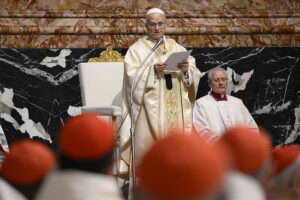
In the discussions leading up to the conclave last May, members of the College of Cardinals shared that they wished for more collegiality between themselves and the pope.
So, from the earliest days of his pontificate, Pope Leo XIV indicated that he wanted gatherings of the cardinals to not be as “extraordinary” (or, out of the norm) as its name suggests, but rather ordinary events in the life of the Church.
As a result, the first consistory in many years took place in early January. But after so few of such gatherings in the last decade-plus, it seems that many observers had hoped for the gathering to bring extraordinary results (usually regarding pet concerns).
Alas, they were disappointed.
But should they be? By all appearances, January’s consistory was a first step to returning to a more collegial sense of governance that has largely marked the exercise of papal ministry since the Second Vatican Council. A fraternal body such as the College of Cardinals inherently needs such occasions to be together — to pray, think and discern — for the pope to be effective in animating ecclesial life and to model for the Church what it means to be a leaven in the world.
In some ways, the extraordinary character of this particular extraordinary consistory was the fact that the cardinals met as a body, aside from seeing new members created or electing a new pope, for the first time in a long time. It illustrates the kind of leadership we might expect now with Pope Leo at the helm of Peter’s barque — a leadership intent upon uniting the ship’s crew amid the kinds of threats found in the storms that make up so much of ecclesial life today.
As I read Pope Leo’s homily from Jan. 8, I thought of how the return of this ordinary gathering was indeed extraordinary — particularly for the kind of leadership that it models to humanity. Pope Leo’s description of the event offers a powerful witness for all of us blessed with the task of leadership, and which resonated as especially true as a leader in a family.
I couldn’t help but think that what Pope Leo is effecting within the college of his closest collaborators is also a model for marriage and family life.
In his homily, Pope Leo observed that the word “consistory” comes from the Latin verb “consistere,” which means “to stand still.” He had me hooked already. Of course it is important in marriage to find such opportunities, especially if blessed with children and all the busyness they often bring. Truly, such an opportunity to “pause” is, in Pope Leo’s words, “a highly significant and prophetic gesture, particularly in the context of the frenetic society in which we live.”
He continued, “(Pausing) reminds us of the importance, in every aspect of life, of stopping to pray, listen and reflect.” This is important because this permits us to “refocus our attention ever more clearly on our goal, directing every effort and resource towards it, lest we risk running blindly or ‘beating the air’ in vain, as the Apostle Paul warns” in 1 Corinthians 9:26.
And Pope Leo remarked that the consistory’s “pausing” — and by the time I got to these lines I was fully committed to thinking the same about my wife and me — “is first and foremost a profound act of love for God, for the Church and for the men and women of the whole world.”
What might a consistory with my spouse look like, I began to wonder.
Pope Leo’s words — recalled from the fifth century and originating from the first pope to bear his name, St. Leo the Great — seem like a great place to start for any “consistory” for the cardinals or at home: “It is a great and very precious thing in the sight of the Lord when the whole people of Christ apply themselves together to the same duties, and all ranks and orders … cooperate with one and the same Spirit.”
Read More Commentary
Copyright © 2026 OSV News
