By the time Vincent Griffin was 20, he had already been shot twice.
The youngest of six children, Griffin had been using drugs and alcohol since junior high. Before long, he was selling drugs on the streets of West Baltimore and cycling in and out of prison.
It was at the start of his last prison sentence more than 25 years ago that Griffin decided to make a change.
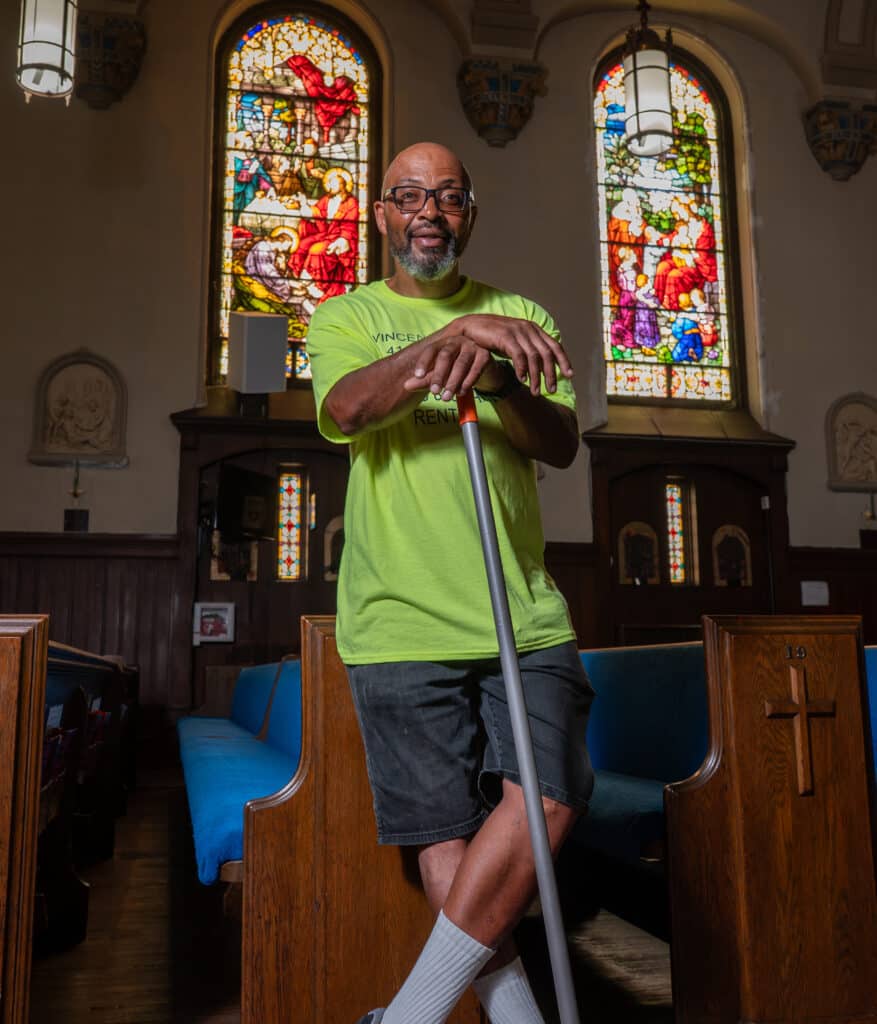
“My main objective was to stop being a bum,” he said.
Raised without a church background, Griffin’s only previous connection to the Catholic faith had been playing basketball for a youth team based at St. Edward in West Baltimore. But while incarcerated at the Metropolitan Transition Center in Baltimore, formerly known as the Maryland Penitentiary, he began attending Catholic Mass every week.
The routine became more than a break from prison life. It provided stability and purpose at a time when he was searching for a new direction.
“It set up a structure for me,” remembered Griffin, who was baptized in prison and joined St. Bernardine in West Baltimore after serving three years of a 10-year sentence. It was the same faith community his mother and a sister had joined some time earlier.
“I wanted something different in my life,” he said. “You can only do this through Jesus Christ. With prayer and faith, that’s what a different life is all about.”
Today, the 59-year-old Griffin – free from drugs and alcohol since his time in prison – serves as custodian of his home parish and runs a small business providing handyman services, lawn care and table-and-chair rentals.
His story is one example of the lives touched by Catholic prison ministry in the Archdiocese of Baltimore, a ministry that brings the sacraments, prayer, companionship and Catholic formation to people in places and circumstances most of society rarely sees.
A ministry of presence
According to the Maryland Department of Public Safety and Correctional Services, 477 of the 17,869 people housed in the state’s 17 correctional and detention facilities – whether serving sentences or awaiting trial – identify as Catholic, comprising roughly 2.7 percent of the total population.
Deacon Seigfried Presberry, coordinator of prison ministry for the Archdiocese of Baltimore, said there are well more than 200 other inmates who identify as Catholic at local, county and federal facilities throughout the region.
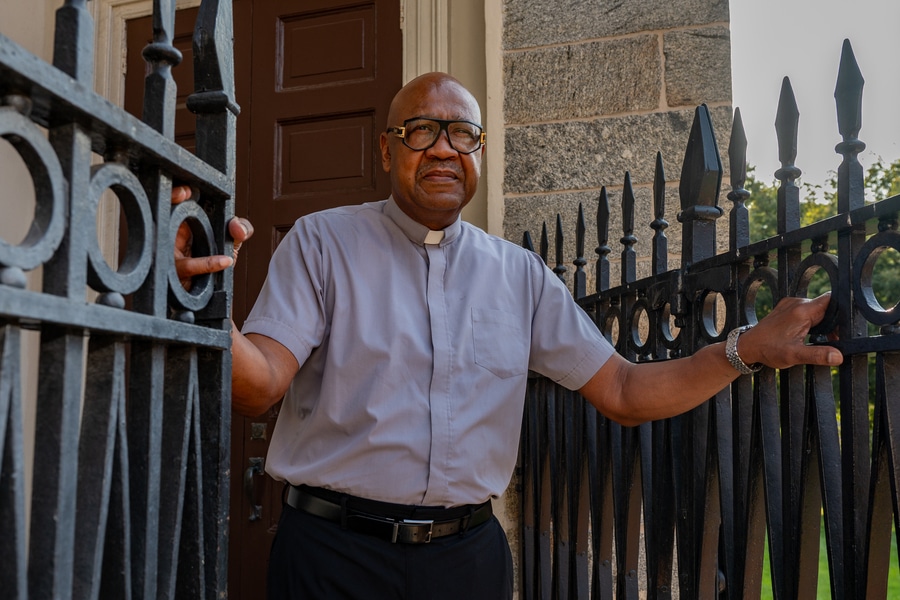
The archdiocese’s prison ministry serves all of them, and non-Catholics, too, offering Bible studies, Mass, faith formation, sacramental preparation, spiritual counseling and other forms of pastoral care.
The archdiocese currently has one full-time prison chaplain, one part-time prison chaplain and seven deacons involved in the ministry.
It isn’t easy.
Deacon Presberry said it can be challenging trying to reach people, particularly those who have committed serious crimes. But he constantly reminds anyone who will listen that everyone is a sinner and that Christ came to redeem all.
“None of us can judge anybody,” Deacon Presberry said. “That’s not our job. God sent his Son to save everyone because of our weaknesses and sinfulness. So all of us are in the same boat.”
A convert to the faith and a former correctional officer, Deacon Presberry recalled being assigned when he was employed with the prison system to guard John Thanos. Thanos was serving on death row for the murder of three Maryland teenagers. As his 1994 execution neared, Thanos didn’t seem worried or frightened, according to Deacon Presberry.
“One day, I came in there and he was just laughing and smiling, and I couldn’t believe it,” Deacon Presberry remembered. “He told me he wasn’t worried about dying because he said God forgave him. And I said, ‘Well, if God could save somebody like that, well, I’ve got a chance.’ ”
That encounter stayed with him. Years later, Deacon Presberry said it still shapes how he approaches every person he meets behind bars: not as a case file, but as someone on whom God has not given up.
It was through his connection to Thanos that Deacon Presberry met Father Charles “Chuck” Canterna, a prison minister for more than 40 years. Father Canterna ministered to those on death row for more than a decade, and Thanos was among those he counseled.
Still active in prison ministry at age 78, Father Canterna recalled being present at Maryland’s last state-sanctioned execution, when Wesley Baker was put to death in 2005 for robbing and murdering a woman in front of her grandchildren. Leading up to the execution, Cardinal William H. Keeler and Father Canterna met with Baker, who was received into the Catholic Church.
“I have found that most prisoners aren’t any different from you or me,” Father Canterna said. “They want love. They want to be loved. They’re sinners, like all of us, and need forgiveness. If you really share the Lord, it’s the Lord who touches a person.”
Meeting people where they are
Giving inmates access to the sacrament of reconciliation is an especially important part of prison ministry, according to Deacon Presberry.
Since December, every priest of the archdiocese is eligible for new identification badges that enable them to visit incarcerated people more easily for confession and pastoral care in the state prisons. Already, 16 priests have been approved for the badges, with more expected to apply.
“It’s been great because previously our priests would go to visit and they wouldn’t be allowed in,” Deacon Presberry said. “They would go on the visiting list and that could take 30 days for a priest to even get into a prison. But now they show that ID and it could be 2 in the morning and they can go make visits.”
Just as Catholics in regular parishes often feel more comfortable going to confession to a priest outside their home parish, inmates sometimes feel more comfortable going to confession to an outside priest rather than the regular chaplain, Deacon Presberry said.
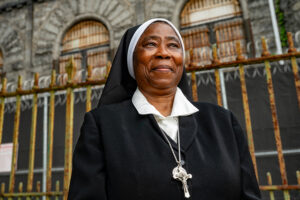
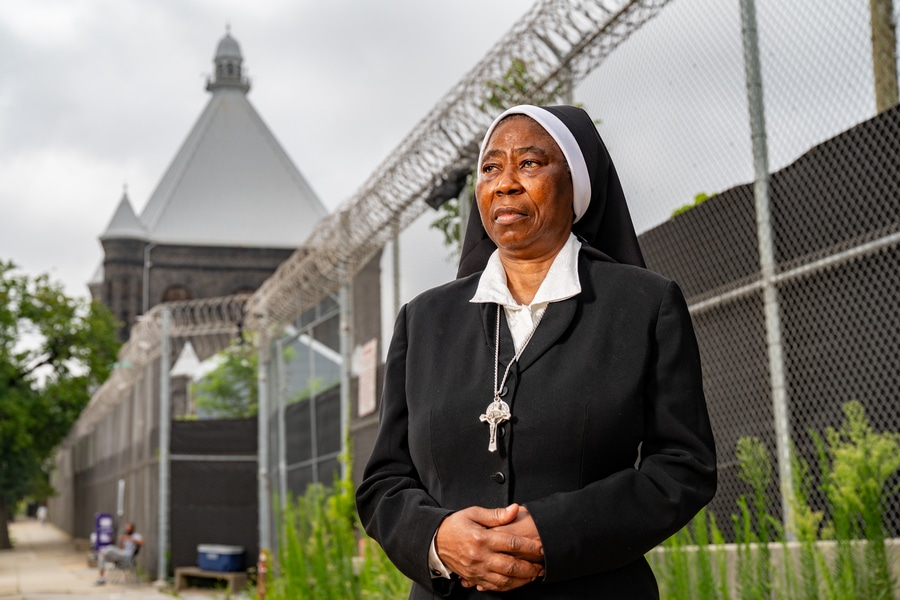
Oblate Sister of Providence Anthonia Ugwu serves as a prison minister at the intake facility located just steps away from her convent near St. Frances Academy in East Baltimore. The women she visits have been arrested for crimes that routinely include prostitution, shoplifting and drug-related offenses.
Sister Anthonia offers them Bible classes and spiritual guidance.
“I tell them if they want to avoid sin, they must avoid the occasion of sin,” said Sister Anthonia, originally from Nigeria. “I encourage them to get out of drugs. Most of the things they do have been done without their senses – it has been because of drugs.”
Pallottine Father Carlos Cardosa, who ministers in the state prisons in Hagerstown, sees another set of challenges. Prison life is stressful, he said, and inmates must navigate confinement, competing groups and the threat of violence.
“One of the big problems is the gang lifestyle,” Father Cardosa said. “It’s one gang against another, all vying for control of the prison – not the control of the physical prison, but vying for control of the inmates. That’s very dangerous because the fallout is that instead of one person being hurt, you have five, 10 people being hurt at the same time.”
Sometimes, suspect activity can turn up even in the chapel through the exchange of notes and signals.
“I have the authority to exclude them from coming if I want,” said Father Cardosa, who is fluent in Spanish, Portuguese and English, “but then I would deprive that person of the opportunity to really come to Christ. I hope against hope that a word may touch one of them and help them come to the light of Christ.”
Bringing Catholic education inside
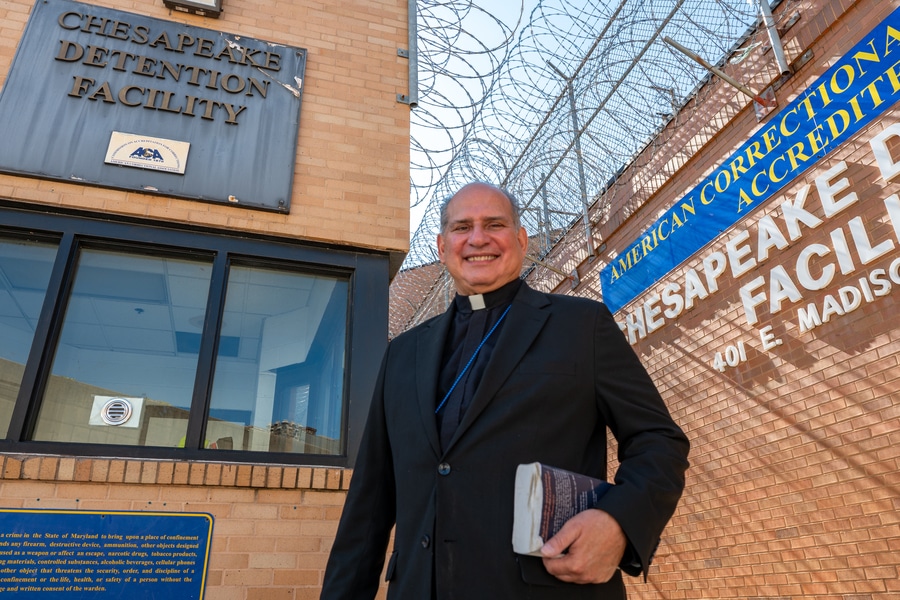
For Charlotte “Charlie” Ponticelli, a parishioner of Ss. Philip and James in Charles Village, prison ministry began with in-person visits to Spanish-speaking inmates at the Chesapeake Detention Facility in Baltimore, where she volunteered from 2014 to 2025.
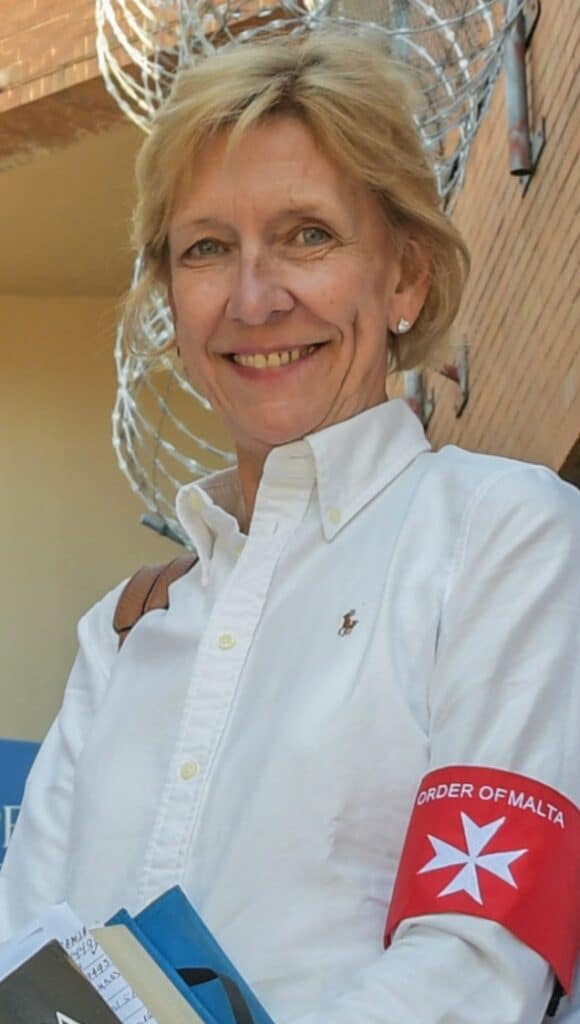
Her ministry has since expanded through Catholic International University, where she directs prison ministry programs that provide Catholic instruction and formation to inmates around the country.
Through a partnership with the Order of Malta, of which Ponticelli is a member, the university reaches 1,600 correctional facilities in 48 states and the District of Columbia.
“We have provided 4 million lessons since 2018,” said Ponticelli, former senior coordinator for international women’s issues in the U.S. State Department.
The lessons cover catechetics, apologetics, theology, devotions and other aspects of Catholic faith and formation. In the past fiscal year, more than 119,000 inmates participated in the program.
During her years of in-person ministry, Ponticelli observed how one inmate would share what he learned with others inside the prison. The digital program has multiplied that reach.
“I recently spoke with someone who told me about an inmate in Texas who has converted 60 fellow inmates to the Catholic faith,” she said. “There’s a ripple effect throughout a cell block, throughout a facility, throughout a family, throughout a community. It’s transformative.”
Touching lives
Deacon Presberry said he has no doubt the ministry touches lives in very real ways.
Two years ago, he said, Archbishop William E. Lori wrote a Christmas letter to Maryland inmates that was read at Masses. One person who had been intent on committing suicide decided to go on living after hearing the archbishop’s message of hope, Deacon Presberry said.
“The people who read that letter felt like they were recognized as a real person – they felt loved,” he said. “And that’s what our mission is: to do what we can to make their life just a little bit more loving and caring.”
That ministry of presence will continue this fall. Archbishop Lori is expected to celebrate Mass with inmates at the Maryland Correctional Training Center in Hagerstown Oct. 31, bringing the archbishop into direct contact with people whom the Church continues to serve behind prison walls.
For Vincent Griffin, who experienced that ministry firsthand decades ago, the impact can last long after a prison sentence ends. He has advice for those who are still serving time behind bars.
“You definitely need to find a higher power,” he said. “Open up your ears. Throw this pride away and realize you need some kind of God in your life. The bottom line is that it’s just much easier to do what’s right.”
Email George Matysek at gmatysek@CatholicReview.org
More local news

Copyright © 2026 Catholic Review Media
