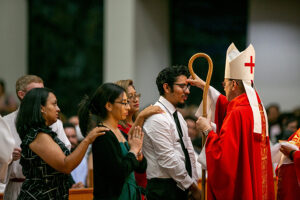
Q: This past week a member of our parish was confirmed at Sunday Mass, but it was just our parish priest who did the confirmation. I always thought confirmation had to be done by a bishop? Is it allowed for a priest to confirm, or was the recent confirmation at my parish an invalid sacrament?
A: The short answer is that while the Latin (a.k.a. “Roman”) Catholic Church normally envisions a bishop as being the minister of confirmation, there are some scenarios where a simple priest is able to celebrate this sacrament.
First, let’s refresh our understanding of what the sacrament of confirmation is. According to the Code of Canon Law, confirmation is a sacrament by which “the baptized continue their path of Christian initiation. They are enriched with the gift of the Holy Spirit and are more closely linked to the Church. They are made strong and more firmly obliged by word and deed to witness to Christ and to spread and defend the faith” (Canon 879).
The Catechism of the Catholic Church gives us some useful background on the development of the sacrament:
“In the first centuries Confirmation generally comprised one single celebration with Baptism, forming with it a ‘double sacrament,’ according to the expression of St. Cyprian. Among other reasons, the multiplication of infant baptisms all through the year, the increase of rural parishes, and the growth of dioceses often prevented the bishop from being present at all baptismal celebrations. In the West the desire to reserve the completion of Baptism to the bishop caused the temporal separation of the two sacraments. The East has kept them united, so that Confirmation is conferred by the priest who baptizes” (CCC 1290).
This passage of the Catechism references the difference in practice between the Western Latin Catholic Church and Eastern Catholic Churches (such as, for example, Byzantine, or Maronite Catholics). Eastern Catholic practice emphasizes the unity of the sacraments of initiation, which is why Eastern Catholic priests routinely confirm infants immediately after baptism. In contrast, Latin Catholics emphasize the connection between Christian initiation and the apostolic role of the bishop, which is why for Latin Catholics, confirmation is usually delayed after baptism so that it can be conferred by a bishop personally.
As to your question specifically, for Latin Catholics, Canon 882 of the Code of Canon Law tells us that although “the ordinary minister of confirmation is a Bishop,” nevertheless “a priest can also validly confer this sacrament if he has the faculty to do so, either from the general law or by way of a special grant from the competent authority.”
A “faculty” in this sense is essentially the proper necessary permission to administer a sacrament or perform some other canonical act.
The law itself gives the faculty to “a parish priest, or indeed any priest” to administer the sacrament of confirmation in an emergency where there is danger of death, with no additional permissions required (See Canon 883, 3). But I’m guessing this was not the situation you witnessed at your parish!
In less extreme scenarios, a diocesan bishop may also make a special decision to “grant to one or several specified priests the faculty to administer this sacrament” if “necessity so requires” (Canon 884).
Generally, this canonical “necessity” pertains to reasonable pastoral goals. For example, an already-baptized Catholic may need to be confirmed, but may not fit into the normal parish timeline for reception of the sacrament, as might be the case for an unconfirmed Catholic bride or groom who is seeking confirmation before their upcoming wedding (See Canon 1065, 1).
Or on the other hand, sometimes a diocesan bishop might delegate a priest to celebrate the sacrament of confirmation if the bishop finds himself unable to do this. For instance, if the diocesan bishop is struck by a sudden serious health issue, he might send a delegated priest to administer the sacrament in his place rather than postpone a scheduled parish confirmation Mass.
read more question corner



Copyright © 2026 OSV News
