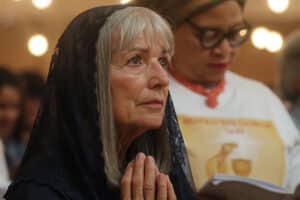
Imagine a daily Mass where, after the Gospel is proclaimed, the priest simply sits. The congregation sits. Silence fills the space — not an uncomfortable void, but a presence. After perhaps two minutes, the priest rises and continues with the prayers. What might such a practice offer in our word-saturated world?
We live surrounded by constant noise. News alerts interrupt our meals. Podcasts accompany our commutes. Social media scrolls endlessly before sleep. Even our churches have embraced verbosity, as if more explanation equals more faith. But the Church’s own law recognizes what we’ve forgotten: The homily at daily Mass is recommended, not required.
The General Instruction of the Roman Missal makes this explicit — while Sunday homilies are mandatory “and may not be omitted without a grave reason,” on weekdays the homily is merely “recommended, especially on the weekdays of Advent, Lent, and Easter Time” (GIRM, 66).
This isn’t a loophole but a liturgical wisdom: Daily Mass can breathe differently than Sunday Mass.
More striking still, that same instruction prescribes silence as part of the Liturgy of the Word itself (GIRM, 56). The Second Vatican Council went further, listing “reverent silence” among the primary ways the faithful achieve “active participation” (“Sacrosanctum Concilium,” 30). This isn’t passivity but engagement — silence as a deliberate liturgical act.
Pope Benedict XVI developed a “theology of silence,” arguing that the Word of God can only “find a home in us” through interior quiet. “The great patristic tradition teaches us,” he wrote, “that the mysteries of Christ all involve silence. Only in silence can the word of God find a home in us, as it did in Mary, woman of the word and, inseparably, woman of silence” (“Verbum Domini,” 66).
The mysteries themselves require stillness to penetrate our hearts. Without it, the proclamation remains external, informational rather than transformational.
Cardinal Robert Sarah pressed this further, warning that we’ve created a “dictatorship of noise.” “God is silence,” he wrote, “and in a world generating so much noise, seeking moments of silence has become both harder and more necessary than ever before.” When even the liturgy becomes dominated by human words, we lose the sense that God is the primary actor.
The irony runs deep: We fill the Mass with explanations of God’s Word while suffocating the space where that Word might actually take root. This is especially true at daily Mass, which attracts those already committed — people who return day after day not for instruction but for encounter. These are disciples hungry for the Bread of Life, coming before work, during lunch breaks, in the quiet hours of early morning.
For Sunday Mass, where the homily remains essential, Pope Francis offered gentle correction about brevity. The homily “should be brief and avoid taking on the semblance of a speech or a lecture,” he wrote in “Evangelii Gaudium.” It should be like “a mother’s conversation” — warm, personal, focused on one nourishing idea. When Sunday preaching becomes sharper and more concentrated, it carries greater impact.
But daily Mass offers a different gift entirely. Here, silence becomes mystagogy — a means of entering more deeply into the mystery rather than explaining it from the outside. The regular faithful don’t need the basics repeated; they need space to let the proclaimed Word sink into the soil of their hearts.
A priest who embraces silence at daily Mass doesn’t abandon his role; he deepens it. His preparation focuses on proclaiming the readings with care and celebrating the Eucharistic Prayer with reverence. After the Gospel, he gives his people the gift of quiet — a chance to hear not just with their ears but with their hearts.
This requires courage from priests and preparation from the laity. Pastors must trust that silence itself is ministry, that their people don’t need their words every day to be fed. The faithful, in turn, must come prepared — perhaps reading the Mass readings at home the night before, arriving early to settle their hearts, approaching the silent time as prayer rather than awkward pause. This isn’t emptiness but fullness, not absence but presence.
“Silence is more important than any other human work,” Cardinal Sarah insisted, “for it expresses God.” In our words, we express ourselves — our thoughts, our insights, our understanding. In silence, we allow God to speak. And God, as Scripture reminds us, often speaks most clearly not in the earthquake or fire but in the gentle whisper that requires stillness to hear.
What if the simplicity of daily Mass, stripped of elaborations, became its greatest strength — a daily renewal in the basics of word and sacrament, uncluttered and clear? The Church’s own liturgical law allows for this. Perhaps what remains is simply the courage to embrace it.
Read More Commentary
Copyright © 2026 OSV News
