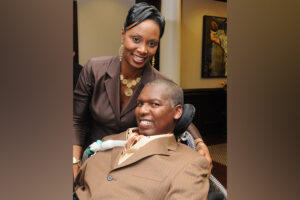
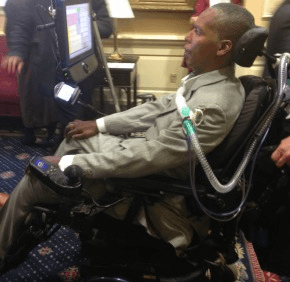
When O.J. Brigance finished testifying before the Maryland Senate Judicial Proceedings Committee in 2015, the packed room burst into applause, with even lawmakers who opposed his political position joining in.
Brigance, who died Aug. 17 at age 56, was largely incapacitated by ALS and unable to speak without the aid of a computerized voice. Addressing lawmakers considering the legalization of physician-assisted suicide, he spoke passionately about the value of life.
“Every day, every hour, every minute, every second of life, is God-given and valuable,” Brigance told the committee. “To enact this legislation would devalue the lives and possible future contributions of Marylanders.”
Someone diagnosed with ALS typically lives two to five years from onset. From the time of his testimony, Brigance would go on to live 11 more. He told lawmakers the diagnosis had been daunting for both him and his wife.
“Once we grieved, we came to the decision that adverse circumstances in no way delete purpose or destiny in one’s life,” said Brigance, a former member of the Super Bowl-winning Baltimore Ravens and the Grey Cup-winning Baltimore Stallions of the Canadian Football League who later served as senior advisor to player development for the Ravens.
Brigance did not deny suffering. He spoke instead of what he had learned through it: that a life marked by profound difficulty can still bear fruit. Because he chose to live as fully as he could after his diagnosis, he said, “there has been a ripple effect of goodness in the world.”
In 2008, he and his wife, Chanda, founded the Brigance Brigade Foundation to “equip, encourage and empower” those living with ALS.
“With the use of no hands, I was able to write a book two years ago,” Brigance said. “I can’t tell you of the numerous people who have been encouraged through their own personal struggle because I decided to face my struggle against ALS. Since being diagnosed, I have done a greater good for society in eight years than in my previous 37 years on earth.”
There was no promise in his testimony that his life would become easier and no assurance that his illness would relent.
“The thought that there would be a legal avenue for an individual to take his or her own life in a moment of despair – robbing family, friends and society of their presence and contribution to society – deeply saddens me and is a tragedy,” he said.
As the State House reporter for the Catholic Review for several years, I covered many powerful moments in Maryland’s debates over the sanctity of life.
In 2007, Bishop Denis J. Madden urged the Senate Judicial Proceedings Committee to abolish the death penalty, pointedly looking toward then-Sen. Alex Mooney, a Catholic who had not declared his position. Mooney ultimately cast the decisive vote against the bill.
At that same hearing, Kirk Bloodsworth, an Eastern Shore crabber who had spent time on death row for a murder he did not commit, spoke passionately against capital punishment. Bloodsworth was the first person in the United States exonerated by DNA testing after being sentenced to death.
In 2008 and again in 2009, then-Archbishop Edwin F. O’Brien testified against capital punishment, describing himself as “a latecomer” to the cause after once believing it could serve as a deterrent.
And many women have testified to the pain they and their families have endured after having an abortion. Most powerfully, in 2011, Stephanie White made an emotional appeal for tighter regulations on abortion clinics after the loss of her 21-year-old daughter, Denise Crowe, who died in 2006 after receiving too much anesthesia during an abortion in Severna Park.
All those moments remain seared into my memory, but none more than Brigance’s testimony that day in Annapolis. I’d like to think that part of the reason Maryland has never enacted physician-assisted suicide, despite repeated attempts, is because of Brigance’s unforgettable witness.
“I did not create my life,” Brigance said, “so I have no right to negate my life.”
May O.J. rest in peace.
Email George Matysek at gmatysek@CatholicReview.org
Also see



Copyright © 2026 Catholic Review Media
