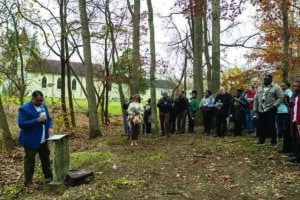
BOWIE (OSV News) — During a Nov. 15 commemoration of Black Catholic History Month at Sacred Heart Church in Bowie, the Archdiocese of Washington unveiled a new project that seeks to “honor those enslaved by the Catholic Church in Maryland.”
“This is a prayerful and powerful initiative,” said Wendi Williams, the executive director of the archdiocese’s Office of Cultural Diversity and Outreach. “This is an honorable and proud act because this is not just a Black Catholic history issue, this is a social justice issue.”
The initiative — titled “Honoring Those Who Were Enslaved: Do Justice, Love Goodness, and Walk Humbly” — was outlined during an afternoon-long “On Holy Ground: Pilgrimage of Remembrance” program.
The event was held on the grounds of the Bowie church because recent archaeological research at the cemetery there has uncovered what are believed to be hundreds of unmarked graves of people enslaved by the Jesuits who established the parish and had a plantation in that area during colonial times and in the early decades of the United States before the Civil War.
“We honor those Black Americans who died under the burden of slavery and are buried in unmarked graves,” said Washington Auxiliary Bishop Roy E. Campbell Jr., one of those who led the creation of the initiative. “We are doing what is right and just to those who knew no justice during their lives.”
The “Honoring Those Who Were Enslaved” project was several years in the making and is the result of what archdiocesan officials called “engagements with the community of descendants of enslaved people in Maryland.”
The Archdiocese of Washington comprises the District of Columbia and five Maryland counties: Calvert, Charles, Montgomery, Prince George’s and St. Mary’s. Bowie is in Prince George’s County.
“It is a real mix of emotions, a real conundrum of emotions,” Williams said of the painful look at the Maryland church’s history of racism and slavery, “but we are taking action — and that has to be positive.”
Those meetings with the descendants of the enslaved highlighted several issues and led to the formation of the project and a pastoral initiative plan with several action items that include:
- Creating two new ad-hoc advisory groups — a pastor advisory group and a descendants of the enslaved advisory group — that will advise on how to communicate the action plan and will plan events such as the Nov. 15 commemoration at Sacred Heart Parish.
- Creating “public-facing resources” on the archdiocesan website (www.adw.org) that showcase the history and contributions of Black Catholics in the archdiocese and to provide resources to support parishes.
- Regularly communicating with the descendant community through a quarterly email newsletter and periodic listening sessions.
- Providing access to sacramental and other records to assist descendants of the enslaved in discovering their family history.
- Collecting and organizing all records related to historical cemeteries in the archdiocese. The archdiocese has 25 parish cemeteries with marked graves that date from before the Civil War and an additional 43 historical parish cemeteries.
In addition, the archdiocesan Office of Cultural Diversity and Outreach will coordinate information sessions for parish staff and interested parishioners; and assist parishes interested in participating in the initiative. The archdiocese also will provide “nonchurch space” where descendants can deal with the reality that the church owned members of their families.
A final item in the pastoral plan calls for funding a public monument to commemorate contributions of enslaved peoples to the Catholic Church in Maryland.
Stephanie Jacobe, director of archives for the Archdiocese of Washington, has conducted extensive research into the harsh reality of the Catholic Church in Maryland owning, and selling, enslaved persons.
“We need to investigate our history,” Jacobe said. “We need to honor our history, and we need to tell the truth about our history.”
Lynn Nehemiah, a member of the initiative’s descendant advisory board, said she was “proud and encouraged by the response of the Catholic Church” to confront its dark history.
“We are uncovering names because names are so important to our history, to our heritage,” she said. “Our people were here. We are significant. We belong.”
Prior to the announcement of the “Honoring Those Who Were Enslaved” initiative, a commemoration and reflection was held in the parish cemetery.
Bishop Campbell blessed the graveyard, and said the event is a way “to honor those of our ancestry and those who lived, worked and died without us knowing who they were.”
“They (the enslaved buried in unmarked graves) were children of God,” Bishop Campbell said. “I am more than happy; I am more than thrilled; and I am more than honored to be a part of this.
“We do this because it is the right thing to do. We do this because it is the Catholic thing to do. We do this because these are our brothers and sisters.”
Father Michael Russo, pastor of Sacred Heart Parish, said the more than 100 people who braved the damp and chilly weather of the overcast day gathered to “emphasize and recognize the toil, hardships and sins endured here.”
“We are here reflecting on this important work — the work of sanctification,” Father Russo said.
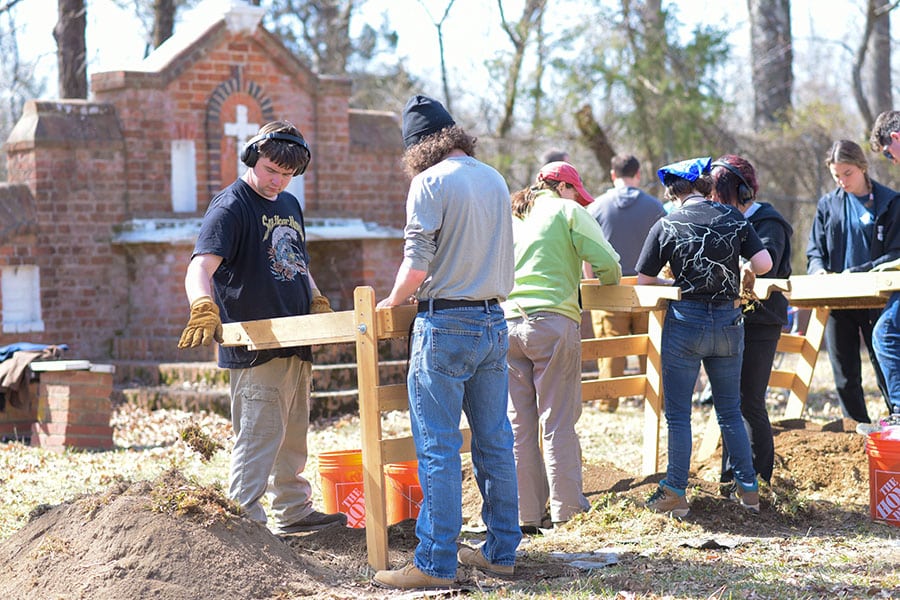
Several years ago, Sacred Heart Parish found through ground penetrating radar that there were hundreds of unmarked and unidentified graves and burial sites throughout its 33-acre property that possibly contain the remains of enslaved men, women and children.
Previously, the property was one of the plantations owned by members of the Society of Jesus — the Jesuits — in Maryland in the 1700s and 1800s, and enslaved people who worked at that plantation are believed to be buried in unmarked graves there.
Some of those buried in the graveyard may be related to the 272 enslaved men, women and children the Maryland Society of Jesus sold in 1838 to Louisiana plantation owners which helped ensure the financial survival of Georgetown College, which is now Georgetown University.
Descendants of those enslaved by the Jesuits were able to share reflections during the walk through the cemetery. Henrietta Pike, one of the descendants, noted that “it means a lot to us to be able to gather like this.”
For Kevin Porter, a descendant of an enslaved person and of a person who enslaved others, called on the Catholic Church to “measure, track and witness” to the past and “recognize the generational harm it has done.”
“As a descendant of an enslaver, I say we can do much better than our ancestors,” he added.
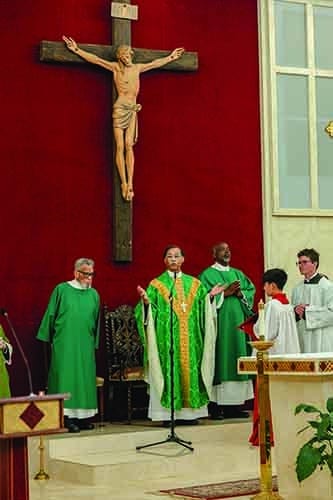
In his homily during the Mass, Bishop Campbell explained that it is important to honor those enslaved by the Jesuits and to acknowledge the past, or “how will we know where to go?” he asked. “Black Catholic history is an integral part of American history.”
He also highlighted the “hope and self-giving” of the seven American Black Catholics whose causes for sainthood have been opened:
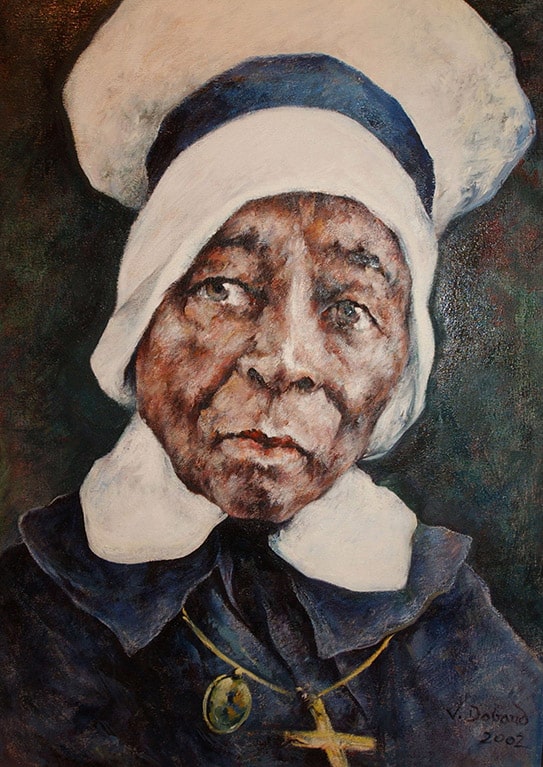
- Venerable Mother Mary Elizabeth Lange, the foundress of the Oblate Sisters of Providence in Baltimore, the first Catholic order of African American women religious.
- Venerable Father Augustus Tolton, the first U.S. Catholic priest publicly known to be Black and who served as a parish priest in Chicago.
- Venerable Mother Henriette Delille of New Orleans, who founded the Sisters of the Holy Family.
- Venerable Pierre Toussaint, a philanthropist and founder of many Catholic charitable works in New York.
- Servant of God Julia Greeley, who was born into slavery and after her emancipation later moved to Denver, where she became Catholic and was known for her devout faith.
- Servant of God Sister Thea Bowman, a native of Mississippi who converted to Catholicism and later became a Franciscan Sister of Perpetual Adoration and was nationally known as a dynamic evangelist before she died of cancer in 1990.
- Servant of God Father Martin Maria de Porres Ward, who converted to Catholicism, became a Franciscan friar and served as a missionary in Brazil for more than 40 years before he died in 1999.
“All of these (candidates for canonization) hoped and lived for the justice due all humans,” Bishop Campbell said. “They loved though they were hated. They forgave though they were despised.”
Read More Racial Justice
Copyright © 2025 OSV News
