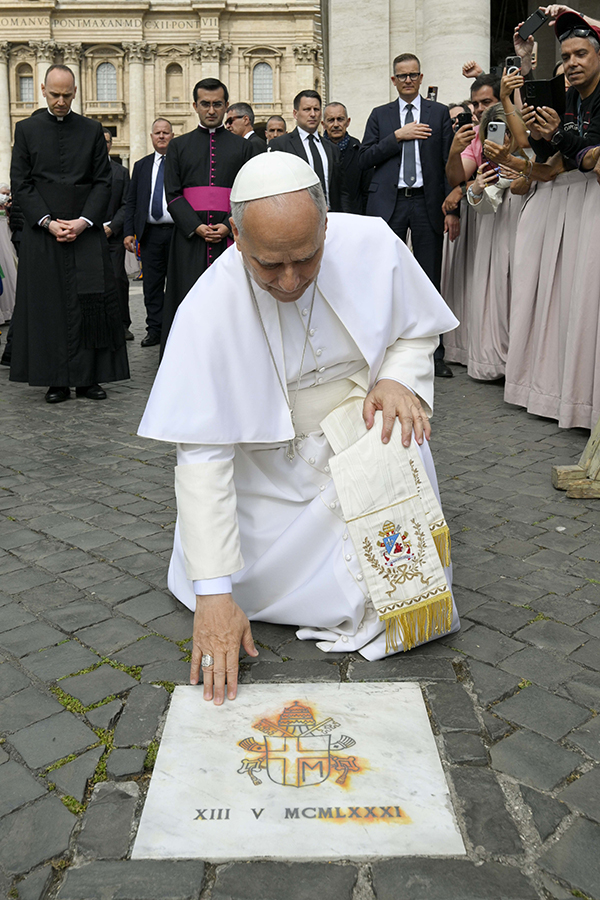
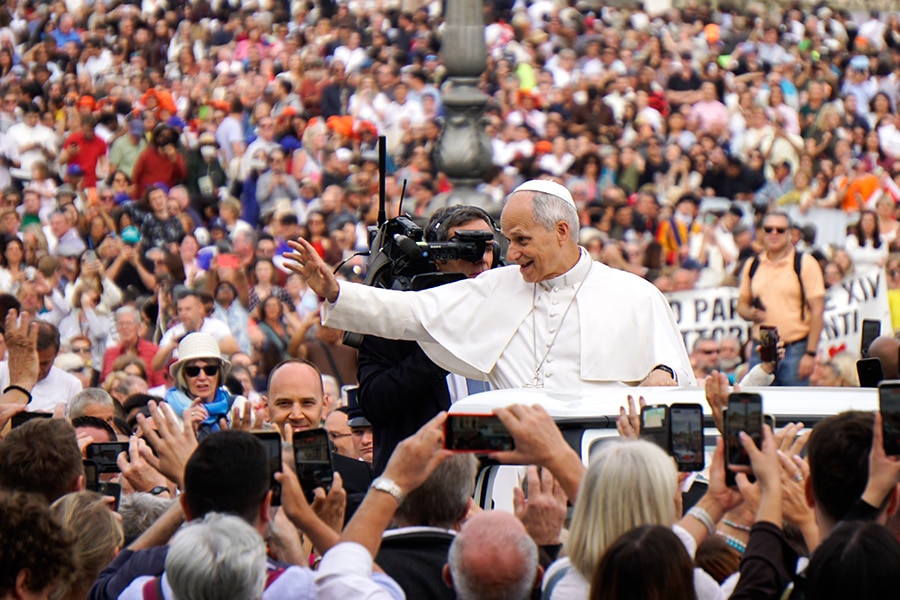
WARSAW, Poland (OSV News) — Before he started his general audience, Pope Leo XIV stepped out of his popemobile on May 13 and walked over to pray beside a plaque marking the spot where history took a turn that shocked the world 45 years before.
St. John Paul II was shot precisely there on May 13, 1981 — a day of the assassination attempt and one when Our Lady saved the pope’s life.
“Today we remember the memorial of Our Lady of Fátima,” Pope Leo addressed English-speaking pilgrims during his audience. “On this day 45 years ago an attempt was made on the life of Pope John Paul II, and for these reasons I dedicated my catechesis today to the Blessed Virgin Mary,” he added.
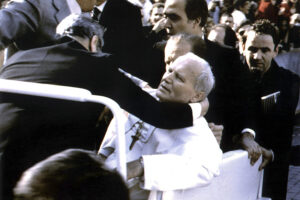
On that fateful day right before lunch, John Paul II rode slowly through St. Peter’s Square in an open white jeep, and he bent down to bless a small girl in the crowd. Seconds later, gunshots rang out.
Turkish gunman Mehmet Ali Agca shot the pope at close range. John Paul II collapsed into the arms of his secretary, then-Father Stanislaw Dziwisz. Blood soaked his white cassock as he was immediately rushed to Gemelli hospital, in what his personal secretary later recalled as “fight with time” to get the pontiff to the operating room.
“One hand fired, and another guided the bullet,” John Paul II would later say, convinced that the Our Lady of Fátima had spared his life. The attack took place exactly on the anniversary of the first apparition of the Virgin Mary to three shepherd children in Fátima, Portugal, in 1917. In 1982, the pontiff traveled to Fátima to thank the Blessed Mother for saving his life. The bullet removed from his body was later placed in the crown of the Fátima statue.
Italian journalist Alberto Michelini, who covered the pope for decades, told OSV News that for John Paul II the connection was never symbolic. “The Marian pope was saved thanks to the hand that diverted the deadly bullet — thanks to the hand of Mary,” Michelini said. “It was a true miracle.”
Father Miroslaw Cichon, director of the John Paul II Pontificate Documentation Center in Rome, told OSV News that the center’s archives preserve moving testimonies of the worldwide prayers that followed the attack, including an image of Our Lady of Czestochowa placed on the empty papal chair in St. Peter’s Square after the wounded pope was taken to the hospital.
Michelini linked the assassination attempt to the broader collapse of communism in Eastern Europe. “I covered the pope’s first trip to Poland,” he said. “From that extraordinary encounter with the crowds — something that worried the Kremlin greatly — we witnessed, within 10 years, from the Baltic to the Black Sea, the collapse of the Berlin Wall.”
For many historians, the geopolitical dimension of the attack can no longer be dismissed as speculation. Pawel Skibinski, Polish historian and former director of the Warsaw’s Museum of John Paul II and Primate (Cardinal Stefan) Wyszynski, said Soviet authorities viewed the Polish pope as a destabilizing force almost immediately after his election in 1978. “The pontificate of John Paul II was undoubtedly a factor changing the situation of believers in the Eastern bloc,” Skibinski, who is a professor of the University of Warsaw, told OSV News.
He said Soviet intelligence services closely monitored Vatican outreach to Catholics behind the Iron Curtain. “We do not have proof of a direct Politburo decision ordering the elimination of Karol Wojtyla,” Skibinski said, mentioning the highest executive, policymaking body within a Soviet communist party. But the beginning of coordinated activity by Soviet and Bulgarian services around Agca is a historical fact.
Skibinski pointed to findings from investigations conducted by Poland’s Institute of National Remembrance indicating that Agca — after escaping from a Turkish prison — underwent training linked to Soviet intelligence networks in Tehran, Iran. “The so-called Bulgarian trail is not speculation anymore,” Skibinski said. “From a historical point of view, there is no doubt.”
Yet the pope’s survival may have ultimately strengthened his authority rather than weakened it.
“The fact that he paid with his own blood for the truths he proclaimed increased his credibility,” Skibinski said. The attack transformed John Paul II into a global moral figure during one of the most fragile phases of the Cold War.
“It is a very important date in the pontificate,” Michal Senk, director of the Center for the Thought of John Paul II, based in Warsaw, told OSV News the assassination attempt intensified themes already present in Cardinal Wojtyla’s spirituality. “It was not a radical change of direction,” he said. “But after the attack he devoted even more attention to suffering, penance and forgiveness.”
Two years after the assassination attempt, on Dec. 27, 1983, the pope visited Agca at Rome’s Rebibbia prison and publicly forgave him — a gesture that became one of the defining images of his pontificate.
Michelini said the pope’s embrace of Agca became stronger than any speech about forgiveness. “Karol Wojtyla was a man of gestures,” he said. “His ability to speak to the world even without words transformed him into one of the most extraordinary natural leaders of our era.”
Still, Senk cautioned against romanticizing Agca or describing the prison meeting as reconciliation. “Agca never asked for forgiveness,” he said. “John Paul II forgave him without being asked. That is something radically evangelical.”
Senk described the Turkish gunman as “a professional killer” and “a compulsive liar,” insisting the burden of forgiveness rested entirely on the pope, who asked Italy to grant him official pardon to his assassin in 1999 — eventually granted to Agca in the Jubilee Year 2000 by the Italian president.
Father Miroslaw Cichon told OSV News that the assassination attempt left a lasting mark on John Paul II’s teaching, especially in his 1984 apostolic letter “Salvifici Doloris,” on the Christian meaning of suffering, written in 1984 “He linked his own fate and the fate of the world even more closely to Mary and the message of Fátima,” the priest said. “The pope’s physical suffering became an integral part of his teaching,” Father Cichon told OSV News.
“That suffering deepened his relationship with U.S. President Ronald Reagan,” Skibinski told OSV News, “who had survived an assassination attempt just weeks earlier.” The two men did not form a kind of secret alliance, Skibinski said, but they did share a common commitment to defending religious freedom and human dignity in Eastern Europe.
Senk noted that even after recovering, John Paul II never fully regained the robust health of his early years. “From that point, he became a man who suffered more often and more visibly,” Senk said. Yet he did not retreat. Security, however, changed forever. The open vehicle in St. Peter’s Square gave way to the glass-enclosed popemobile.
On March 25, 1984, John Paul II consecrated the world — including Russia — although not named specifically in the consecration text — to the Immaculate Heart of Mary, fulfilling a request tied to the Fátima apparitions.
Weeks later, on May 13, a massive explosion at a Soviet naval base in Severomorsk destroyed a large portion of the Northern Fleet’s missile stockpile. Soviet officials blamed a cigarette; no Western government claimed responsibility.
Senk cited the episode as an example of symbolic links many Catholics drew between Fátima and the weakening of Soviet power.
“The coincidence of dates is striking,” historian Skibinski told OSV News. He and others noted that John Paul II viewed history through a spiritual lens, where grace and geopolitics were intertwined. Father Cichon added that in his 2005 book “Memory and Identity,” the pope interpreted the assassination attempt “above all in theological terms.”
By the end of the 1980s, the Berlin Wall had fallen and communist regimes across Eastern Europe had collapsed. Two years later, the Soviet Union dissolved.
Iconic Italian television journalist Michelini told OSV News: “Perhaps the full truth about the assassination will never emerge, but it was clear that the Slavic pope had become a destabilizing force for the last empire.”
Father Cichon added that the assassination attempt marked a turning point — a “threshold moment,” giving John Paul II’s ministry a more “distinctly martyr-like and mystical” dimension.
Read More Vatican News
Copyright © 2026 OSV News
