(OSV News) — As the July 19 World Cup final approaches, players from two historically Catholic nations can count not only on the prayers of their fans, but also on a rich web of Catholic threads surrounding the showdown between Spain and Argentina.
From the tournament’s origins to the faith openly lived by players and coaches on both sides, this final carries a distinctly Catholic dimension.
The match at New Jersey’s MetLife stadium brings together two football giants whose paths to the final have been marked not only by sporting excellence, but also by visible expressions of Catholic faith.
Spanish coach is a magician of footballing who loves Christ
If anyone wondered where the precision combined with clearly having fun on the pitch comes from in the Spanish team, striker Ferran Torres gave a sense of the answer when he spoke publicly about his Catholic faith.
“I have a cross and an image of the Virgin,” he said in a video shared by the Spanish national soccer team. “In the end, I think it’s something that gives me a lot of support. It gives me great strength in my faith, and for me it’s something very important.”
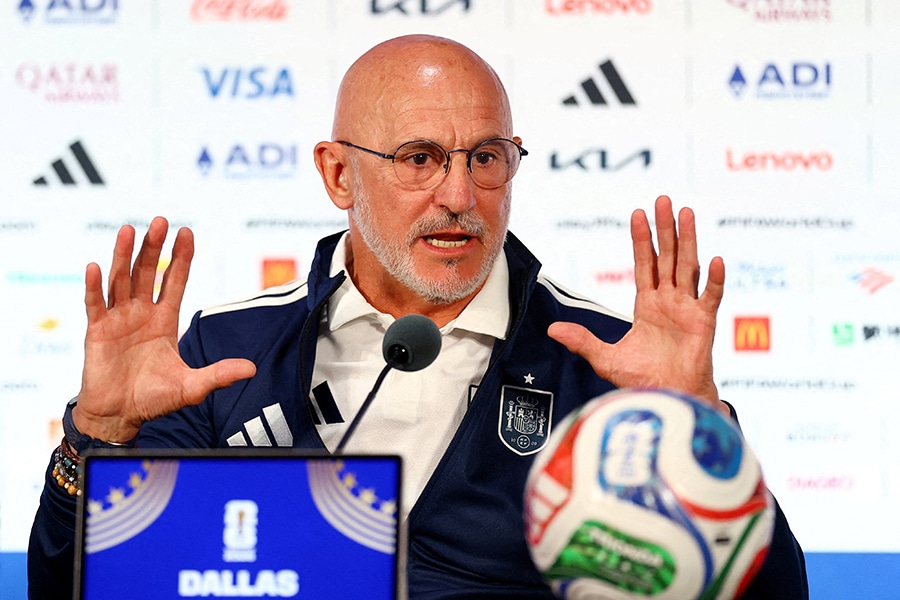
Spain — a country deeply rooted in Catholic tradition and recently visited by Pope Leo XIV — arrives under the wings of coach Luis de la Fuente — known as much for his personal faith as for his magic tactical skill. After Spain’s record fourth European Championship title in July 2024, the country’s bishops publicly praised his witness.
Archbishop José Ángel Saiz Meneses of Seville described de la Fuente at the time as “a deeply religious man” unafraid of “publicly expressing his faith,” noting his devotion to the Holy Christ of the Expiration in Seville. An image of the coach praying before the famed crucifix went viral at the time, and certainly Spanish soccer fans are turning their eyes heavenward before the July 19 final.
“He has been able to transmit faith, humility, the value of the team above individualities, the spirit of sacrifice, effort, confidence” the archbishop of Seville said of de la Fuente after Spain’s 2024 victory.
Bishop José Ignacio Munilla Aguirre of Orihuela-Alicante also highlighted “the testimony of faith of the coach,” comparing it to that of Argentina’s Lionel Messi and citing the Gospel of Matthew: “Everyone who acknowledges me before others I will acknowledge before my heavenly Father.”
Argentina, meanwhile, has carried its own strong Catholic identity throughout the tournament — both in the locker room and on the pitch.
Our Lady of Lujan hidden in a shin guard
Before every match, kit man Mario Di Stéfano sets up a small prayer altar in the team’s locker room. (A kit man is a vital member of a sports team’s backroom staff who manages all equipment and uniforms.)
The prayer altar is centered on a statue of Our Lady of Luján, Argentina’s patroness, alongside images of Our Lady Undoer of Knots and St. Expedite — considered the patron saint of urgent causes.
The tradition dates back decades, echoing practices from the team’s 1986 World Cup run.
Players’ personal devotions have also drawn attention. Lautaro Martínez was seen with a holy card of Our Lady of Luján tucked into his shin guard, while before the tournament began, Lionel Messi’s boots were blessed at the basilica dedicated to the same Marian title.
It was sports journalist Walter Queijeiro who brought the soccer boots of Messi — Argentina’s legendary captain, and the player most credited with the team’s 2022 title, which the Albiceleste are now defending — to the Basilica of Our Lady of Luján.
The boots, a limited Adidas edition called “El Último Tango” (“The Last Tango”), a nod both to Argentina’s musical heritage and to what is expected to be Messi’s last dance in the national jersey, were blessed by the basilica’s rector, Father Lucas García, in a small ceremony before pilgrims and children. Messi wore them on June 16 in Kansas City when he scored his first World Cup hat trick, against Algeria, tying Miroslav Klose’s record for most goals in men’s World Cup history — a milestone in what is Messi’s sixth World Cup.
Messi: ‘Grateful for everything God has given me’
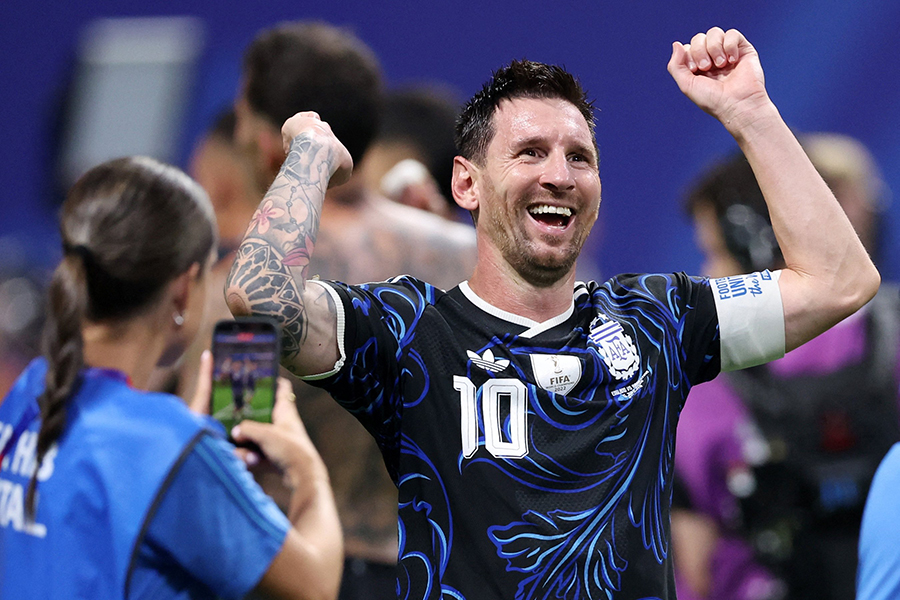
Messi and his teammates have also welcomed religious gifts from fans in public. After Argentina’s win over Cape Verde, content creator Julián Pérez Regio approached the six-time FIFA player of the match outside the stadium and handed him a rosary blessed at the Vatican, telling him it was meant for him, his wife, Antonela, and their their children, and for his parents, in gratitude for two decades of joy he has given Argentine fans. Messi stopped, visibly moved, and accepted it.
Messi has also spoken openly about his faith. After Argentina secured its place in the final, he said: “God is great, and he always has something else. But honestly, I cannot ask God for anything else. I am grateful for everything he has given me.”
Even the World Cup itself has Catholic roots.
Jules Rimet: French Catholic founder of World Cup
“The World Cup was founded in 1928 at the initiative of Jules Rimet, a French Catholic who was then president of the International Federation of Association Football,” Isabelle de Chatellus, program director for sports at the French bishops’ conference, told OSV News.
Chatellus emphasized that Rimet’s vision of the tournament was shaped by Catholic social teaching and a desire to promote human dignity and social cohesion through sport, particularly among the working classes.
“He was inspired by the social doctrine developed by Leo XIII in his encyclical ‘Rerum Novarum,’ and was committed to defending human dignity, social justice, and collective responsibility toward the most vulnerable,” she said.
“His parents were grocers in Paris,” she said of Rimet. “He immediately saw sports as a popular activity. For him, soccer was the quintessential popular sport and a prime vehicle for promoting attention to the most disadvantaged communities and social justice. He wanted to foster social cohesion through soccer, transcending class distinctions.”
“Rimet was therefore in favor of professionalization and the payment of soccer players, which he saw as a way to make the sport accessible to workers,” Chatellus said. “He recognized that the working classes did not have the luxury of playing sports at the expense of their livelihoods.”
Sports: a school of conflict resolution
For Chatellus, sport remains a place where competition and conflict can be lived out within rules, respect and shared values — even at the highest level.
“The soccer field remains a place of conflict. But it is a place where conflict must take place with respect, within the rules and guided by team values that are very constructive. There is a unique path to holiness that can be experienced through sports,” she told OSV News.
Chatellus is the director of the Holy Games, the Catholic association supported by the Archdiocese of Paris that provided pastoral care during the 2024 Olympic and Paralympic Games. It has since become a permanent structure within the French bishops’ conference.
A soccer fan herself, she expressed her disappointment following the French national team’s defeat in the semifinals on July 14, Bastille Day — France’s biggest national holiday. “It was truly a huge disappointment, and one that took us by surprise, because it was a great team. But the Spanish team played very well,” she said.
As Spain and Argentina prepare to meet on football’s biggest stage, it remains to be seen at the final game which Spanish-speaking team that the patron saint of urgent causes, St. Expedite, will cheer on.
read more sports

Copyright © 2026 OSV News
