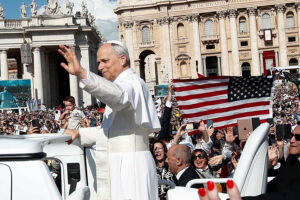
ROME (OSV News) — When Robert Francis Prevost stepped onto the loggia of St. Peter’s Basilica one year ago May 8, he carried with him a piece of paper on which he had carefully written the first words he would utter as Pope Leo XIV. His first speech was, in ways that would only become clear over the year that followed, a preview of what was to come.
“Peace be with you all,” the newly elected Pope Leo said.
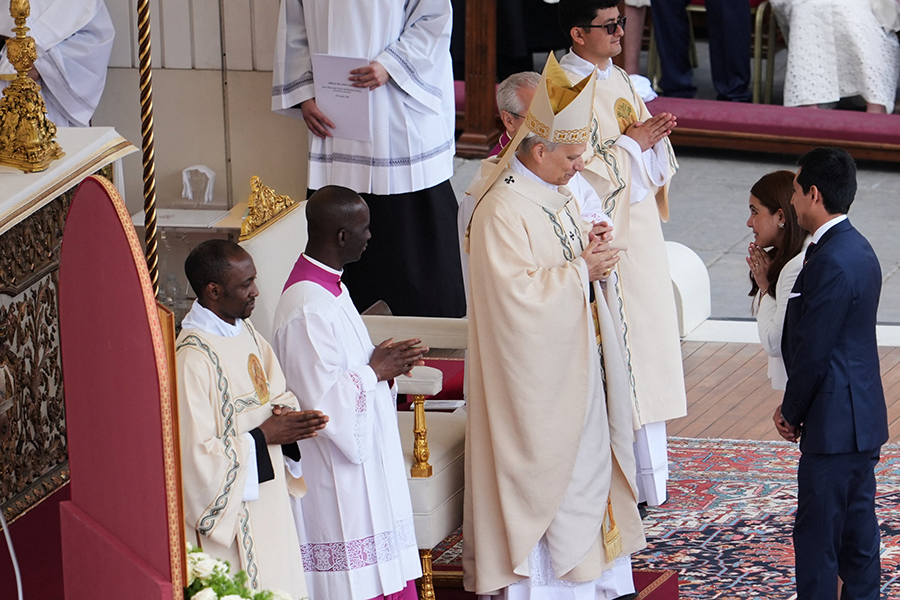
Peace would become perhaps the most visible theme of his first year, as war flared in the Middle East and Pope Leo became a persistent and sometimes lone voice of moral authority for restraint and dialogue. But the eight-minute speech that followed also contained many of the other major themes of his early pontificate: a vision of “a united Church,” theological rootness in St. Augustine, the pope’s missionary heart and a prioritization of God above all else.
One year on, the first words with which Pope Leo chose to introduce himself to the world merit a close reading.
‘God loves you all and evil will not prevail’
Not only was “peace” the very first word of Pope Leo’s pontificate, but it was one of the most used words in his first speech. He highlighted “the peace of the Risen Christ” that “comes from God, God who loves us all unconditionally.”
“Peace,” however, was not Pope Leo’s only most frequently used key word that day. That distinction belongs to “God” and other references to the Trinity. “The world needs his light,” he said of Jesus.
Pointing the world to God is a priority that Pope Leo has since felt compelled to clarify to journalists who sought to frame his papacy in political terms. His primary focus, he said, is not politics, but God, the source of peace. “The message of the Church, my message, the message of the Gospel: Blessed are the peacemakers,” he emphasized to journalists traveling with him in April.
From the loggia May 8, 2025, he told the crowd gathered in St. Peter’s Square that “God loves us, God loves you all, and evil will not prevail.”
“Christ goes before us. The world needs his light. Humanity needs him as the bridge that can lead us to God and his love,” Pope Leo added.
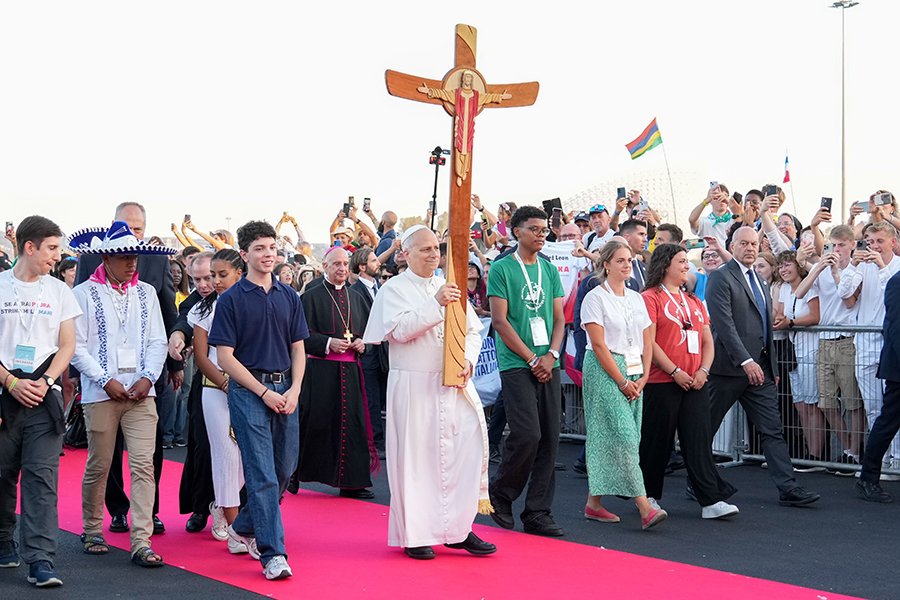
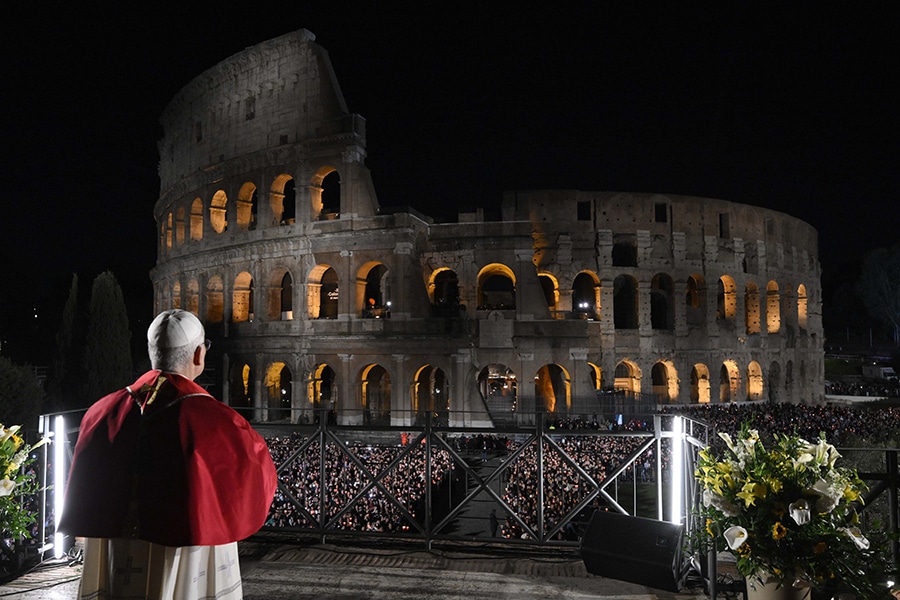
Over the year that followed, Pope Leo put significant effort into elevating the signs of faith — he offered more than 65 public Masses, carried the Eucharist in procession through the streets of Rome on the feast of Corpus Christi, and then carried the cross for two key events: first through a crowd of 1 million young people during the Jubilee of Hope, and then through the darkness of night for all 14 Stations of the Cross on Good Friday in the Colosseum.
He also leaned into personal acts of devotion. The pope noted in his first speech that he had been elected on the feast of Our Lady of Pompeii, and he invited everyone to pray a Hail Mary with him. His first year included several papal pilgrimages, from Genazzano, Italy, where he prayed before Our Lady of Good Counsel, to the ancient site of Hippo Regius in Algeria, where St. Augustine once served as bishop.
Pope Leo has now chosen to mark the anniversary of his election with a pilgrimage to the Pontifical Shrine of the Blessed Virgin of the Rosary of Pompeii, where he will offer yet another public papal Mass.
‘A united Church’
From the loggia, Pope Leo outlined his vision for the Church in a cascade of descriptive phrases: “a missionary Church,” “a Church that builds bridges,” “a synodal Church,” “a Church that always seeks peace,” “a faithful Church of Jesus Christ.” But the very first descriptor he used to articulate his vision for the Church was “a united Church.”
At Pope Leo’s inauguration Mass, he went on to say, “Brothers and sisters, I would like that our first great desire be for a united Church, a sign of unity and communion, which becomes a leaven for a reconciled world.”
Twelve months on, it is clear Church unity has continued to be a key goal for the first American pope. Pope Leo has gone conspicuously out of his way to avoid isolating many theological or political factions within Catholicism. He has moved slowly in his handling of the Roman Curia, choosing not to rapidly overturn his predecessor’s key prefect appointments or signature decisions. And he has cited not only his immediate predecessor, Pope Francis, but he has also frequently quoted Popes Benedict XVI and St. John Paul II.
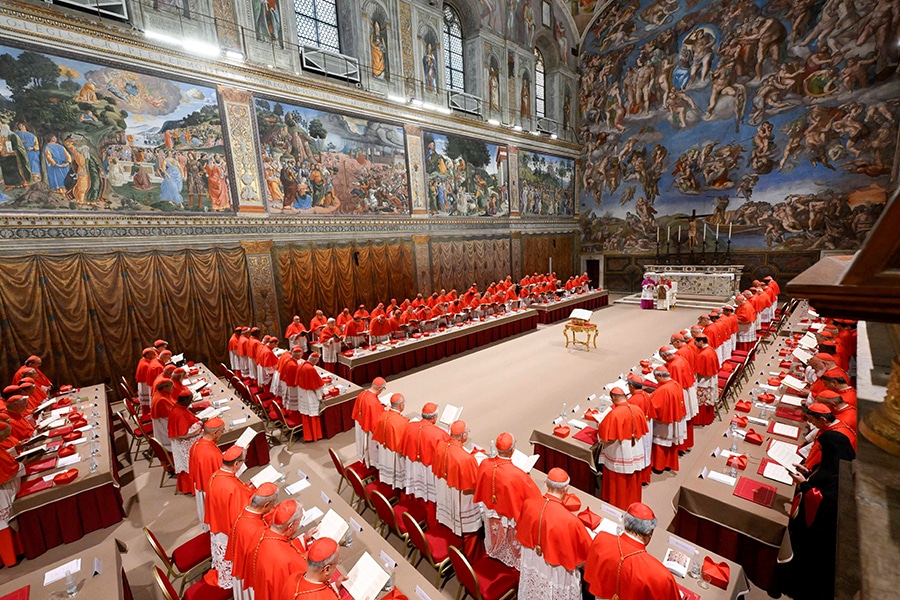
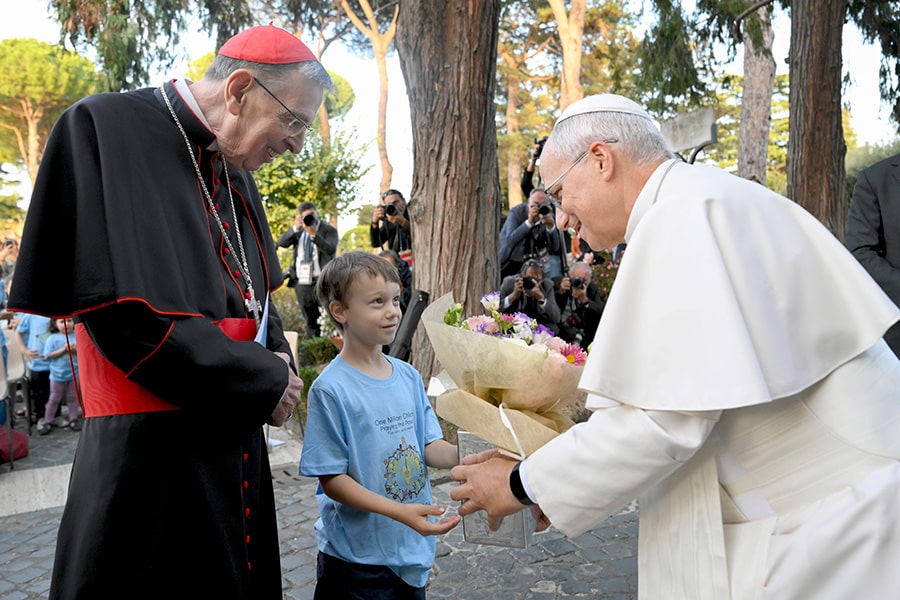
The results of Pope Leo’s prudence, at least by one measure, appear to have landed. According to recent polling, Pope Leo has emerged as one of the most popular Americans in the world. His focus on Church unity has also extended to ecumenical outreach from praying with the King of England in the Sistine Chapel to standing side by side with Orthodox leaders marking the 1,700th anniversary of the Council of Nicaea.
‘A disarmed peace and a disarming peace’
Pope Leo defined the “peace of the Risen Christ” that first spring evening as “a disarmed peace and a disarming peace, humble and persevering.” The phrase captures both the content of what would go on to be some of Pope Leo’s strongest statements, such as “lay down your weapons” as the pope’s home country launched a war in Iran, as well as the pope’s style of communicating his peace message, “humble and persevering.”
But even before the Iran war began, Pope Leo prayed publicly for peace at nearly every Sunday Angelus or Regina Caeli address throughout the year: for “an authentic, just and lasting peace” in Ukraine, for relief from “a dire humanitarian situation in Gaza,” and for an end to violence in Myanmar, Nigeria, Haiti and many other parts of the world, frequently invoking Mary under her title Queen of Peace.
The theme reached its most concrete expression during his apostolic journey to Africa, where Pope Leo presided over a peace meeting in Bamenda, Cameroon, a region scarred by ongoing conflict, and where, on the papal plane, he pointedly responded to harsh words from U.S. President Donald Trump by saying “Blessed are the peacemakers.”
A ‘son of St. Augustine,’ a missionary at heart
Two aspects of Pope Leo’s personal identity emerged unmistakably in that first speech. When he finally spoke of himself, about halfway through his address, he did not begin with his nationality or other biographical information. He identified himself with his religious order and spirituality as “a son of St. Augustine,” an Augustinian friar who had given decades of his life to missionary work in Latin America.
“‘For you I am a bishop, with you I am a Christian,'” he said, quoting St. Augustine directly in the first of many such citations of the fifth-century doctor of the Church frequently woven into his speeches and writings throughout the year, from invoking the “City of God” in a meeting with an African dictator to addressing young Catholics in Chicago via video message.
His missionary identity has shone in his first year through his linguistic range, delivering speeches, homilies and Masses in Spanish, Italian, French and Portuguese, in addition to his native English, and offering greetings in Arabic and even Kimbundu, a language spoken in Angola. His very first speech gave a preview of this as well when the pope broke into Spanish to offer a warm greeting to the diocese of Chiclayo, Peru, where he had served both as a missionary and as a bishop.
What the first speech did not reveal
Not everything was foretold on the loggia.
Pope Leo spoke in Italian, then Spanish, but notably offered no word of English, and no acknowledgment of his American roots. That reticence was reflected, in part, throughout his first year, in which he did not visit the United States, did not meet the American president, and appeared, at first, to be deliberately careful about wading into American domestic politics until the U.S. president criticized him by name.
American Catholics, for their part, were not so restrained in their enthusiasm — sending him Chicago pizza, custom White Sox jerseys and pumpkin pie. And as the year went on, Pope Leo appeared to begin to recognize the singular reach that comes with being the first native-born English speaking pope in the 21st century: a statement in English outside Castel Gandolfo or aboard the papal plane can land on every major news outlet around the world within the hour.
Pope Leo’s first speech notably omitted any reference to technology, artificial intelligence or Catholic social teaching, an interest that he revealed later in his first week when he explained why he had chosen the papal name Leo as a reference to Pope Leo XIII, the pope who addressed the upheavals of industrial capitalism in the landmark social encyclical “Rerum Novarum.”
The first encyclical from Pope Leo XIV, addressing artificial intelligence ethics, is now widely anticipated as the defining document of the start of the second year of his pontificate.
Read More Vatican News
Copyright © 2026 OSV News
