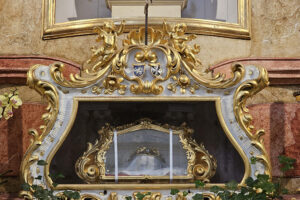
(OSV News) — Police announced May 15 that the stolen skull of one of the Czech Republic’s most beloved saints has been found.
It was taken by a thief who slipped into a Dominican basilica just before evening Mass on May 12, smashed a glass reliquary and escaped in a flash with the remains of St. Zdislava of Lemberk, a 13th-century Dominican laywoman whose relics have been venerated by pilgrims for centuries.
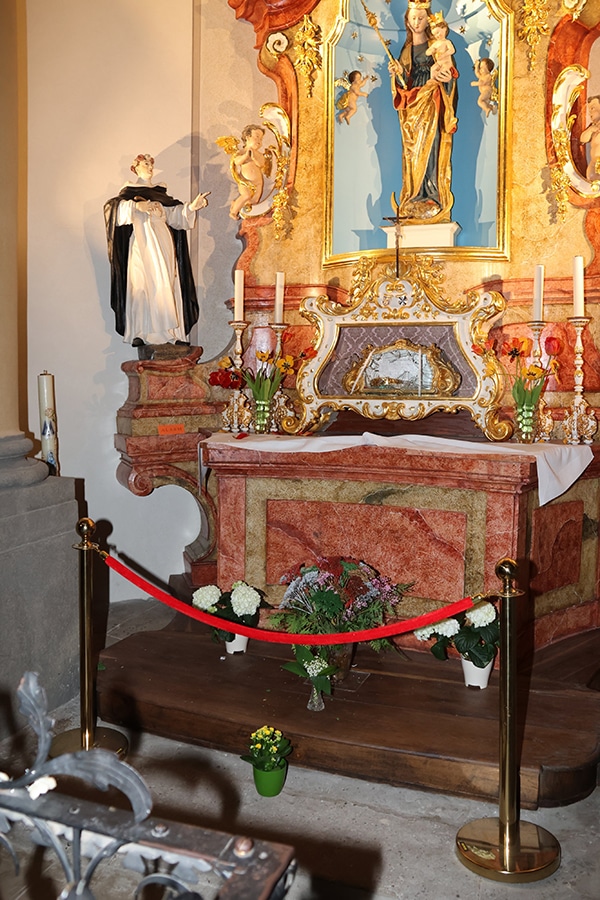
Police said they recovered the skull after finding it encased in concrete. Investigators said the 35-year-old suspect believed the saint’s remains “would not find peace there” if they continued to be displayed in the basilica. According to police, he planned to throw the relic into a river and bury it privately.
“His motive was not to obtain money for it,” police spokeswoman Ivana Baláková said. Experts are now working to remove the skull from the hardened concrete and assess its condition.
Events on May 12 unfolded like a scene from a movie: the silhouette of a figure dressed in black, two quick bangs, shattered glass, and, before anyone could react, one of the Czech Republic’s most treasured Catholic relics had vanished.
The theft took place at the Basilica of St. Lawrence and St. Zdislava in Jablonné v Podještedí, a small Czech town 70 miles north of the country’s capital, Prague, and home to one of the country’s most important pilgrimage sites. A security camera captured the moment, but the footage is blurry.
It looked like a carefully planned burglary. Father Štepán Filip, a Dominican priest who serves at the basilica, told Czech media outlet Seznam Zprávy that the entire operation lasted “a few seconds.”
He said he just saw someone run from the church with the relic in hand. The thief broke through two layers of protective glass, likely using a small emergency hammer, according to local reports. The alarm in that part of the church had been switched off because Mass was about to begin.
“We have to pray now that it gets back and that it’s OK,” Father Filip said in an interview before the relic was found. “It’s an old skull” that is “fragile,” he added.
Police released surveillance footage and appealed to the public for help identifying the perpetrator. On May 14, they announced that a 35-year-old man had been detained.
The news shocked Catholics throughout the Czech Republic. Now-Archbishop Stanislav Pribyl, who headed the Diocese of Litomerice, where the basilica is located, until he was installed as archbishop of Prague on April 25, told the Czech news agency CTK that the disappearance of the skull was “devastating news.”
“The skull was revered by pilgrims. … I cannot believe that someone practically in broad daylight steals from church a relic whose value is above all historical and also spiritual for believers,” he said.
Born around 1220 into a noble Bohemian family, St. Zdislava (also known as Zdislava Berka) married and raised four children. She became associated with the Dominican order as a lay member while devoting herself to the poor and the sick. She founded a hospital, supported the establishment of religious communities and was known for personally tending to those who were ill.
Her contemporaries called her the Mother of the Poor. After her death in 1252, devotion to St. Zdislava spread as believers attributed miraculous healings to her intercession.
St. John Paul II canonized her in Olomouc on May 21, 1995. In his homily, he pointed to her life as a model of holiness lived in marriage and family life.
“St. Zdislava, by intensely living the spirituality of a Dominican tertiary, was able to make a gift of herself, in the words of Jesus: ‘It is more blessed to give than to receive.’ This is the secret of the great attraction which her figure always exercised during her life, as well as after her death and still today,” St. John Paul said in his homily.
“Her example seems remarkably timely, particularly with regard to the value of the family, which — she teaches us — must be open to God, to the gift of life and to the needs of the poor,” the pope said.
Her shrine in Jablonné draws pilgrims from across Central Europe, many of them praying for children, healing and strength in marriage. In a country often described as one of Europe’s most secular nations, devotion to St. Zdislava continues. The timing of the theft was especially painful as Catholics were preparing for her feast day, which is May 30.
read more saints
Copyright © 2026 OSV News
