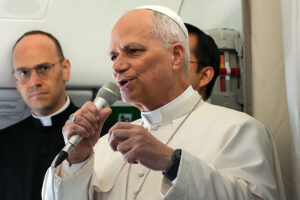
ABOARD THE PAPAL FLIGHT FROM MALABO TO ROME (CNS) — Pope Leo XIV, who has repeatedly called for peace and dialogue in the Middle East, went a step further April 23, condemning the unjust taking of life by governments as violence continues in Iran.
Speaking to reporters aboard the papal flight back to Rome after an 11-day trip to Africa, the pope said, “As a shepherd I cannot be in favor of war,” while addressing the escalating conflict involving Iran.
Since the start of the conflict Feb. 28, when the United States and Israel launched strikes in Iran, more than 3,000 people have been killed, including an estimated 1,700 civilians, according to human rights groups and Iranian media. A fragile ceasefire remains in place, even as tensions continue to rattle global markets and oil flows through the Strait of Hormuz.
Until now, Pope Leo had limited his public remarks on the conflict to appeals for peace and dialogue. On the return flight, however, he directly addressed the moral implications of state violence.
“If there is regime change or no regime change, the question is how to promote the values in which we believe without the death of so many innocents,” he said, responding in Italian. “The question of Iran is evidently very complex.”
Responding to a similar question in English, asking whether he directly condemned the reported state violence aimed at Iran’s citizens, he said, “I condemn all actions that are unjust. I condemn the taking of people’s lives. I condemn capital punishment. I believe that human life is to be respected and that all people, from conception to natural birth, their lives should be respected and protected.”
“So when a regime, when a country takes decisions which takes away the lives of other people unjustly, then obviously that is something that should be condemned,” he said.
Continuing his broader call for peace rooted in dialogue, he said in Italian, “I would like to encourage everyone to make efforts to look for answers that come from a culture of peace and not from a place of hate and division.”
The comments came after a week of criticism from U.S. President Donald Trump, who said the pope was “terrible for foreign policy” and questioned his stance on the conflict. Pope Leo declined to engage directly.
“I have no intention of getting into a debate,” he said April 18, adding that he would continue to advocate for peace.
Throughout the in-flight press conference April 23, the pope also reflected on themes that emerged during his Africa trip, including governance, and he answered questions on migration and the blessing of same-sex couples.
The pope reaffirmed the position spelled out in the Dicastery for the Doctrine of the Faith’s publication of “Fiducia Supplicans” (“Supplicating Trust”), which allows Catholic priests to bless a same-sex or other unmarried couple. However, it cannot be a formal liturgical blessing, nor give the impression that the church is blessing the union as if it were a marriage.
The pope was asked how he intended to preserve the unity of the global church on the matter, given a recent decision by Cardinal Reinhard Marx of Munich and Freising to allow priests to bless same-sex couples in his archdiocese, and the clear opposition to such practices by a number of church leaders, particularly in Africa.
“First of all, I think it’s very important that the unity or division of the church should not revolve around sexual matters,” he said.
“We tend to think that when the church is talking about morality, that the only issue of morality is sexual, and in reality, I believe there are greater and more important issues, such as justice, equality, freedom of men and women, freedom of religion, that would all take priority before that particular issue,” he said.
Pope Leo underlined that the Vatican does not agree with more “formalized” blessings of homosexual couples or couples in “irregular situations,” as is spelled out in the Vatican document.
He recalled the meaning behind Pope Francis’ expression of “todos, todos, todos,” meaning “everyone,” as being “an expression of the church’s belief that all are welcome, all are invited, all are invited to follow Jesus, and all are invited to look for conversion in their lives.”
“To go beyond that today, I think that the topic can cause more disunity than unity, and that we should look for ways to build our unity upon Jesus Christ and what Jesus Christ teaches,” he said.
In another question, the pope defended the Vatican’s practice of maintaining diplomatic relations with political leaders, including those criticized by human rights groups, saying such engagement can create opportunities to advocate privately for justice and humanitarian concerns.
“We are actually trying to find a way to apply the Gospel to concrete situations so that the lives of people can be improved,” he said.
On migration, he questioned the role of wealthier nations in driving global inequality.
“What does the global North do to support the global South, and those countries where young people today find no future?” he said, pointing to economic disparities that fuel migration.
While acknowledging the right of nations to control their borders, he stressed that migrants must be treated with dignity.
“We need to treat human beings in a humanitarian way and not treat them worse than house pets,” he said.
read more conflict in the middle east
Copyright © 2026 Catholic News Service/U.S. Conference of Catholic Bishops
