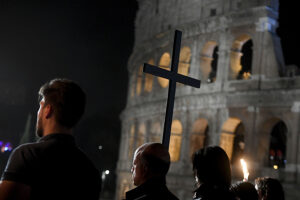
Q: In the Apostles Creed, we say that Jesus “descended into hell” after he died on the cross. But why would Jesus go to hell if he was sinless?
A: The short answer is that Jesus was not sent to hell as a consequence for his own sinfulness, but in order to free us from ours.
As you correctly point out, as the incarnate son of God Jesus was totally, completely without sin. As we read in the New Testament Letter to the Hebrews, “we do not have a high priest who is unable to sympathize with our weaknesses, but one who has similarly been tested in every way, yet without sin” (Heb 4:15). And the first Letter of St. Peter describes Jesus as “a spotless unblemished lamb” (1 Pt 1:19).
But on the other hand, with the singular exception of the Blessed Virgin Mary, who through a special action of God’s grace, was sinless from the first moment of her immaculate conception, the rest of humanity suffers from the consequences of original sin.
The first sin of Adam and Eve created a rupture between God and humanity, a rupture which carried over to all their descendants, the entire human race. And on top of this, every person throughout history has had to contend with their actual sins, or those which they have personally and freely committed.
Jesus’ saving mission was not only to grant forgiveness of our personal sins, but more foundationally to restore the possibility of human beings’ friendship with God that had been lost in the fall of Adam and Eve.
The fact that human beings suffer bodily death at all is understood to have been a consequence of original sin (for example, see Rom 5:12-14). And also because of original sin, the men and women who died prior to the coming of Christ — no matter how holy or virtuous they happened to be — were not capable of entering into the full blessedness of heaven.
And so the pre-Christian “hell” of the Old Testament is different from the “hell” that exists after the coming of Christ. The Catechism of the Catholic Church notes that: “Scripture calls the abode of the dead, to which the dead Christ went down, ‘hell’ … because those who are there are deprived of the vision of God. Such is the case for all the dead, whether evil or righteous, while they await the redeemer” (CCC 633).
However, as we know from Jesus’ parable of the rich man and the beggar Lazarus in Chapter 16 of St. Luke’s Gospel — where after their deaths the rich man is in torment because of his lack of charity, while Lazarus walks with Abraham — there apparently was a distinction between the virtuous dead and the dead who had separated themselves from God by their sins. As the Catechism goes on to tell us, “Jesus did not descend into hell to deliver the damned, nor to destroy the hell of damnation, but to free the just who had gone before him” (CCC 633).
After his death on the cross, Jesus descended into the “hell” that was simply the netherworld in order to free the dead who had sought to love and honor God despite the original sin that bound them, in order that Jesus might bring them into the fullness of life. This is why most traditional art which depicts the events of Holy Saturday show Christ descending into hell as a triumphant victor, rather than as a suffering victim as he was on Good Friday.
The catechism describes this beautifully: “The descent into hell brings the Gospel message of salvation to complete fulfillment. This is the last phase of Jesus’ messianic mission, a phase which is condensed in time but vast in its real significance: the spread of Christ’s redemptive work to all men of all times and all places, for all who are saved have been made sharers in the redemption” (CCC 634).
Jenna Marie Cooper, who holds a licentiate in canon law, is a consecrated virgin and a canonist whose column appears weekly at OSV News. Send your questions to CatholicQA@osv.com.
Read More Question Corner
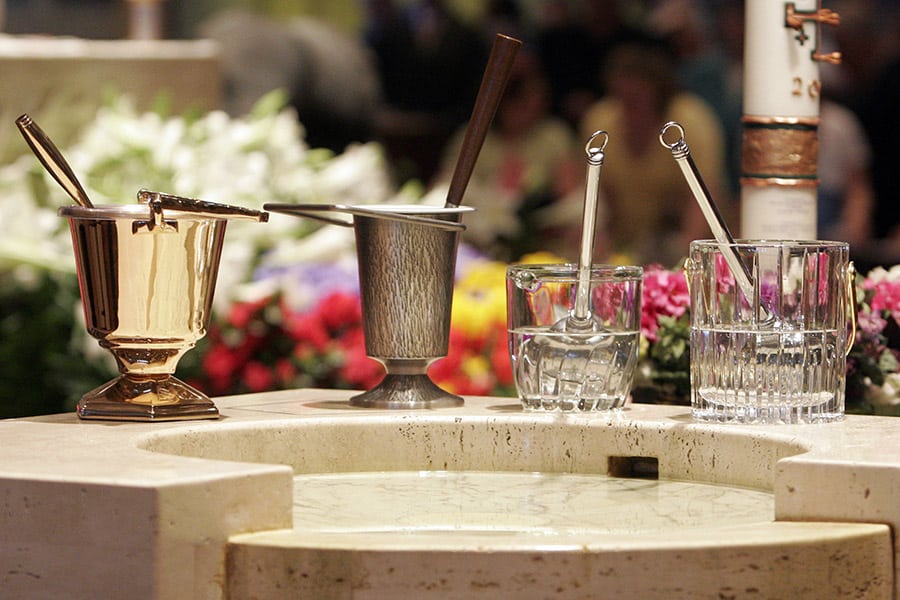
Question Corner: Does holy water ‘absolve’ us from venial sin?
With respect to holy water in particular, St. Thomas Aquinas specifically identifies the “sprinkling of holy water” as a means for the remission of venial sin in question 87, article 3 of the “Third Part” of his work the “Summa Theologica.”
Continue Reading Question Corner: Does holy water ‘absolve’ us from venial sin?

Question Corner: How do you proceed if an ex refuses to be a part of the annulment process?
An important principle in the Church’s law regarding the marriage nullity process is treating both spouses as fairly as possible.
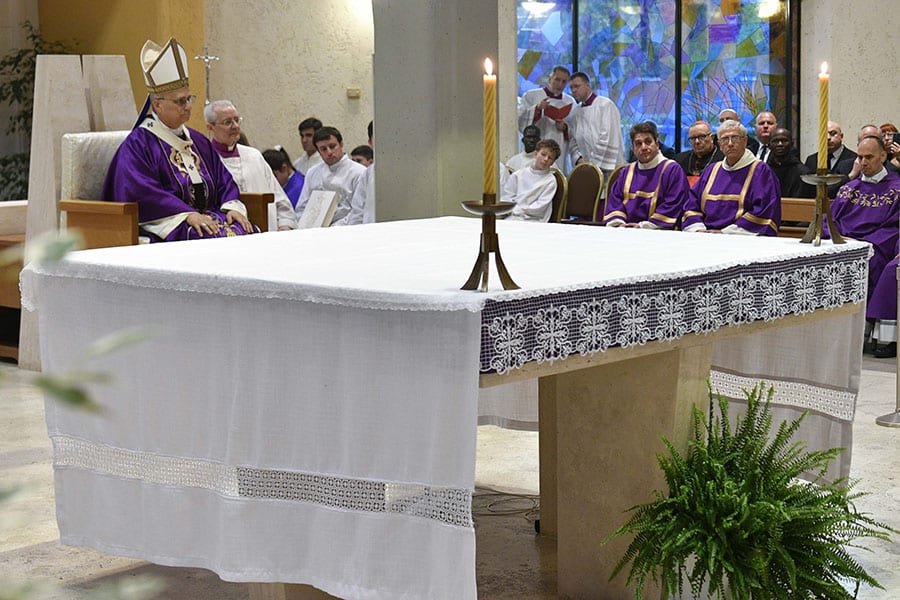
Question Corner: Can you use a deconsecrated altar for other purposes?
while a church building that could no longer be used for its original purpose might in some cases lawfully be sold and re-purposed as something like a museum or private residence, this relegation or re-purposing would not affect the status of the altar it once contained.
Continue Reading Question Corner: Can you use a deconsecrated altar for other purposes?
Question Corner: Does my ex have to be involved in the annulment process?
Practically speaking, when a respondent is willing to participate in the nullity process, this greatly helps the canon lawyer judges in a trial come to a fair and accurate decision, insofar as hearing from the respondent gives the judges a fuller picture of what actually happened.
Continue Reading Question Corner: Does my ex have to be involved in the annulment process?
Question Corner: Should I give up prayers of petition this Lent as my priest suggested in his homily?
Prayers of intercession, where we ask God to help other people in their needs, are also prayers of petition. Since praying for both the living and the dead is a spiritual work of mercy, it wouldn’t seem fitting to give this up for Lent!

Question Corner: Why doesn’t the Church require more demanding fasting for Lent?
A more demanding common discipline would require far more exceptions, which could make it difficult for the majority of the Church to observe them together as one spiritual family.
Continue Reading Question Corner: Why doesn’t the Church require more demanding fasting for Lent?
Copyright © 2026 OSV News
