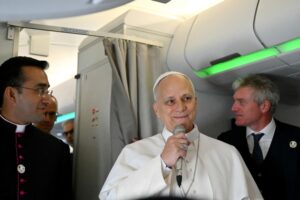
When President Donald Trump criticized Pope Leo XIV on Truth Social on April 12, he sidestepped the substance of the pope’s message.
The president’s first criticism, one that he repeated later, was that the pope is “WEAK on Crime.” Since the president was not explicit as to what precisely prompted this criticism of the pope, one can only make educated guesses as to which statements of the pope concerned him.
Here are two statements that must have encouraged the president to draw his conclusion. First, with respect to undocumented immigrants, last fall the Holy Father wrote:
“I think we have to look for ways of treating people humanely, treating people with the dignity that they have. . . If people are in the United States illegally, there are ways to treat that. There are courts; there’s a system of justice.”
Second, in January Pope Leo expressed “deep concern” following the capture of Venezuelan President Nicolás Maduro and his wife. The Holy Father went on to say:
“The good of the beloved Venezuelan people must prevail over every other consideration. This must lead to the overcoming of violence, and to the pursuit of paths of justice and peace, guaranteeing the sovereignty of the country, ensuring the rule of law enshrined in its constitution, respecting the human and civil rights of each person and working together to build a peaceful future of cooperation, stability and harmony, with special attention to the poorest who are suffering because of the difficult economic situation.”
Why would the president have thought that these statements displayed weakness on crime?
Regarding the treatment of immigrants, President Trump has repeatedly and emphatically defended his administration’s harsh treatment of undocumented immigrants by saying that he is getting rid of criminals, the worst of the worst. Whether that is what is happening or not – and there is evidence that most deportees do not have a criminal record – he employed this rationale to construe the Holy Father’s statement as an indication of weakness on crime.
Regarding the actions in Venezuela, the president has insisted that he is carrying out a policy designed to stop the flow of lethal drugs into the U.S. He wants to save American lives. In line with this, he has explained the rendition of Maduro as bringing an indicted major drug dealer to justice. So that also led him to brand the pope’s comments as an expression of weakness on crime.
The president’s second criticism of the pope is that he is “terrible for Foreign Policy.” In this regard, the president was surely prompted by the Holy Father’s recent statements on Iran. At the end of March, the Holy Father expressed the hope that the president would find an off-ramp for the war in Iran. A week later the Holy Father said, “Today, as we all know, there was also this threat against the entire people of Iran, and this truly is not acceptable.” Since among the president’s many aims for going to war against Iran was to deny Iran the ability to enrich uranium, he misconstrued the pope’s criticism along those lines: “I don’t want a Pope who thinks it’s OK for Iran to have a Nuclear Weapon.” On April 16 the president doubled down on this criticism.
There are a great many things that could be said about these criticisms of the pope. For example, Pope Leo XIV and his predecessors have consistently opposed nuclear proliferation, and he has also said, “I think every country has a right to determine who and how and when people enter.”
But I’d like to focus on one issue only: the president confuses means with ends. Traditional ethical theory, including Catholic moral theology, distinguishes the two. On the one hand, an end, or an aim, or a goal, is something we seek through our action. The agent sees it as good, and that motivates him to act.
So, for example, regarding immigration, President Trump’s actions toward undocumented immigrants seem to be motivated at least partly by a desire to rid the country of dangerous criminals who have no right to be here. In the abstract, this is a good end, and polls show that most citizens support it. It is also part of his larger goal of getting control over immigration, a goal that helped him be reelected. In the second example – the war in Iran, one of his longstanding goals, or ends, has been to prevent Iran from having nuclear weapons. Given Iran’s long history of hostility to Israel and the U.S. and its support of terrorism, this goal is desirable as well.
However, the choice of means is a different question. The term “means” refers to the measures or methods that an agent takes to achieve his aims or goals. The means are different from the goals that motivate agents to act in the first place. For example, if I am bothered by a persistent fly and want to rid myself of it, I have a choice of means to achieve that goal. I can open the window and try to shoo it out, swat it with my bare hand, spray it with insecticide, etc. I would not think about which means to use if I did not have the goal already in mind. So, regarding immigration, the surge of ICE personnel in certain cities, the construction of detention centers and the use of masked agents are choices of means that presuppose certain goals. Regarding Iran, the bombing of missile factories, the blockade of the Strait of Hormuz, the sinking of Iran’s major naval ships and, indeed, the entire military action itself are also means serving a range of goals.
President Trump’s assessments of the pope’s words misconstrue criticism of means as criticism of ends. That error deflects attention from the real issue, the issue of the means employed. The morality of the means was the specific issue that the pope was highlighting.
Inhumane or cruel treatment of immigrants violates their human dignity. Rather, they should be processed legally, with due respect for their basic human rights.
Waging preventive war is unjust when there is no imminent danger of serious harm. Rather, dialogue and negotiation are the best means to resolve a serious conflict between nations.
Threatening to attack civilian targets shows a willingness to do immoral acts that violate both American and international laws. Rather, any threats that have to be made should stay within morally and legally acceptable bounds.
The Holy Father believes that it is his duty to raise moral concerns about certain means whether he approves of the ends or not.
Citizens who are trying to follow the president’s ways of justifying his actions should be alert to how he confuses means and ends. The pope has been consistent in respecting the distinction, but the president either doesn’t appreciate it or does not have a convincing reply to the Holy Father’s concerns. Add to that the confusion caused by recent media reports, and it is too easy to misinterpret the Holy Father’s main points.
Citizens should listen to what the pope actually said.
More commentary



Copyright © 2026 Catholic Review Media
