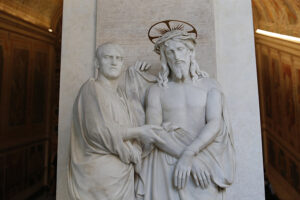
Q: One thing about which I’ve always been curious, especially this time of the year, is why in the various Gospel accounts of Jesus before Pilate, Jesus never directly answered, “Are you the king of the Jews?” Instead of simply saying “Yes,” full stop, Jesus gave what many consider to be sidestep answers like “If you say so” or “Is that what you heard?” Could you comment? Is there a greater understanding of this exchange that I’m missing? (Indiana)
A: Of course, I personally don’t know exactly what Jesus was thinking, nor do I think this is something that anyone can absolutely know for sure this side of heaven.
That being said, I think we can gain some insight by looking at the specific scriptural passage you seem to be referencing. In Chapter 18 of St. John’s Gospel we read the exchange between Jesus and Pontius Pilate:
“Pilate went back into the praetorium and summoned Jesus and said to him, ‘Are you the King of the Jews?’ Jesus answered, ‘Do you say this on your own or have others told you about me?’ Pilate answered, ‘I am not a Jew, am I? Your own nation and the chief priests handed you over to me. What have you done?’ Jesus answered, ‘My kingdom does not belong to this world. If my kingdom did belong to this world, my attendants [would] be fighting to keep me from being handed over to the Jews. But as it is, my kingdom is not here.’ So Pilate said to him, ‘Then you are a king?’ Jesus answered, ‘You say I am a king. For this I was born and for this I came into the world, to testify to the truth. Everyone who belongs to the truth listens to my voice'” (Jn 18:33-37).
On a straightforward surface level — albeit a level that is still meaningful — it looks like Jesus and Pilate are essentially talking past each other.
Pilate, as a pagan Roman, was asking questions from a very prosaic and earth-bound perspective. Jesus, on the other hand, had full supernatural insight into the great cosmic, spiritual scope of what was actually occurring.
Pilate was asking Jesus if he was an earthly king in a political sense, whereas Jesus was communicating that his kingship went far beyond this, in the sense that Jesus is ruler and Lord of all time and creation. Jesus’ answer was simply too big to fit into the limited question Pilate understood himself to be asking.
My own impression is that when Jesus at first responds with what might be seen as a dodge (i.e., “Do you say this on your own…?”), this might actually be Jesus’ attempt to clarify the question with Pilate or even, in a manner of speaking, to “catechize” him.
That is, Jesus may have been asking Pilate the equivalent of “Are you asking if I am a ‘king’ according to your secular definition?” And Jesus may have meant to ask this in such a way so as to introduce the idea that there is indeed a spiritual level of authority that transcends the visible world and its merely human governing structures.
I suppose in theory Jesus could have spelled all this out even more explicitly, but one thing that always strikes me about the broader dialogue with Pilate in St. John’s Passion narrative is how Pilate does seem to have an inkling that something more profoundly spiritual is playing out before him (for example, see Jn 19:7-8).
Perhaps Pilate was in that moment given sufficient grace to realize to whom exactly he was speaking. And Jesus, knowing this, might have concluded that more detailed answers to Pilate’s questions would not have benefited the reluctant Pilate any further.
So one of the many insights we might take away from this passage of the Gospel is the importance of being sensitive to the voice of the Lord however He comes to us in our own lives.
read more Question Corner

Copyright © 2026 OSV News
