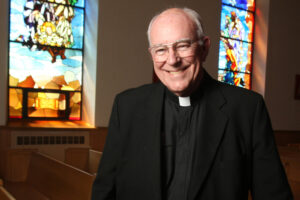
A few years ago, while sorting through parish archives at St. Joseph in Cockeysville, parish bookkeeper Pat Villacrusis discovered copies of letters Monsignor Paul Cook had written over the years to parishioners marking important moments in their lives – congratulating them on getting into college, becoming an Eagle Scout or buying a new home.
“It was just amazing to me that, with all his duties and responsibilities here in the parish and in the archdiocese, that he took time and paid attention to those little moments in people’s lives,” Villacrusis said.
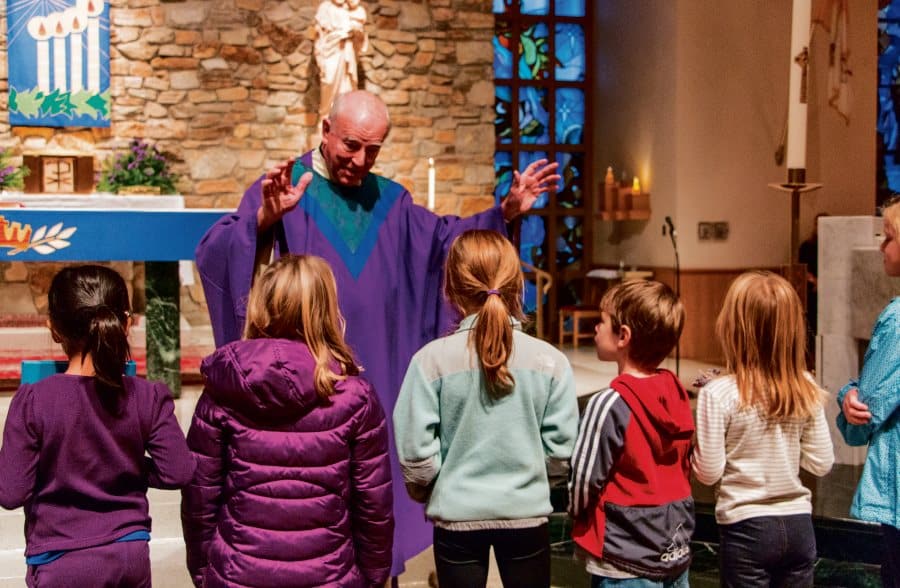
For the people of St. Joseph, those gestures reflected the heart of the priest they lovingly called “Father Paul” – a pastor remembered as deeply attentive, compassionate and personally invested in the lives of the people he served during 37 years at the Baltimore County parish.
Monsignor Cook died May 24 at 93. At the time of his death, he was the oldest priest in the Archdiocese of Baltimore. Archbishop William E. Lori will offer the funeral Mass May 29 at St. Joseph, with Monsignor James Barker preaching the homily.
When Monsignor Cook retired from St. Joseph in 2015, parishioners packed the church to bid farewell to the beloved pastor who had guided the parish through decades of growth and change.
As pastor of St. Joseph, Monsignor Cook ministered to 3,500 registered families. One of those families was Leslie Masterman’s. Masterman said she was about 8 or 9 when Monsignor Cook began his ministry at St. Joseph. In the ensuing years, she said, he became part of her family and the lives of countless other parishioners.
“He was such a healing presence when families went through tragedies, crossroads and the celebrations too,” Masterman said. “I’ve heard stories from parishioners about how he helped them survive the loss of a child, or helped them talk through their fears during health scares. So many people in this parish owe their faith to his ministry.”
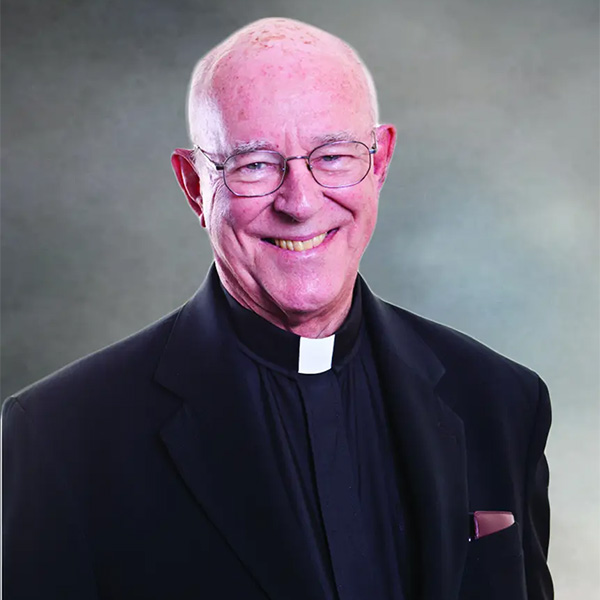
During his years at the parish beginning with his 1977 appointment as pastor, Monsignor Cook kept St. Joseph thriving both physically and spiritually. He enlarged the parish school and oversaw the completion of new school structures and a parish center. He also instituted programs to strengthen the parish community, including a neighborhood ministry in which captains welcomed new residents to the area.
Villacrusis, who worked with Monsignor Cook for 11 years, said he fostered an environment of trust and respect by empowering people to carry out their responsibilities.
“That didn’t mean he was a hands-off kind of guy,” she said. “He was thoughtful, kind and he really valued respect. He gave respect to other people and there was a level of respect and care that he fostered with staff and in the parish.”
Monsignor Cook did not make decisions lightly, Villacrusis said.
“He didn’t rush into things. He was very deliberate, careful and thoughtful. And I think as a result, when he would make a decision it was with a great deal of confidence.”
In the early 1970s, when Monsignor Paul Cook was appointed to lead the archdiocesan religious education office, Cardinal Lawrence Shehan told him that he would not have chosen him for the role unless the priest’s expertise in religious education surpassed his own.
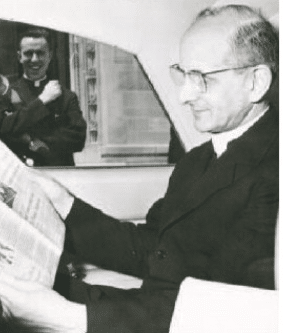
Entrusted with broad authority over what was then known as the Confraternity of Christian Doctrine, Monsignor Cook was given considerable freedom to guide the office’s direction. Even so, he later recalled in a 2014 interview with the Catholic Review that Cardinal Shehan also expected him to be fully accountable for the decisions he made.
“That’s been my same style as pastor,” Monsignor Cook said. “All these people (leading parish ministries) know more about what they’re doing than I do, so they have a free hand to do it. But they’re also accountable.”
Monsignor Cook served as a trusted adviser to the archbishops of Baltimore and, during his years at St. Joseph, supervised more than 50 seminarians assigned to the parish.
He was also known as a forward thinker. As suburban growth expanded north of Cockeysville, Monsignor Cook recognized the need for another Catholic community and arranged for Masses to be celebrated at the Hunt Valley Inn. That effort eventually led to the formation of the Catholic Community of Hunt Valley, which later became the Catholic Community of St. Francis Xavier.
For Masterman, one image captures Monsignor Cook perfectly.
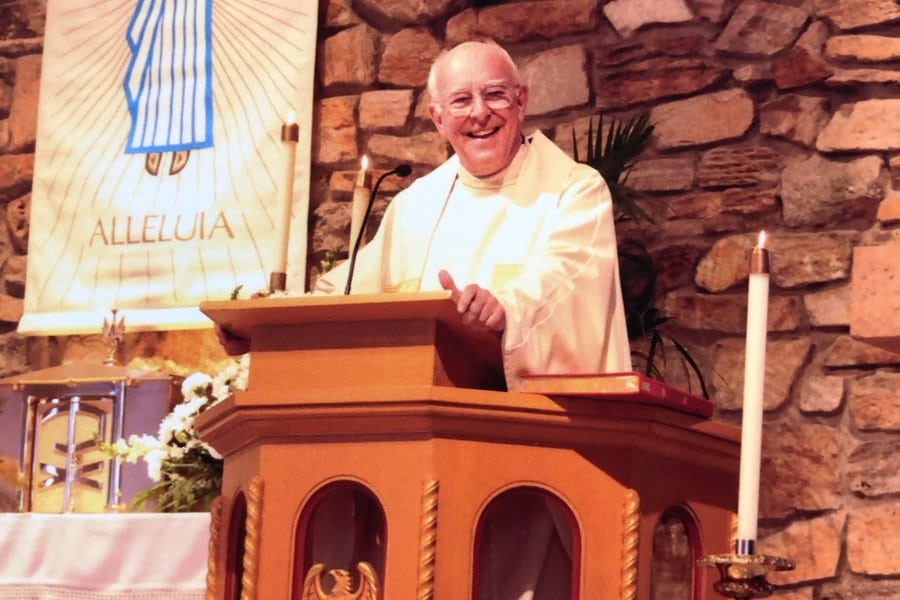
“I always think of him at the annual parish cookouts for volunteers,” she said. “The clergy were in charge of grilling the hamburgers. He was always smiling, flipping hamburgers, wearing a silly apron that read ‘For This I went to Seminary?’ beaming and chatting with everyone like a proud dad.”
Monsignor Cook was baptized at St. Martin Church in Baltimore and raised in St. Bernardine Parish, where he attended the elementary school. He often credited both his parents and the Sisters, Servants of the Immaculate Heart of Mary with encouraging his vocation to the priesthood.
“We must have had a dozen men who went into the seminary who were ordained to the priesthood and twice that many girls who entered religious communities,” Monsignor Cook told the Catholic Review in the 2014 interview. His younger sister, Mary Ann, became a Sister of Notre Dame de Namur.
“Everything was very affirming,” he said.
At 13, he entered St. Charles College in Catonsville, then a minor seminary for the Archdiocese of Baltimore. He later continued his studies at The Catholic University of America in Washington, D.C., and was ordained to the priesthood in 1959 at the Basilica of the National Shrine of the Assumption of the Blessed Virgin Mary in Baltimore.
Among his early assignments were 12 years as associate pastor of the Cathedral of Mary Our Queen in Homeland, service as director of the Confraternity of Christian Doctrine and ministry as chaplain to the Daughters of Charity, who cared for unwed mothers in the Baltimore area.
In 1974, he helped reorganize departments at the Catholic Center and became secretary of the Department of Education, overseeing Catholic schools, religious education, campus ministry and related outreach ministries.
Throughout his ministry, he was known for encouraging lay leadership and collegiality.
“So much of what our parish is today comes from Father Paul’s insights, efforts and pastoral zeal,” said a statement posted on St. Joseph’s Facebook page. “His legacy is all around us.”
Monsignor Cook’s body will be received May 28 at 1 p.m. at St. Joseph in Cockeysville. Visitation will follow from 1 to 4 p.m. and from 6 to 8 p.m. A 7 p.m. vigil service will be offered. Archbishop Lori will offer the 11 a.m. funeral Mass May 29 at St. Joseph, preceded by visitation from 9:15 to 10:45 a.m.
More obituaries
Copyright © 2026 Catholic Review Media
