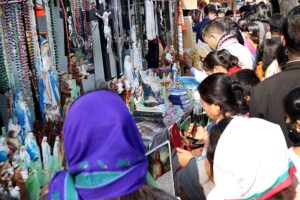
Thousands of pilgrims have gathered at St. Anthony’s shrine in Bangladesh’s Archdiocese of Dhaka, despite anxiety and fears of violence, ahead of national elections in Muslim-majority Bangladesh, as they pray for peace in Bangladesh and the world.
Like every year, on Feb. 6, about 40,000 devotees gathered at Panjora village, in St. Nicholas of Tolentino Church in Gazipur district, despite fears of attacks on minorities, including Christians, ahead of the country’s national elections scheduled on Feb. 12.
St. Anthony’s pilgrimage is traditionally held on the first Friday of February — but in 2026, the scene looked different as a large number of law enforcement officers were seen around the pilgrimage site amid fears of sabotage against minorities. Authorities also said that the entire area was monitored by CCTV cameras.
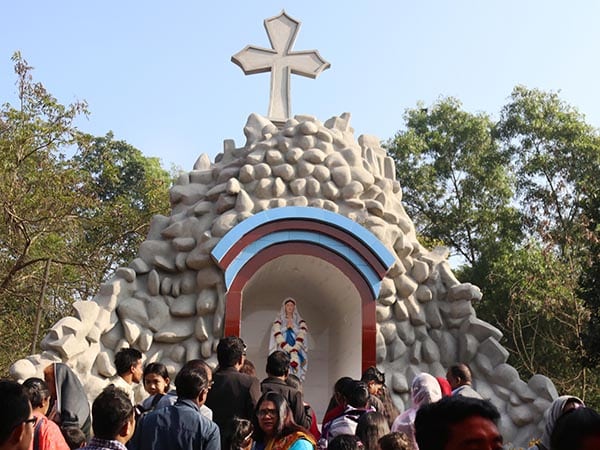
Animesh Gomes, 42, joined the pilgrimage from the Rajshahi diocese, around 160 miles from Dhaka, with his wife and two children. Gomes said that while there were a lot of pilgrims, it seemed few compared to previous years.
“We also did not want to come to the shrine this year out of fear, but later we decided that if something happens while attending a religious ceremony, it is not a problem. So, I came with my family,” Gomes told OSV News.
While he thought security was sufficient, fear was still mounting in the minds of people.
In November 2025, hand grenade explosions occurred at the Dhaka Cathedral and St. Joseph’s School and College. The following month, a Muslim group threatened several Catholic educational institutions and individuals in Dhaka through a letter. The letter threatened to attack cathedrals, churches, chapels and missionary institutions, and mentioned they belong to a Muslim group.
“In a country where 90% of Muslims live, you are trying to convert people by using educational institutions as a tool,” the Muslim group stated in the letter from Archbishop Bejoy D’Cruze of Dhaka, who expressed “a grave concern for the Catholic Church” after the letters were discovered.
Christians in Bangladesh, which has a population of 180 million, make up less than 1%, and fear among them is growing as elections approach. A student-led uprising toppled the Sheikh Hasina government in August 2024, and she fled to India. Nobel peace-prize laureate Muhammad Yunus took charge days after Hasina’s fall. Since then, the country’s Hindu Christians and other minorities have repeatedly expressed their concerns about their security to the government.
Political analysts believe that either the Bangladesh Nationalist Party, or BNP, or the hardline Islamist party Bangladesh Jamaat-e-Islami could form the government in the national elections on Feb. 12. However, the BNP has a bigger chance in terms of chances.
During the Feb. 6 pilgrimage, Dhaka’s Auxiliary Bishop Subroto Boniface Gomes said that God’s word is a letter of love — a message for the faithful not to leave behind, but to implement in our daily lives.
“Just as the great St. Anthony was able to bring many people to God, may we also be able to use the word of God to bring people to the path of God,” Bishop Gomes said.
The prelate criticized Catholics and said that nowadays it is seen that faithful come to St. Anthony only to ask for favors, and forgetting to give back in regular Mass attendance.
“But St. Anthony calls us to live according to the ideals of Christ and to bring others to the path of Christ,” said Bishop Gomes.
Every year, Christians, Hindus, Muslims and Buddhists together participate in the St. Anthony’s pilgrimage to offer special prayers and thanksgiving to the Portuguese Franciscan saint in the biggest yearly interfaith gathering led by Catholics in Muslim-majority Bangladesh.
Devotion to St. Anthony in the region where the shrine is situated comes in part thanks to local legend and belief that a statue of St. Anthony mysteriously disappeared and reappeared at the site.
An 18th-century Bengali Catholic Dom Antonio also contributed to the popular piety in the Archdiocese of Dhaka. He is known for converting thousands of lower-caste Hindus in the Bhawal region, now part of the archdiocese.
Read More Religious Freedom
Copyright © 2026 OSV News
