

This month marks the 164th anniversary of the U.S. Supreme Court’s ruling in Scott v. Sandford (1857), which infamously denied the freedom petition of Dred, Harriet, Eliza and Lizzie Scott — an African American family held in bondage in antebellum Missouri.
Chief Justice Roger B. Taney, the high court’s first Catholic, authored the majority opinion, which ruled that free and enslaved Black people were not citizens and declared that Black people “had no rights which the white man was bound to respect.”
The U.S. Civil War and the ratification of the 13th, 14th, 15th and 19th Amendments eventually overturned the tenets of the Dred Scott decision. However, the anti-Black animus that guided Taney and the other supporting justices remains with the nation and church today.
So, too, does the spirit of resistance that fought against such hateful attitudes and unjust laws.
As a historian who is Black and Catholic, I am often asked how I can keep the faith knowing that my church’s history includes people like Taney, who was also a member of one of Maryland’s most prominent slaveholding families.
My answer is always the same: Martha Jane Chisley Tolton.
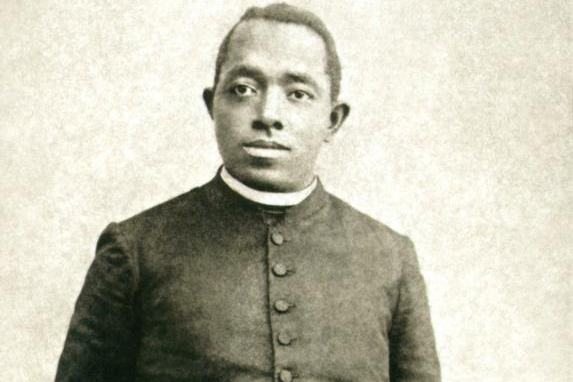
Many Catholics have heard of Martha Jane’s youngest son, Father Augustus Tolton, the nation’s first self-identified Black priest and one of six African Americans currently under consideration for sainthood in the Catholic Church.
However, there would no Venerable Augustus Tolton without the devout faithfulness, extraordinary courage and spiritual leadership of “Mother Tolton.”
Born into Catholic slavery in the “Holy Land” of Kentucky in 1827, Martha Jane was given away as a wedding gift in 1849. Martha Jane never saw her family again. She also never forgot them.
After her Catholic union to Peter Paul Tolton in Missouri produced children, Martha Jane named her first and second-born sons after her brother, Charley, and her father, Augustine, respectively.
Following the issuance of the Emancipation Proclamation, Peter Paul escaped slavery to join the Union Army to fight for his family’s freedom, since Missouri was exempted from the decree. However, he soon died in the war.
A turning point came in mid-1863, though, just six years after Scott v. Sandford. That year, Martha Jane liberated herself and her three young children, including 20-month-old daughter Anne, from Catholic slavery by fleeing to Quincy, Illinois.
In so doing, she rejected the legitimacy of a nation and church that could justify destroying families and holding people in slavery. However, like many of the church’s formerly enslaved, Martha Jane chose to remain Catholic and fought to rid the church of racism and exclusion.
While many narrations of Father Tolton’s fiercely contested journey into the Catholic priesthood center on the few white nuns and priests who formally educated him, the surviving record is clear: Martha Jane was her son’s first and most dedicated champion.
Martha Jane not only nurtured and supported her son’s religious vocation, but also that of a young woman who eventually joined the historically Black Oblate Sisters of Providence in Baltimore.
Martha Jane and Anne also remained at Father Tolton’s side after he began his ministry first in Quincy and later in Chicago where they served the city’s neglected Black Catholic community. Martha Jane lived with her son, assisted in his evangelization work, which brought over 600 Black people into the faith, and eventually served as the sacristan at St. Monica’s, the city’s first Black Catholic parish.
Although white church leaders refused to assign a Black priest to lead St. Monica’s after Father Tolton’s untimely death at age 43 in 1897, Martha Jane Tolton and Anne held the line.
Mother Tolton, as she was affectionately known by her son’s parishioners, served as the sacristan at St. Monica’s until her death in 1911. Anne also supported the parish until her death in 1912 — underscoring the fact that Father Tolton’s ministry was always a family endeavor.
Mother Tolton’s journey is representative of the thousands of Black laywomen who kept the faith alive when most in the white-dominated church sought to abandon Black Catholics.
In the face of often humiliating segregation and exclusion, these holy Black women of God organized Black missions and parishes; established Black Catholic schools; nurtured Black religious vocations; and brought hundreds of Black people into the faith (oftentimes singlehandedly).
Yet, most of these local and national “saints” remain hidden figures in church history.
This March, as we celebrate Women’s History Month, let us pledge to rediscover and remember the lives and labors of the Black women, like Mother Tolton, who in the face of unyielding discrimination fought to make the church in the United States truly Catholic.
Also see
Copyright © 2021 Catholic News Service/U.S. Conference of Catholic Bishops


 English
 Spanish